Many years ago, I started this blog to write about cycling and sports sponsoring. It was my passion, in in some way still is. I have written about charity sports sponsoring or a Breton cycling team’s sponsors in 2009, or about one of my students’ masters thesis about female sports in 2015, or Sunweb’s “indefinite” cycling sponsoring agreement in 2018 (it lasted a couple of years only).
I have been less active in past years, especially on this blog, which receives less attention than in my years as a curious, avid student & cyclist. WordPress blogs are for boomers anyway, right? Anyway, I recently got referred to a very smart student who is investigating the cycling industry – especially the notion of sponsoring.
His name is Skylar Ross, he’s a master’s student at ESCE in Paris, and he’s majoring in international marketing, conducting his thesis investigation on brand equity, loyalty and effective Corporate Social Responsibility (CSR) initiatives within professional road cycling teams.
I’m publishing this post to support him. With a passion for the sport and industry, I encourage all cycling fans and supporters who read me to take 5 minutes to answer his survey.
Professional road cycling, a sport that has been around since the early 19th century, generates billions of dollars, supports many luxury and world-renowned brands, and attracts millions of fans yearly. With such rich history, heritage, and cultural resonance, cycling represents speed and modernity.
With events and races that range from a couple of hundred kilometers to days and weeks on end, cycling events have been described by journalists as “epic fights between modern heroes.”
These races, particularly the Tour de France, which ends the week-end, are known to be among the world’s largest sporting events, spanning three weeks, covering 21 different stage events, and totaling 3,400 km. It is the most distinctive cycling event, world-renowned, and recognized as a commercial success story.
However, cycling as a whole has received little attention, specifically as it relates to sports literature and analysis of the entire organizational structure. The industry of cycling, particularly for teams and the cycling business model, has several peculiarities compared to other professional sports.
Teams employ staff for medical, technical, marketing, and administrative duties, among other roles, but they often operate with small profits or losses. Since professional cycling teams do not have home stadiums to generate revenue from ticketing or broadcasting rights to their events, they are highly dependent on their sponsors for survival.
The entire business model of professional road cycling is fragile. Within the cycling industry, teams and riders are the primary actors, but their existence year to year is always under threat.
Some teams have tried to change the paradigm, like Team Aqua Blue in 2017, which was hoping to rely on e-commerce revenue, creating an “Amazon for bikes to fund itself” so that “the business [would] pay for the team.” The plan was to last at least four years; but the project folded less than two years later.
In its obituary for Aqua Blue, Connor Kelly wrote that “it [became] obvious that this team was no different to any other rich man’s set of toy soldiers. Four years? Pah. The team barely had one-and-a-half, with four months of farce to follow.” Poor management, issues with the bike supplier, impatience (maybe?) and an ultimately imbalanced business-model brought the project to a halt.
Cycling still has no alternative business model to sponsoring.
The student is investigating alternative ways a cycling team can survive within this noncommercial business model. How is he doing this? His focus is to understand the extent to which Corporate Social Responsibility (CSR) initiatives of a professional road cycling team could impact brand equity and loyalty among their fans and supporters.
Through a quantitative research approach (a.k.a. survey), the purpose of his study is to understand and contribute to the unique ways in which a professional road cycling team can create brand equity and loyalty, ultimately making the team more attractive for sponsors to endorse and financially support.
By distributing three unique surveys to different cycling target audiences around the globe, he will analyze how a cycling team’s purpose can build trust, engagement, brand/team equity, and image, as well as both behavioral and attitudinal loyalty among cycling fans and supporters.
His survey is focused on the initiatives of a professional cycling team. Please read the scenario of Cycling Team “X” and then complete the brief questionnaire which follows: SURVEY LINK.
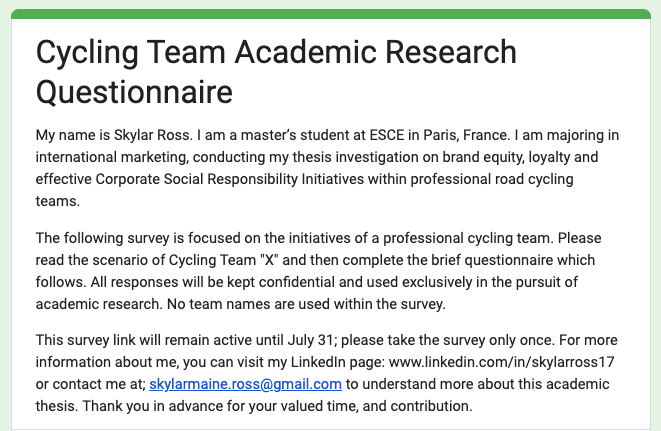
All responses will be kept confidential and used exclusively in the pursuit of academic research. No team names are used within the survey. This survey link will remain active until July 31; please take the survey only once.
Thank you in advance for your time, and contribution. You will probably hear about the results here in a couple of months.
Cheers from the Vercors region!
 Yannig Roth / This is my personal blog