Crowdsourcing: Serial participants end up proposing less diverse ideas

thumbnails

Right after writing that blog post about crowdsourcing at Dell, I read an interesting piece of research about participation in the Dell Ideastorm crowdsourcing-platform. The paper is authored by Barry L. Bayus an d will be published in Management Science in the next months (see the first version, and the second version – by the way, it’s a great way to see how mauch a paper evolves durring the reviewing process). While it has not been published yet, the findings are interesting to look at, because they’re among the first ones to analyze participation in crowdsourcing over time. And it seems that there are challenges ahead for Dell… Continue reading →
Are external idea contests really unpopular and uneffective?

diagram

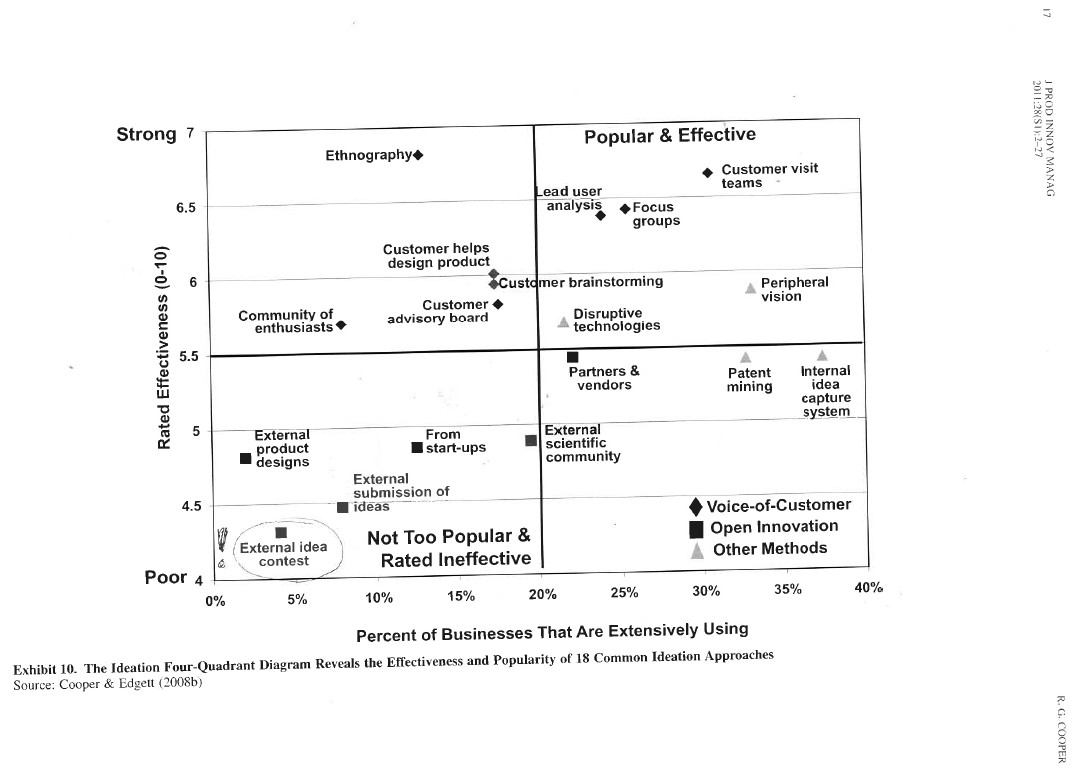
Robert G. Cooper's diagram on common ideation approaches


In the last issue of The Journal of Product Innovation Management, Robert G. Cooper, inventor of the Stage-Gate process for new product development, ranks 18 popular ideation approaches according to popularity and effectiveness. In his article called The Innovation Dilemma, it’s interesting to read that he says that “few of the open innovation methods were found to be either particularly popular or effective” before highlighting that “the fact that open innovation is relatively new and is yet to be proven over time“.  He also says that “seeking ideas from outside […] applies best to a handful of industries, such as consumer goods“…

Continue reading →

Crowdsourcing is a lot less anxiogenic than actual co-creation – Bernard Cova’s critical and insightful perspective

portrait

When you think about co-creation litterature, depending on what type of litterature you read, you might think of academic publications like SD-Logic or  Co-Creation Experiences, or you might think about business publications like The Future of Competition or The Power of Co-Creation. These types of publications are not opposed to one another, rather are they complementary in the emergence of trends, says Bernard Cova, professor at Euromed Management Marseille. According to him, there is a general pattern of amplification in consumer research: post-modern sociologists like Michel de Certeau describe general consumption trends, marketing-sociologists (or socio-marketers) like Patricia Seybold illustrate these trends with updated examples and approaches, and new marketing propagators like Venkat Ramaswamy spread the word to broader audiences like the mass media and business (Cova & Cova, 2009). I recently spoke to Bernard Cova about his view of co-creation. Continue reading →

Academic representations of crowdsourcing, co-creation and open innovation

mixed-visualizations

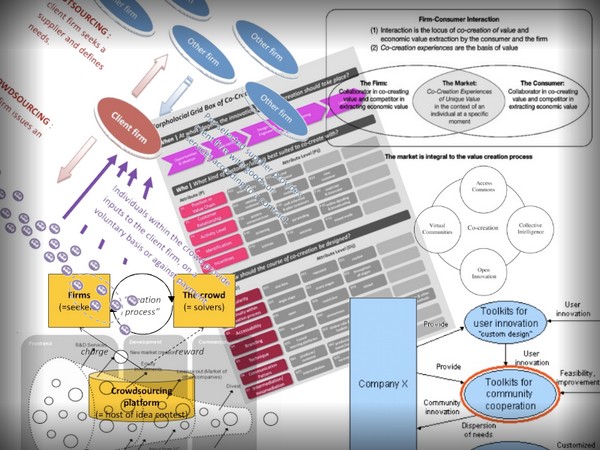
As part of my work as a PhD student, I read lots of papers about open innovation and/or participative marketing. These papers are highly interesting but, I must admit, sometimes a little repelling with huge chunks of texts, references and citations. Visualizations of the described phenomena are greatly helpful to understand some of this information… I thought it would be interesting to gather a couple of visualizations of my research interests: crowdsourcing, co-creation and open innovation in a blog post ! This is not only quite entertaining, but might help people out there find new sources. Here we go… [this post was last updated on October 6th 2015] Continue reading →

Two videos by leading co-creation vendors: projects & people

Why do people participate in co-creation & Where do you find them

Answering these questions basically leads to one answer: COMMUNITIES


Forrester Research recently issued its Forrester Wave™ about Co-Creation vendors in 2011.This report can help consumer product strategy professionals to choose a vendor to work with in idea generation or content creation projects, and compares 6 actors of the field: eYeka (Paris, France), jovoto (Berlin, Germany), Hyve (Munich, Germany), ChallengePost (New York City, USA), Redesignme (Eindhoven, The Netherlands) and NapkinLabs (Boulder, USA). This post is not about the report (download it for free here) but about two neat videos released by Hyve and eYeka recently, check it out… Continue reading →

How crowdsourcing delivers authentic insights and/or breakthrough innovation

screenshot

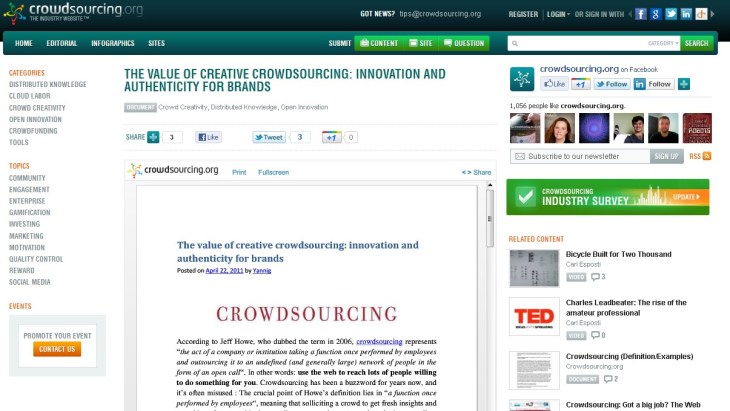
(click on image to access article)

Here’s a blog post I recently wrote about crowdsourcing. The inspiration came from an academic paper of French researchers Jean-Fabrice Lebraty and Katia Lobre who identify two relevant sources of value for crowdsourcing: innovation (new ideas, concepts and uses) and authenticity (brand perception, marketing message etc.). I thought this had to be shared, and therefore translated into English! Glad to find it on crowdsourcing.org, I hope it will encourage mature discussion about the concept of crowdsourcing in marketing.

EDIT (June 26th): The article won the CIGREF-AIM 2011 award, which rewards the best article published in the French academic journal Systèmes d’Information et Management.

What brings better innovation: Competition or collaboration?

hate-love

Today, when you talk about innovation, you’ll probably discuss open innovation as well. Keeping the corporation closed and hoping that visionnary geniuses come up with ideas is possible (Apple does this!), but more potential lies in opening the innovation funnel to get inspiration from outside. One of the most popular ways to access innovative ideas and solutions is to set up a contest. Popular examples are Pepsi’s Refresh Project (PepsiCo) or the Co-Creation Lab (Hyve for BMW). But are we talking co-creation or crowdsourcing here? In other words, do consumers collaborate or do they compete to win? Recent research suggests that output is better when you combine competitive and collaborative aspects. Continue reading →