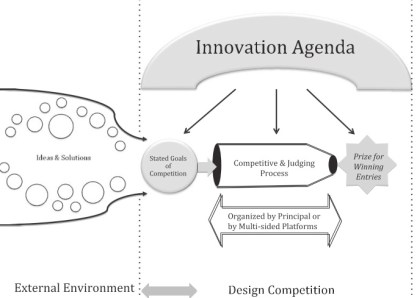
Actually both brands and companies increasingly use crowdsourcing in their strategies: brands do it often for marketing and communication, companies do in for innovation. The latter has been described in a recently published article: Test-Driving the Future: How Design Competitions Are Changing Innovation, written by three London researchers, and published in Academy of Management Perspectives. It focuses on innovation-related crowdsourcing, like Cisco’s and GE’s challenges. Let me give some information about the former in this post. Continue reading →
Tag / crowdsourcing
Crowdsourcing by Best Global Brands [Infographic]
The first (crowdsourced) timeline of crowdsourcing by brands

I’m happy to present the first visualization of the use of crowdsourcingby brands over time. This interactive timeline, called Crowdsourcing by World’s Best Global Brands, is built on Tiki-Toki, a tool to create timelines. Tiki-Toki turned out to be a good way to show how the use of crowdsourcing has exploded since the early 2000’s. The objective was indeed to have a rich and visual representation of how brands increasingly use of crowdsourcing to pursue marketing- and innovation-related business objectives. And the best part is: it will be crowdsourced. Continue reading →
Whitepapers about crowdsourcing, co-creation and open innovation

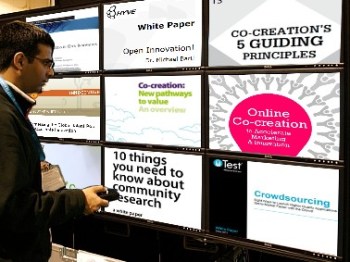
Last year, I compiled a selection of academic representations of crowdsourcing, co-creation and open innovation. The post is one of the most popular one of this blog, which indicates that there’s quite some interest in these topics. Now, let me share some whitepapers in a similar manner. Generally speaking, a whitepaper is an authoritative report or guide that helps solve a problem (Wikipedia). It is very common for companies to write commercial whitepapers today, designed to promote their products or services. Leading actors in the fields of crowdsourcing, co-creation and open innovation have written numerous whitepapers to promote their respective categories, and here’s a selection of them.
I only selected whitepapers that have been written and published by actors of the field, like consultancies and platforms, leaving aside brand-initiated documents. Also, the whitepapers are listed in some categories (crowdsourcing/co-creation /open innovation), but the companies might also be associated to several of then (for example, eYeka positions itself on co-creation, but uses crowdsourcing and is sometimes also associated to open innovation) Continue reading →
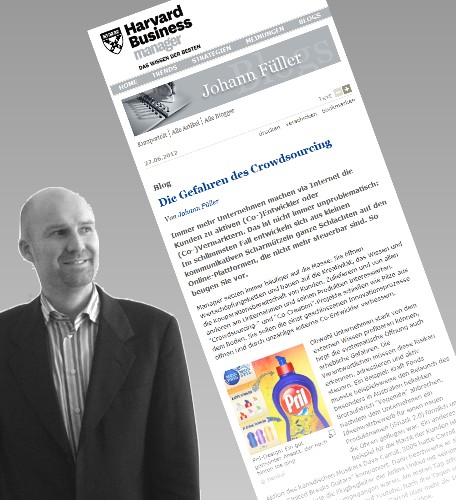
The dangers of crowdsourcing (Johann Füller’s post on Harvard Business Manager)

Johann Füller is CEO of Hyve AG, a company that organizes crowdsourcing for co-creation and/or open innovation purposes, and professor at the University of Innsbruck (Austria)
I already blogged about academic articles in French that should have been translated into English, because they’re pretty darn interesting and useful for people interested in co-creation or user innovation. This post is about a blog post that Johann Füller, an experienced researcher and businessman, wrote in German on Harvard Business Manager. It’s called Die Gefahren des Crowdsourcing (The Dangers of Crowdsourcing) and highlights some of the dangers that brands should be aware of before kicking off a crowdsourcing campaign. Not only does he give some examples, but he also cites 3 often encountered sources of crowd-resistance, as well as 5 ways to avoid failures. This post is an unedited translation, I only changed the illustrations and added a couple of links in the text. Continue reading →
Defining creative crowdsourcing (crowdsourcing of creative activities)
In the first year of writing a PhD thesis, you’re basically asked to define key terms and to set up a research question. I’m particularly interested in crowdsourcing, and more particularly crowdsourcing of creative tasks. This post proposes to define the term creative crowdsourcing, or crowdsourcing of creative activities, as it hasn’t been defined yet (to my knowledge). I would love to have your thoughts about the proposed definition, it can only help me refining it in order to improve my doctoral dissertation! Continue reading →
Crowdsourcing and Marketing: Should companies try to target specific audiences?

Crowdsourcing and marketing, a tough equation to solve. Why? Because crowdsourcing is about openness whereas marketing is about targeting; crowdsourcing offers serendipity when marketing is looking for predictability. Brands often want to target a specific target audience: “Can you only ask Chinese people to participate?” or “Is it possible to accept only the users of my product?” or even “I want only ideas from women from 25 to 35 years, is that possible?” are questions that often get asked while discussing the possibility to launch a crowdsourcing project. The truth is that the internet is a global medium and that everyone can potentially participate in a crowdsourcing challenge. Targeting is difficult, and only few succeeded. Continue reading →