Crowdsourcing across cultures: Recent evidence from Mechanical Turk

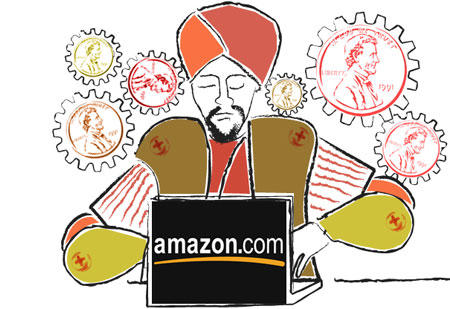
mechanical-turk-amazon-illustration

Image via vator.tv

Do you know Mechanical Turk? It’s a web-platform that is hosted by Amazon.com and allows you to perform small (and usually repetitive) tasks and to earn a little money. Everybody can set up a task, and everybody can perform a task, that’s why Mechanical Turk  is called a “marketplace for work” (there are numerous other platforms like this). For the person who sets up a task, it’s like having a human-powered machine that performs tasks for you. And for researchers, it’s a fantastic playing field to explore crowdsourcing because of the sheer amount and diversity of people who perform tasks on the platform for little money! This post highlight three pieces of research that explore why people from India and the United States are active on Mechanical Turk.
Continue reading →

Are external idea contests really unpopular and uneffective?

diagram

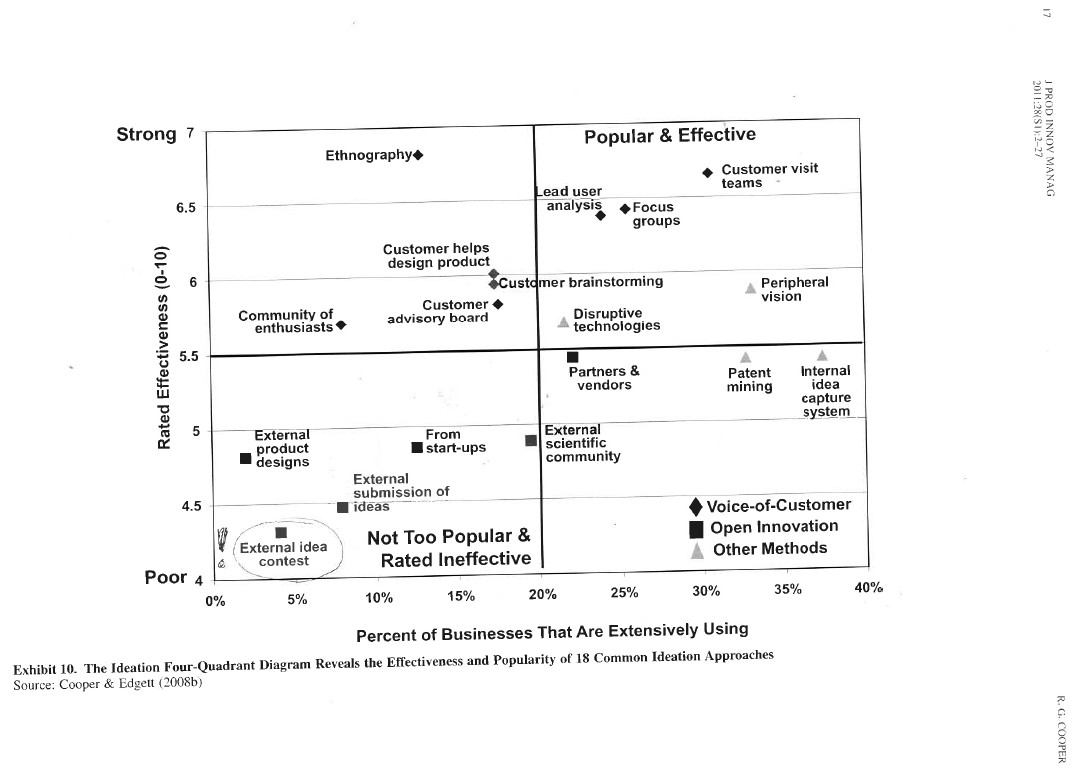
Robert G. Cooper's diagram on common ideation approaches


In the last issue of The Journal of Product Innovation Management, Robert G. Cooper, inventor of the Stage-Gate process for new product development, ranks 18 popular ideation approaches according to popularity and effectiveness. In his article called The Innovation Dilemma, it’s interesting to read that he says that “few of the open innovation methods were found to be either particularly popular or effective” before highlighting that “the fact that open innovation is relatively new and is yet to be proven over time“.  He also says that “seeking ideas from outside […] applies best to a handful of industries, such as consumer goods“…

Continue reading →

Crowdtap’s Brand Influence metric: my questions

puma-head

Few people will commit to a brand like this little boy... but how to measure brand influence?


I am a passionate reader of FastCompany.com and its design pendant FastCoDesign.com (and I advise you to have a look at it, very inspiring!). Right after publishing a blog post the difficulty of classifying crowdsourcing actors, in which I placed CrowdTap as an example of good measurement/metrics, Fast Company published an article about their last innovation: the Brand Influence Metric. Brand Influence (“the cross-channel metric for marketing impact“) measures the power of any marketing action to impact consumers’ advocacy of the client’s brand and willingness to purchase its products. Does this metric usher a new era for marketing metrics or is it a proprietary metric with limited broad impact? Some questions…

Continue reading →

How crowdsourcing delivers authentic insights and/or breakthrough innovation

screenshot

(click on image to access article)

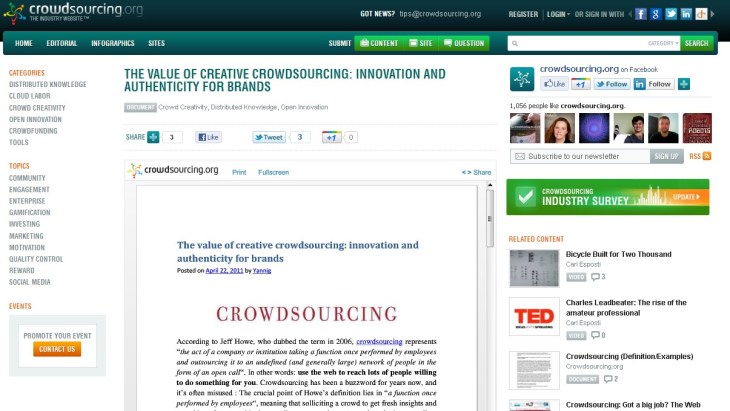
Here’s a blog post I recently wrote about crowdsourcing. The inspiration came from an academic paper of French researchers Jean-Fabrice Lebraty and Katia Lobre who identify two relevant sources of value for crowdsourcing: innovation (new ideas, concepts and uses) and authenticity (brand perception, marketing message etc.). I thought this had to be shared, and therefore translated into English! Glad to find it on crowdsourcing.org, I hope it will encourage mature discussion about the concept of crowdsourcing in marketing.

EDIT (June 26th): The article won the CIGREF-AIM 2011 award, which rewards the best article published in the French academic journal Systèmes d’Information et Management.

What brings better innovation: Competition or collaboration?

hate-love

Today, when you talk about innovation, you’ll probably discuss open innovation as well. Keeping the corporation closed and hoping that visionnary geniuses come up with ideas is possible (Apple does this!), but more potential lies in opening the innovation funnel to get inspiration from outside. One of the most popular ways to access innovative ideas and solutions is to set up a contest. Popular examples are Pepsi’s Refresh Project (PepsiCo) or the Co-Creation Lab (Hyve for BMW). But are we talking co-creation or crowdsourcing here? In other words, do consumers collaborate or do they compete to win? Recent research suggests that output is better when you combine competitive and collaborative aspects. Continue reading →

Crazy presentation about augmented research !

This presentation by Face‘s Director of Research Francesco d’Orazio kicks ass ! Several things make me say that : the pitch “Plugging brands into the fabric of society” is completely in line with the concept of societing that I’ve discovered recently, which basically recommends brands to propose themselves to society instead of imposing themselves to markets. In the future, we’ll “wear data like we wear clothes“, and this massive amount of data represents a tremendous opportunity for those who will be able to harness and analyze it !

+ it’s a beautifully designed presentation and… the main example is bikes !

Who participates in co-creation, and what do participants expect ?

screenshot-of-twitter

One of the most brilliant answers I’ve read is given by Johann Füller, CEO of Hyve, in his research paper Refining Virtual Co-Creation from a Consumer Perspective. He highlights that a lot has been written about the empowerment of the consumer, the capabilities provided by the web or the benefits of collabporative innovation, but “our understanding about who participates and what those participants expect from their engagement in virtual co-creation projects is limited“. In his paper, he explores how heterogeneous participants are and how co-creation focused companies should handle these different personnalities. Continue reading →