Why the web is making us (somehow) autistic

book-cover

I already blogged about how Google empowers us by enlarging our abilities to treat and recognize information (in French). I now just finished another book that deals with the way we deal with information today, in The Age of the Infovore. Written by blogger and professor Tyler Cowen, the book actually talks more about autism than about the web… but it gives us useful insights about thinking in the Information Economy. Continue reading →

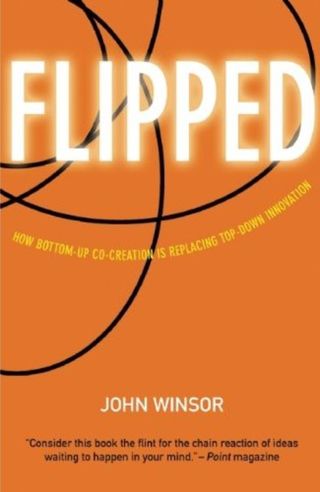
Flipped: How bottom-up co-creation is replacing top-down innovation, John Winsor

book-cover

Image via JohnWinsor.com


I just finished this little book written by John Winsor, and as accustomed I’m sharing my thoughts about it. M. Winsor is the co-founder and CEO of the ad agency Victors & Spoils, the first agency built on crowdsourcing principles. In this short book, he tells us how businesses can benefit from co-creation in marketing and innovation, and details the seven steps that allow them to embrace a beneficial bottom-up strategy.

“If I had asked my customers what they wanted, they would have said a faster horse” Henry Ford

What John Winsor calls a “bottom-up” is the fact that companies should get into a relationship with their customers before the launch of a product, not after it. But more than asking people what they want, this relationship is more about “intimately knowing the customers at the front end of the process“, says Winsor. I won’t give the seven steps that he advises companies to build  up to co-create from the bottom-up because (1) it would be boring, and (2) it’s what the whole book is about. Let me highlight some examples that are used to illustrate strategies of bottom-up co-creation. Continue reading →

The Globalization of Nothing, George Ritzer, Pine Forge Press

book cover

Image via PineForge.com

George Ritzer, from the University of Maryland, is a well-known specialist of globalization and its effects on society. With The Globalization of Nothing 2 (second edition, a “shorter, tighter, and more focused [on] globalization” than the first edition), he writes one more book about globalization, which might be considered as tiresome – but he introduces new concepts like grobalization and the somethingnothing continuum, and provides a discerning analysis of today’s world.

“Anything that is purely local is fast disappearing from the world scene”

Continue reading →

No hands: The rise and fall of the Schwinn Bicycles Company: an American institution, Judith Crown & Glenn Coleman, Henry Holt&Co.

When I arrived in Florida in early January I noticed all these Schwinn-bikes on campus, in the gym and in the supermarkets. This aroused my curiosity about this brand I already heard of, but who still was misterious to me ; that’s why I lended No Hands: The rise and fall of the Schwinn Bicycle Company: an American institution in the UWF Library. And here’s what I learned in the book, that was published in 1996 (and therefore does not cover Schwinn’s most recent history).
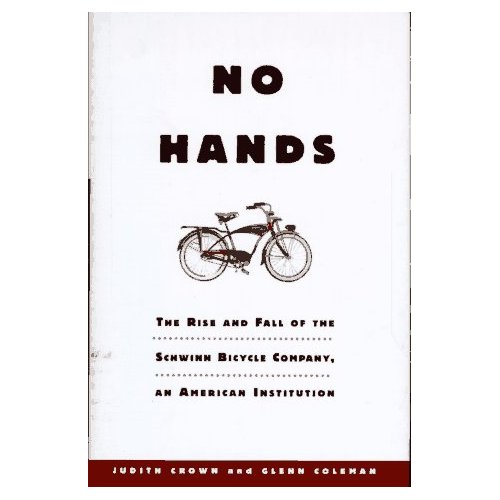
Judith Crown, who is a senior correspondent for BusinessWeek in Chicago and worked for Crain’s Chicago Business, started the book in 1992 after she heard that Schwinn was in serious financial trouble. With Glenn Coleman from Crain’s New York Business, they started investigating the reasons for the turmoil of America’s most notorious cycling brand.

picture

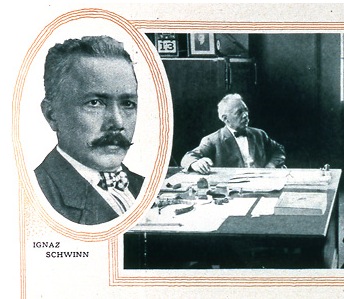
Ignaz Schwinn, co-founder of Arnold, Schwinn & Company (retrieved from http://www.motorcyclemuseum.org)

Ignaz Schwinn emigrated to the United States in 1891 and make profit from the late XIXth century’s bicycle boom to create a successful bicycle manufacturing company with an American partner, the Arnold, Schwinn & Co. The turn of the century and the start of the automotive era (Ernest Pfennig bought the first Ford T in 1903) saw a wave of consolidations in the bicycle business, out of which Schwinn emerged weakened – but even more ambitious. Various takeover made Schwinn one on the big players, and retailing through mass merchants allowed the Chicago-based company to achieve big sales. In 1928, the in-house brand for motorcycles that had been acquired in 1912 and 1917, Excelsior-Henderson, even ranked 3rd in the national motorcycle industry.

advertisement

This advertisement for Schwinn's Sting-Ray is from 1963 (retrieved from http://www.raleighronsclassics.com)

During the following decades, Schwinn built up a (very) strong brand. The best example certainly is the success of the Sting-Ray that originated from the Californian kids’ street culture (at that time, Schwinn listened to its customers…). Sociologist Arthur Asa Berger saw it in a bit more, let’s say, austere way : “[the Sting-Ray] symbolizes a perversion of values, a somewhat monstruous application of merchandising and salesmanship that… has led to grave distortions in American society“. His vision may be exagerated, but what he said about Schwinn’s marketing efforts gets to the heart of the company’s success : they mastered selective distribution and franchising better than any other consumer product company at the time. Furthermore, Schwinn’s “customers around the country were true believers“, as the book states on page 75, and owning a Schwinn was considered a status symbol in the 60’s.

ride

The mountain-bike pioneers started on converted Schwinns, recognize the frame ? (retrieved from sanfrancisco.about.com)

In the 70’s, Soutern California kids started following new trends (the BMX), just like the kids created the Sting-Ray culture during the sixties. This time, however, Schwinn decided not to engage into the movement, maily because the company saw the sport as too dangerous and unsuitable with Schwinn’s quality image. The same happened with the mountain-bike culture of the 80’s pioneered by Northern California riders like Michael Sinyard (founder of Specialized), Tom Ritchey and Gary Fisher. What Schwinn didn’t recognize is that trends are often set by minority thinkers, and not by the Number One.

Giant Store Amsterdam

In 1988, Giant Manufacturing produced 82% of Schwinn's bicycles, nowadays it is the world's leading bicycle manufacturer (retrieved from http://www.bike-eu.com)

But what eventually drove Schwinn into the turmoil that led the company to file for Chapter 11 in 1992 was it’s inability to cope with management and quality problems, as well as some unsuccessful investments. Basically, the company had to choose in where to produce bicycles at a more competitive prices. The Schwinns decided to turn to Taiwan and China, but even though suppliers like Tony Lo’s Giant Manufacturing (photo) made high quality products, unlucky sourcing desisions led to supply shortage, angry retailers and receding customers. Edward Schwinn, CEO, just wasn’t as passionate about bicycles as his ancestors were. Yoshi Shimano, who was Edward Schwinn’s personal translator during his business trips to Asia, described him as “a nice fellow“, who “had a lower degree of interest for the business“.
advertisement

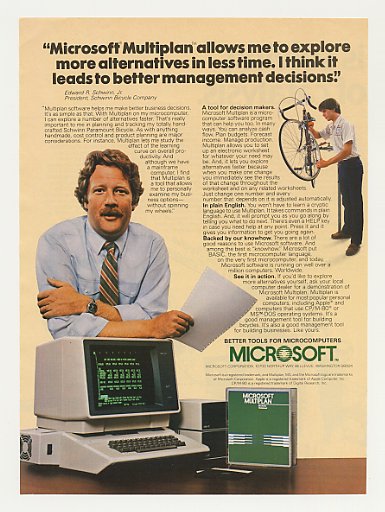
If only Microsoft had helped Schwinn taking better strategic decisions... (advertisement from 1982, retrieved from aroundme.fr)

In 1992, Schwinn filed for bankruptcy. Ed Schwinn looked for an investor during the difficult years that preceded this sad ending, but this reveals a part of the problem : instead of an investor that would provide funds to keep the business running, Ed Schwinn should have found a buyer, which implies that this buyer would have taken control of the company – what the Schwinns wouldn’t accept. When the company was too damaged to be saved, the company and name were sold to the Zell/Chilmark Fund, an investment group, in 1993.

To conclude, let me just quote very hard words that Judith Crown writes about Ed Schwinn, in the introduction of the book : “Most of all, it is a tale of a young CEO who alienated just about everyone he needed – from relatives, employees, and longtime dealers to lenders, lawyers, suppliers and bidders – with a mix of arrogance and ignorance that only can be described as hubris

He now runs a cheese shop in Wisconsin, so he certainly won’t destroy another American institution !

The Dumbest Generation, Mark Bauerlein, Penguin

Book cover

The book came out first in May 2008

As I walked around in the UWF Bookstore a couple of days ago, I fell on this book with the provocative title “The Dumbest Generation, How the Digital Age Stupefies Young Americans and Jeopardizes Our Future (or, don’t trust anyone under 30)“. Labelled national bestseller and praised by renown newspapers all over the front & back covers, I wanted to find out more. Not only that I’m curious and that I want to discover what American academics think about my peers, but also because that stuff certainly applies to us Europeans ! By the way, the title “The Dumbest Generation” comes from Philip Roth’s novel The Human Stain, published in 2000.

Public lecture

Mark Bauerlein at Augusta State University in November 2009 - Retrieved from asupr.com on February 2010

The author is Mark Bauerlein, English professor at Emory University in Atlanta, Georgia, where he lives with his family. He was appointed director of Research & Analysis at the National Endowment for the Arts (NEA) in 2004, which is a cultural federal agency promoting fine arts and litterature among Americans. He also writes for various newspapers like the Wall Street Journal, The Washington Post, The Chronicle of Higher Education and other periodicals like The Yale Review or the Publications of the Modern Language Association (PMLA). He seems to be highly engaged in education and litterature research as I figured out while reading his book (see here, here or there).

The message that Bauerlein wants to deliver is the following : how come that the youth has so little knowledge while surrounded by so much information ? Based on a lot of survey & study results like Reading at Risk (which he oversaw while at the NEA), the statement basically says that young Americans “don’t know any more history or civics, economics or science, litterature or current events“. According to the book, Generation Y spends stunning $172 billion a year while saving only $39 billion… “marketers had better be ready for it“, it says – regretting that material possessions matter more than intellectual possessions.

“What do you think of student ignorance and apathy ? the interviewer asks the sophomore. “I dunno and I don’t care”

American universities still have the world’s best engineering programs, he says, but more than half of all the doctorates come from abroad, and it’s no secret that in a couple of decades knowledge will shift to the Asian continent. The XIXth century was European and the XXth century was American, the XXIst will be the Asian century. The knowledge deficits cover various disciplines like history, civics, science and fine arts according to Bauerlein. The 2006 National Survey of Student Engagement reported that 27% of first-year college students “never” attended an art exhibit, gallery, play, dance or other theater performance.

Adolescents

"The sole book event, qualifies more as a social happening than a reading trend" (about the Harry Potter phenomenon) - Picture retrieved from bbc.co.uk on February 2010

Generation Y is the first one to ever trumpet what Mark Bauerlein calls a-literacy : knowing how to read, but choosing not to ! It is proven that regular readers score better at knowledge tests and learn at a faster pace than those who don’t – it’s also called the “Matthew Effect” – and young Americans seem to disregard reading today. The question is : does this generation have other, maybe more valuable skills, like some kind of digital literacy or “E-literacy” ?

Some say that nowaday’s youth has a particular mental flexibility, a “general deployment capacity” acquired by multi-tasking and regular handling of information and technology. The author supports that we may be “mentally agile“, but also “culturally ignorant” ! I may not totally agree with that one, at least I think that he underestimates these skills – or overestimates the importance of academic knowledge…

shelf

Laptops (ond now the iPad) to replace books ? - Photo from an Apple Store retrieved from http://www.dynamist.com/weblog/archives/001802.html in February 2010

Is Apple‘s “decisive lifestyle choice” awkward or even damageable for uorselves ? They designed a whole new way of approaching information by making it more visual and pleasurable, and I think that’s not were the problem lies. As Bauerlein implies, the problem is the freedom of choice that we all have (and claim!). Hence, our web-based environment has become “a consumer habitat, not an educational one“, where peer-pressure and peer-judgement matters more than “vertical modeling” such as relations with teachers, parents, employers which is so crucial to gain maturity. The youth downplays tradition, history and experience in favor of short-sightened social interactions, which leads a kind of Peter Principle (“by proceeding in school and social circles without receiving correctives requisite to adult duties and citizenship. They reach a level of incompetence, hit a wall in college or the workplace, and never understand what happened“).

Mark Bauerlein concludes his book by refering to the youth movements of the 60’s and 70’s who “denounced the legacy of their elders […] but at least they knew them well“, which he calls informed rejection of the past. Today, we are facing an “uninformed rejection of the past, and then complete and unworried ignorance of it“. Not that he wants a generation of elite intellectuals, but he highlights the importance of lesser intellectuals whose general knowledge is so important to educate the coming generations – what kind of parents will we be in 20 years ? “If social life has no intellectual content, traditions wither and die“.

A very pleasant book which highlights a worrying evolution of a part of the youth. Sometimes a bit loaded in survey results but well-written and interesting. I definitely recommend it. If you want to find out more, visit dumbestgeneration.com .

The Designful Company, by Marty Neumeier

Marty Neumeier is president of a consulting firm called Neutron and based in San Francisco, CA. He began his career as a designer and nowadays also writes about innovation and corporate culture, his two previous books The Brand Gap and Zag (“When other Zig, Zag”!) dealing about radical differentiation and business strategies regarding innovation. In this book, published very recently, the American defends a corporate culture based on design thinking, in which innovation is driven by a new approach : radically new creation, fuelled by designer’s minds.

In his survey led with Stanford University, Neutron’s CEO revealed that top executives’ most “wicked problems” to solve in their daily business life is :

  1. Balancing long-term goals with short-term demands
  2. Predicting the returns of innovative concepts
  3. Innovating at the increasing speed of change, and so on…

You would probably argue that these challenges, even if he calls them “wicked problems” (expression first used by the German design theorist Horst Rittel), aren’t new to companies since they always needed to be competitive by innovating. This is actually true, but Marty Neumeier tells us he has found the best way to conciliate these problems with company benefits is to adopt design thinking : using empathy, creativity and rationality of designers to fuel innovation, and thereby drive business success.

The mistake would be to say what I just said : “of designers“! But with designers, I don’t (only) mean a weirdo who draws sketches all day long, but the whole creative class (Richard Florida, 2002) made of entrepreneurs, scientists, engineers, artists etc. which thinks like designers. One example is given by railroad baron Collis P. Huntington, who once said “Your Eiffel Tower is all very well, but where’s the money in it?” when a journalist asked him about a critique, just after the completion of the monument. According to Neumeier, the  designer’s reaction would more likely sound like this : “What a stirring symbol of achievement! From now on, people will never forget their visit to Paris“. The designful company will have to “think […], feel […], work like designers“.

Antother idea that Neumeier defends is that design is change. Therefore, whether you find a situation worth improving or not, innovation should be design-driven because it focuses on imagining what could be. An example regarding this is the Freestyle dispenser imagined by Coca-Cola : making drinking Coke a whole new experience. They are designing the drinking experience in a whole new way, check it out yourself ! Together with other marketing & branding tools like storytelling, and management tools like branded training, your company will build-up a culture of nonstop innovation, according to him. Let’s not forget that it’s actually his business to fuel change in companies, by consulting and training services offered by Neutron !

A phrase I loved in the book is the following one : “Companies will create wealth from the conversion of raw intangibles -imagination, empathy and collaboration- into finished intangibles -patents, brands and customer tribes“. As synthetic as this quote is his book, designed to be read and understood very easily, but also to give useful tools to implement change in your very own company !

If you want another review of the book, check this post from Designdroplets.com