 One of my favorite French blogs, InternetActu, offers a bi-monthly selection of articles, studies & papers which I always love to browse through. Despite being a little long, it offers a condensed view of the latest trends, beyond Mashable’s or FastCompany’s trending articles. In order to share more and better about marketing, design & other exciting subjects (the title of this blog), let me do the same on my side, sharing some of my preferred readings on a monthly basis. To start, here are some articles and links I have enjoyed in March, or tweets I’d like to share again. Continue reading →
Category / EN : News
In 2012, Happy New Year greetings come from India!
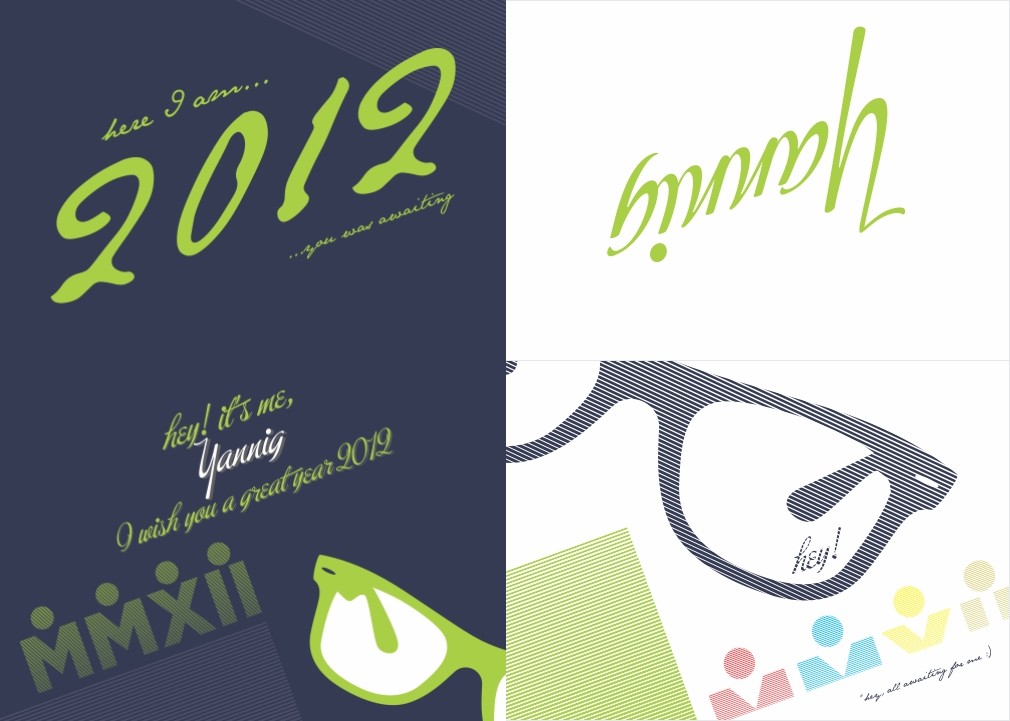
Click to enlarge
Some of you might have received this greeting card these days. The visual is nice, but there’s much more behind it: the card results from a creative contest. In other words: I used the internet to ask people to design me a greeting card, it’s called “crowdsourcing”. There are a lot of websites for this: 99designs (Australia), Creads (France), Crowdspring (USA), 12designer (Germany), JadeMagnet (India)… A lot of them have communities of designers, both amateurs and professionals, located in the whole world. Actually, one of these websites, the Chinese Zhubajie, could be considered as the largest employer in the world, with more people than the Peoples’ Liberation Army of China or Walmart-Stores in the USA!
Such creative contests are increasingly used by companies to outsource creative work, to look for innovative ideas, to seek inspiration… It’s a fascinating research topic that I would like to explore, and that’s why I started my PhD-work about creative “crowdsourcing” this year. So, what is “crowdsourcing”?
Crowdsourcing is the act of […] taking a job traditionally performed by a designated agent and outsourcing it to an undefined, generally large group of people in the form of an open call (Howe, 2006) Continue reading →
“You have been crowdsourced” – When academics get busted for plagiarism
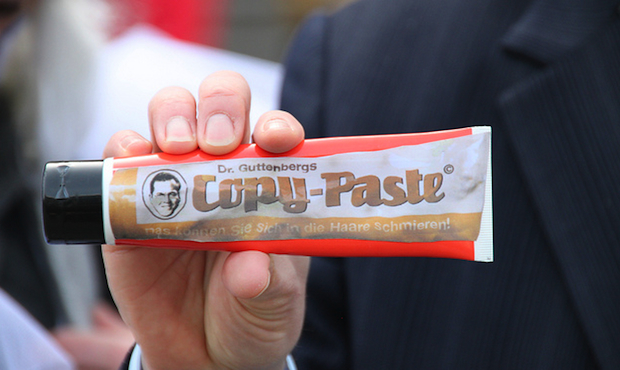
Image via FastCompany.com
In the German newspaper Welt Am Sonntag, I recently stumbled upon a very interesting article which discusses a very hot topic: trust (or not) in the academic world. The title, which could be translated by “Hunting plagiarists per mouse-click“, indicated that we’re again talking about a web-related subject; and indeed the article is all about the wikis that allowed to reveal serious frauds in thesises of highly ranked German politicians. The most famous one was GuttenPlag Wiki, which is closed today… now that the former German Minister of Economics and Defense Karl-Theodor Zu Guttenberg resigned. Who are the people who read thesises to reveal fraudulous passages? Why do they do it? Continue reading →
2010 in review
The stats helper monkeys at WordPress.com mulled over how this blog did in 2010, and here’s a high level summary of its overall blog health:

The Blog-Health-o-Meter™ reads Wow.
Crunchy numbers

About 3 million people visit the Taj Mahal every year. This blog was viewed about 34,000 times in 2010. If it were the Taj Mahal, it would take about 4 days for that many people to see it.
In 2010, there were 40 new posts, growing the total archive of this blog to 103 posts. There were 210 pictures uploaded, taking up a total of 383mb. That’s about 4 pictures per week.
The busiest day of the year was September 23rd with 210 views. The most popular post that day was Advertisement war within the automotive industry (2006).
Where did they come from?
The top referring sites in 2010 were facebook.com, bikerumor.com, bicycledesign.net, bicycledesign.blogspot.com, and twitter.com.
Some visitors came searching, mostly for boston university, sixt werbung, toblerone, alain minc, and colorado license plate.
Attractions in 2010
These are the posts and pages that got the most views in 2010.
1
Advertisement war within the automotive industry (2006) October 2009
2
Prison Valley, ‘Prison-nomics’ in Cañon City, Colorado (web-documentary) April 2010
5 comments
3
Cycleurope refreshes traditional brands Gitane & Peugeot January 2010
4 comments
4
Autovermieter SIXT : Aufmerksamkeit durch “Guerillastrategie” October 2009
2 comments
5
Le logo de Carrefour n’est pas le seul “subliminal” October 2009
4 comments
Happy New Year !
Cycleurope refreshes traditional brands Gitane & Peugeot
As a survey led in 2008 by TNSDirect for bike4all.com, and related by B2BIKE.com, shows, bicycle brands like Peugeot and Gitane are (still) top-of-mind brands in France. Although these brands stopped selling bikes for several years now, these “traditional” names are quoted by a lot of Frenchmen, one of the reasons might be that Poulidor, Mercier and even Gitane-bikes are sold at very cheap prices in French supermarkets.
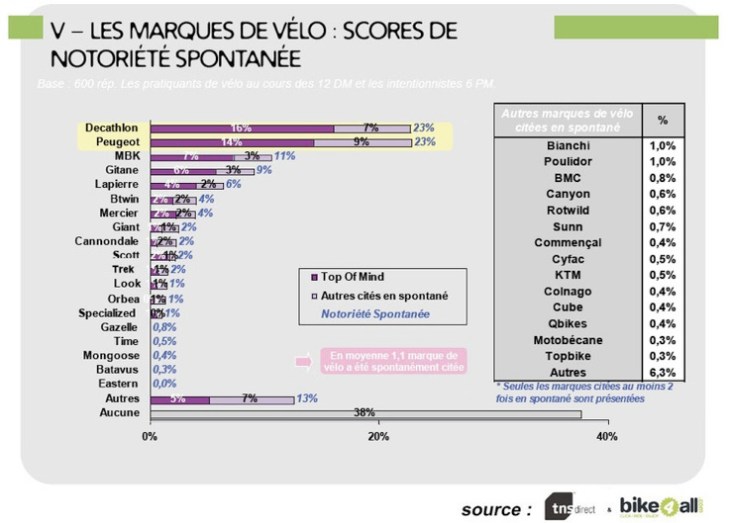
Retrieved from B2BIKE.com on January 11th 2009
As the previous histogram shows, brands which don’t exist anymore are very often quoted by the interviewees : Decathlon nowadays sells bikes under the brands B’twin (6th position) and Rockrider (not quoted), Peugeot has marginal bicycle sales and is distributed by about 40 authorized Peugeot-dealers, Gitane and Mercier are currently cheap supermarket bikes and Motobecane doesn’t exist since 1984 at all (the brand MBK survived to Motobécane’s bankruptcy and as a fair spontaneous notoriety).
Even though it reveals that the French bicycle market offers a huge number of brands and that consumers seem to be lost within that abundant offer, Cycleurope tackles this issue in a quite courageous way : they bet on the revival of these brands ! Strengthened by the notoriety of Gitane and Peugeot, and fairly aware of the asset that it represents, the Grimaldi Group (owner of Cycleurope, which already runs brands like Bianchi and Monark) decide to take the plunge and awake Gitane and Peugeot (at the request of Peugeot Cars HQs). The existing Gitane range will indeed be expanded with a top-of-the-range brand called Definitive Gitane, and Peugeot will extent its distribution network and eventually launch a Peugeot e-Bike.

"The One" bike that Definitive Gitane provides to the Saur-Sojasun team. Gorgeous. (photo from http://www.saur-sojasun.com/goodies.php)
To give credit to Gitane’s revival, Cycleurope Industries developped an additional range of high-performance bikes that meet the competitor’s expectations : cross-country hardtrails and fullies in the MTB-segment, a small range of road bikes topped by “The One“, on which the pro-riders from Saur-Sojasun will compete in 2010. Smaller partnerships were announced like the creation of the French Team ASPTT Definitive Gitane on the national MTB stage.
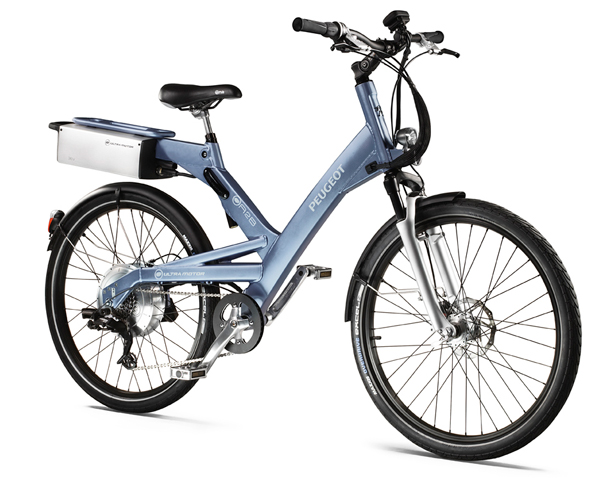
The Peugeot A2B hybrid bike (in blue) developped with Ultra Motor (about 2300€). Retrieved on January 11th 2009 from jepedale.com
Peugeot bikes (the car manufacturer recently unveiled a new logo) will be manufactured in the French factory of Romilly/Seine and will be sold by Cycleurope, as Toni Grimaldi told Bike Europe a couple of days ago at the official launch of Peugeot Bikes, and they will be distributed both in Cycleurope’s dealer-network (France and abroad) and via Peugeot car dealers, although I guess that’s not the distribution channel that brings them the highest number of sales… The range will include a road racer, a mountainbike, a hybrid/trekking and a city bike which will all be painted black&white. As Peugeot now pushes into the market of electric vehicles, they announced the development of an e-Bike with the Amercians from Ultra Motor.
The move is courageous but clever : two brands with a very high awareness among – at least France’s – cyclists make a credible comeback on the front stage. I’ll certainly be watching the Definitive Gitane bikes on the roads at pro races, Peugeot may gain significant market share by flooding Velo & Oxygen-stores in France and Peugeot-dealers worldwide with their tiny bicycle range. Good luck !
The Freestyle fountain: the largest equipment investment in Coca-Cola’s history
Rankings and articles show how high the Coca-Cola Company ranks among the world’s largest firms : on the top ! For the marketing student that I am, the company undoubtfully is one of the best examples to observe this enormous system, particularly its brand identity. One of the recent projects is a new distribution concept which is currently tested on USA’s West Coast : the Freestyle™ fountain.
Code-named “Project Jet” in Atlanta, the project was one of the top priorities of Coca-Cola Company in the last four years. The challenge was to find a way to surprise and satisfy customers by offering the maximum of company products, while reducing the carbon footprint of the distribution and, last but not least, ideally get feed-back on customer choices. Good luck. To tackle this challenge, David Butler, Vice-P of Global Design and Todd Brooks, Design Director for Global Brands formulated four core principles for the design process of a Coke product : simplicity, authenticity, powerful red colour and being “familiar yet suprising“. The particularity of a beverage-firm like Coca-Cola is that design and marketing have more visibilty than product innovation. Actually Coke doesn’t change at all, the growth potential is external : the recent acquisition of Vitamine Water is one of many examples.
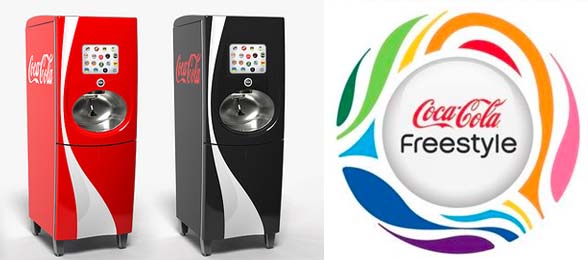
Industrial designer Raymond Loewy designed fountain dispenser for the 13 billion-dollar-company decades ago, and the Freestyle’s design emerged from the offices of the Pininfarina studios, one of the 300 design agencies worldwide Coca-Cola works with, also renown for numerous italian automotive designs. But it’s Butler, who mastered the whole development process, partly with Vince Voron, who came from Apple a couple of years ago to manage Cokes machines design. The resulting Freestyle machine aims to conciliate the global brand ID with a specific focus on local expectations. As another of the company’s executives states : “we have created a concept […] a representation of the way people will experience our beverages years from now“. “Experience” beverages !
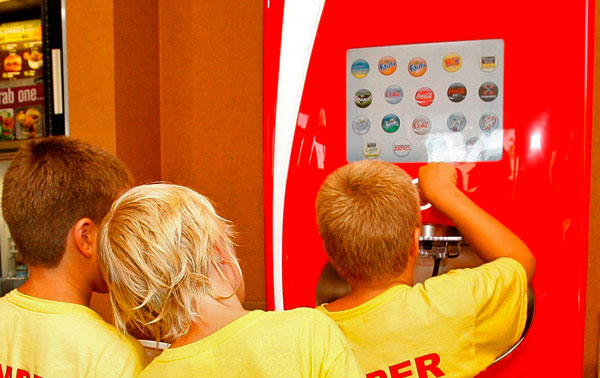
© digitalsignageuniverse.com
The machine enables the customer to chose within more than 100 different low-calorie beverages (and hybrids of various Coca-Cola sodas, juices and waters : Fanta, Sprite, Minute Maid etc.), from the authentic Coke beverage to more exotic ones like Minute Maid Raspberry, Caffeine-Free Diet Coke with Lime or Fanta Peach ! But it’s the touchscreen that is remarkable : intuitive browsing through the company’s brands, variants and tastes. And the machine gives feedback : not only about customer-preferences (tastes, peak times, locations etc.), but also allows quick product recall if necessary. Finally, the use of highly concentrate syrup reduces the impact of transport and packaging to a minimum. It’s already used in the McDonald’s dispensers, never watched at it when the Coke pours into your cup?
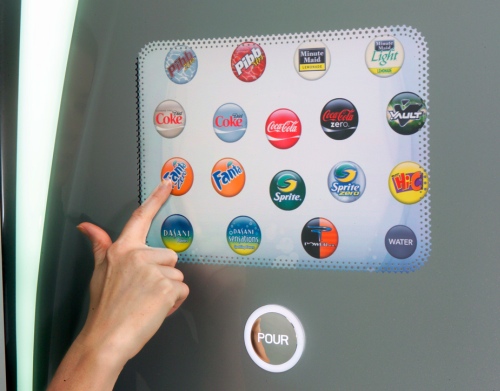
Select your mix ! (recognize the Apple-like design ?)
Fast Company wrote a very good post about David Butler and his work on the Coke fountain. According to them, he doesn’t use the expression “design thinking” but prefers to “create more value“, and design is one of numerous tools that allow it (“improve the experience to make more money“). It’s as simple as that, and reminds us that design isn’t only about products, but also processes. As Butler repeats at the end of the Fast-Company-journalist’s visit : “This is not a design story […] we’re leveraging design to drive innovation and to win at the point of sale“.
I’ll tag this post with the D-word anyway !
 Yannig Roth / This is my personal blog