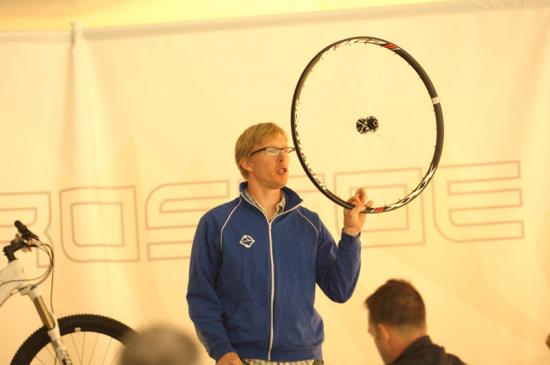
I often get asked what I’d like to do after graduating from ESSCA, hopefully with a succesfull marketing degree ! A very popular choice within the graduees is product management, starting as junior product manager for example. I started monitoring sport business websites and other comparable feeds related to the cycling industry and came across a couple of very interesting articles and interviews. TheProduct Manager is the “father” of a product, which means that he manages the life-cycle of a product (or range of products) from the cradle onwards. Trek’s product manager for women bikes, Heather Henderson, tells BikeRumor.com that “a product manager determines what product will go to market for any given segment“. But the bicycle industry seems to show some particularities. More after the break…
Being Product Manager is, as I said, like being a father. Actually I’m not a father and it’ll take me a couple of years before I will, but the comparison seems eloquent to me. A product idea can arise from different sources : a pionneer who spots an unsatisfied need (Mike Sinyard, Specialized founder, invented the mountainbike), a technological breakthrough (same example) or just a company brainstorming aimed to give a lift to an ageing product portfolio (think about the mountain-bike forks of Cannondale, Headshock and Lefty).
Product development involves working with engineers on new concepts or news materials, testing etc. Here is what Tyler Pilger says about his job as Road, Triathlon and Cyclocross Product Manager for Trek : “I work with a team of Industrial Designers and Engineers to determine future projects and current specifications. We do a lot of research both inside and outside the bike industry“. Concerning this “research“, Tyler Pilger says that the major fields of inspiration for his team are automotive, motorcycle and consumer electronics industries. A very succesfull bike here in France, the Triban Road 5, developped and sold by sports retailer Decathlon, was inspired byNYC messengers according to one of the company’s product managers.

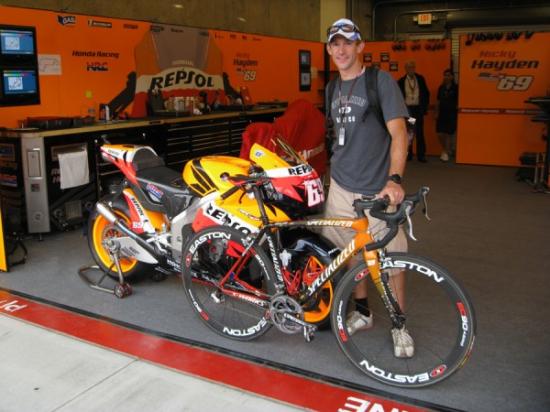
A product manager needs to work with all kind of media to get his products to the customer. Not only to launch a new bike, but also to “bring in new customers from other areas” as Specialized PM Nic Sims explains. For iinstance, he works “with a lot of motorsport athletes to try to build awareness for Specialized in other non bike related magazines and at events like Moto GP etc“. I wouldn’t have thought about this aspect spontaneously, but it’s interesting to notice indeed. I had other events in mind like stage races, interviews or trade shows. Nic Sims says that visiting this kind of events is essential for the brand to show that Specialized is passionate and involved… well that’s a minimum.
But being a product manager not only requires creating and launching products targetting specific consumer groups. The manager also has to ensure a valuable service to every single customer in particular by selecting points of sale. That’s what the French distributor of the Swiss brand BMC (Bicycle Manifacturing Company) explains to B2BIKE : “we seek retailers that focus on high-end products, that have strong technical competence and a valuable sales surface that can present several products. Financial strength of the retailer is also essential. BMC bring commercial and technical support (a dedicated catalog, POP, wingflags, stickers etc.)“. This support is very important for the retailer, whose success depends on the attractivity of the store and on the ability to respond to customer’s needs.
Within the Specialized marketing department, there are 16 people working on different fields like web content (corporate website, social media etc.), promotion (in print ads, TV spots etc.) or retailer supply. And while the promotion of the 2009 product range is still going on in stores, the team has to to manage the 2010 range (presentation in mid-2009) and allready work on the products of 2011 and beyond. At Trek’s HQs in Waterloo, the schedule must be quite similar. Heather Henderson, who is quoted in the introduction, details her activities : “Some days it means I get paid to sit at my computer and talk on the phone about production issues and model details, some days it’s sitting through extensive meetings, some days it’s meeting with dealers, other days it’s research travel to check out market segments or specific events“. And being a product manager seems to be a 24/7 job, because what stands out is that they are always on the look-out for ideas : “I take tons of pictures when I’m out and about to articulate ideas to my colleagues“.
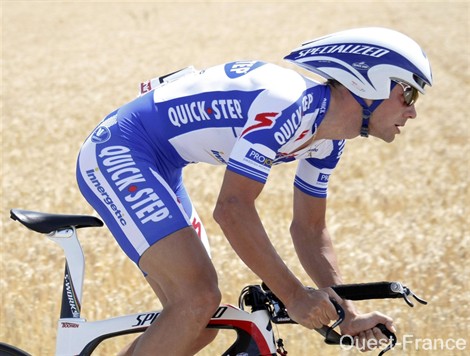
As Nic Sims says, sports marketing (sponsorship) represents “a very large budget as we have a lot of pro road teams and individuals to support“. Specialized is one of the most notorious brands in the pro and amateur peloton. For instance, the red “S” is almost more visible than the “Quick Step” logo on the team apparel, as the following picture of Tom Boonen shows. According to Sean McLaughlin (oncyclingnews.com), the squad is one of the most valuable teams to sponsor in a marketing point of view : “The perceived market value among ProTour teams varies dramatically“. Whatever McLaughlin says, this kind of sponsorship should ad up to an estimated mid-rande seven figure sum !
Sponsorship not only provides visibility to the brand. The product managers has to collect the rider’s feedback on bikes and equipment in order to continuously improve existing products and to develop new ones. Specialized is “dealing with the best athletes in all sorts of fields and hopefully people can feel the improvements that are being made“. Sure they can. At Trek Bikes, they “have a team liason named Ben Coates whose full time job is to interact with the Astana team and get feedback on equipement“. Combined with thefeedback coming from retailers and customers, the product manager has to find a compromise between technology push and the demand pull to drive innovation.
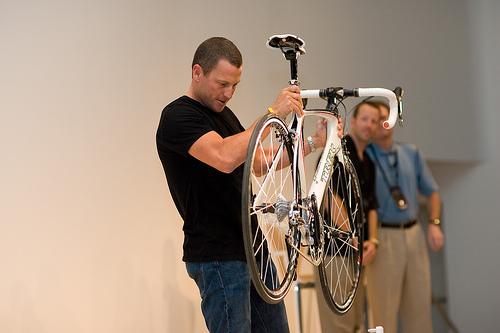
How do you get to these jobs? Some have a business degree, some have studied art at university and others don’t even have a degree. The common thing about all of them is that they all worked in the cycling industry before getting the job, either working themseves up the hierarchy (Nic Sims started as a bike mechanic in an English store that sold Specialized) or meeting people at races or events (Chad Price, urban bikes PM for Trek, was a semi-pro in the US and France). When asked to Nic Sims how you can start in the business, the answer is as follows : “check out the website Specialized.com and contact our HR department or if you know someone in the company that can pass along a resume to the right people“. Tyler Pilger (black shirt, in the background of the following pic) from Trek stays vague as well, saying “through some fortunate happenstance, I ended up at Trek“. Ok we get it…
Links :
- What it’s like… Specialized Global Marketing Manager Nic Sims, interview published August 17, 2009, on BikeRumor.com
- What it’s like… Trek Bikes product managers, interview published June 12, 2009, on BikeRumor.com
- Interview de Paul Didier, Responsable BMC France, interview published June 23, 2009, on B2Bike.com
- Interview of Olivier, City Bikes product manager for Decathlon, published February 11, 2009, on JePedale.com

 Yannig Roth / This is my personal blog