How crowdsourcing is changing advertising: insights from an expert panel

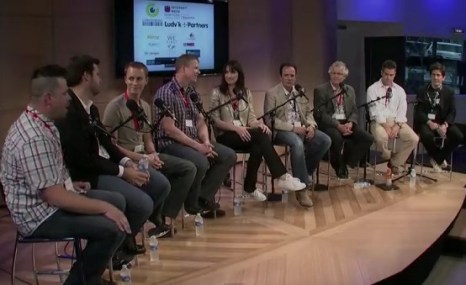
internet week 2011 expert panel

The experts on stage during Internet Week 2011: Mike Martoccia, Peter LaMotte, Epirot Ludvik Nekaj

I already blogged about the evolution of creative crowdsourcing plateforms, saying that companies mostly adopt one of 3 models: agencies, platforms & crowd-sources. To catch up on this, I’d love to share some very interesting excerpts of last year’s Internet Week panel about creative crowdsourcing. The debate focused on how crowdsourcing was changing the advertising landscape, and was moderated by Mike Martoccia. Intendees were GeniusRocket’s CEO Peter Lamotte, 99design’s co-founder Matt Mickiewicz, AdHack’s CEO James Sherrett, Victors&Spoils’ COO Claudia Batten, Collective Bias’ CEO Johan Andrews, Chaordix’s VP of Business Development Randy Corke, Tongal’s CEO Rob Salvatore and Ludvik+Parters’ CEO Epirot Ludvik Nekaj. Continue reading →

“The video contest landscape is like the Wild West” says an experienced participant

colt

Image via Gerard Elmore (vimeo)

I recently read a very interesting blog post from Jared Cicon (a.k.a. Video Contest King) about participation in crowdsourcing. Jared is a pioneer participant in video contests; he was one of the finalists of the first Doritos contest in 2006, and has taken (and won) a lot of contests since then. In his blog post “You…against the rest of the freelance world“, Jared shares his point of view about the current video contest lanscape. In his blog post, he says how much more competitive it is now: “what I’m hoping to demonstrate […] is how difficult it can be to freelance in our video world, and that we are clearly facing ongoing increased competition with every passing week“. As a consequence, he says, brands’ expectations are getting higher and it is therefore more difficult to win contests and earn money.

While it is always tempting to do those things that feel more ‘artisitic’ and which are more personally fulfilling, they must be balanced with content that the brands can use and that ‘get the money to pay the bills’

The crux of his blog post is “Evolve or die” – much like in the Wild West. I invite you to read the great post that he wrote on his blog if you want to find out more. After reading his insightful post on his blog, I thought it would be great to talk about crowdsourcing “from the other side”. He nicely took the time to answer a couple of questions about himself, his activity as a producer and about crowdsourced video production in general, and it’s my pleasure to publish the interview here on the blog. Continue reading →

Crowdsourcing in China : Learnings from the “Red Mat” design experiment

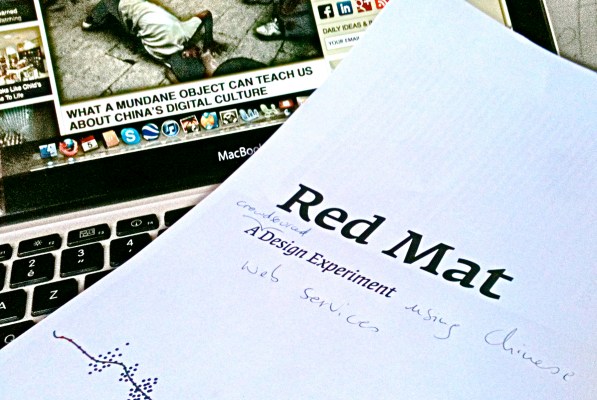
cover

On this blog, I’ve already blogged about crowdsourcing across cultures and crowdsourcing on Chinese platforms. To be honest, it’s a topic that I would like to explore further on my PhD work, because there seems to be few research about this. This post relates some findings of a design expermiment called Red Mat, which is a personal project of Jan Chipchase, who is also Executive Creative Director of Global Insights at Frog Design. I found out about the Red Mat project on PSFK, but at first I didn’t really understand what it was about… Now I see that it’s an exploratory project that heavily involved the use of Chinese crowdsourcing services. Here are some of the learnings… Continue reading →

Crowdsourced video contest reveals how people feel about luxury today

luxury

Image via Zooppa.com/contests/what-is-luxury

French reserachers Lobre & Lebraty say that the value of crowdsourcing lies in the innovativeness of ideas and in the authenticity of contributions. Similarly to what is explained in this whitepaper, this post is about a specific case where crowdsourcing is being used by a company to get authentic market feedback from consumers: The What is Luxury contest on Zooppa. This competition has been sponsored by Euro RSCG and explicitely asks videomakers to interview consumers about their perception of luxury. Since all the videos were available to everyone, I thought I would do a brief content analysis… and found some interesting insights! Continue reading →

Crowdsourcing for innovation, a visual confirmation of the trend

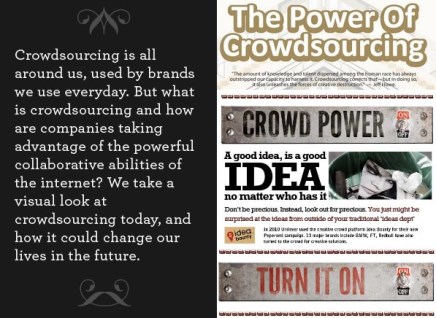
the-power-of-crowdsourcing

Images via smilespread.co.uk, 99designs.com and oBizmedia.com

I like visualizations, as much as I like to write about the trend of crowdsourcing. Since the term is certainly overused (as in this article about an “crowdsourced” electric vehicle, which is actually the result of an innovation cluster), what do you think about getting back to some facts about crowdsourcing-platforms? I mean websites like InnoCentive, Hyve, Jovoto or Zooppa which leverage a crowd of contributors to participate in online-hosted contests. Let me share my visual perspective about 2011, a year in which crowdsourcing gained a lot of steam! Continue reading →

Crowdsourcing is a lot less anxiogenic than actual co-creation – Bernard Cova’s critical and insightful perspective

portrait

When you think about co-creation litterature, depending on what type of litterature you read, you might think of academic publications like SD-Logic or  Co-Creation Experiences, or you might think about business publications like The Future of Competition or The Power of Co-Creation. These types of publications are not opposed to one another, rather are they complementary in the emergence of trends, says Bernard Cova, professor at Euromed Management Marseille. According to him, there is a general pattern of amplification in consumer research: post-modern sociologists like Michel de Certeau describe general consumption trends, marketing-sociologists (or socio-marketers) like Patricia Seybold illustrate these trends with updated examples and approaches, and new marketing propagators like Venkat Ramaswamy spread the word to broader audiences like the mass media and business (Cova & Cova, 2009). I recently spoke to Bernard Cova about his view of co-creation. Continue reading →

The Shazam-effect in marketing: when “push” and “pull” strategies become obsolete

shazamization

Before turning into a super-hero, Captain Marvel pronounced the magic word "shazam" (which stands for Salomon, Hercules, Atlas, Zeus, Achilles and Mercure)

Steve Jobs’ genius was to combine existing technologies in an innovative manner to create seamingless browsing and multimedia experiences. Now, Apple sells its hardware with a price premium for which a lot of people are willing to pay, and it will stay like this in the future. The people from Shazam revolutionized media consumption in their way too. By allowing us to tag music whenever and whereever we are (as soon as we are connected to the internet), this application is symptomatic of a shift in our consumption: it has become ubiquituous and instantaneous. That’s what two French researchers describe in a recent paper, the call it the “shazamization”. Continue reading →