Dans le cadre du master en Web-Marketing, j’ai assisté la semaine dernière à un colloque de recherche sur le E-marketing (précédemment Journée nantaise de Recherche sur le E-marketing), organisé par le professeur Jean-François Lemoine à La Sorbonne. A l’ordre du jour, dix présentations sur divers aspects du marketing sur internet, sélectionnés par un comité scientifique composé essentiellement de professeurs de gestion de grandes écoles et universités françaises. Voici quelques conclusions présentées dans ces papiers : Continue reading →
Tag / research
L’analyse sémiologique (QualiQuanti)
Une présentation très intéressante sur par le cabinet d’études QualiQuanti sur l’analyse sémiologique des espaces et de la publicité. Cela me rappelle une séminaire intitulé “Sémiologie de l’image” que nous avons eu à l’ESSCA. C’était Pol Corvez, sémiologue à l’Université d’Angers, qui nous avait introduit à cette discipline très intéressante.
Design Thinking for social innovation, the “third way” to empower the Third World
The issue of the Stanford Social Innovation Review was on a corner of my desk for a while, but I finally managed to find the time to read this article which makes the cover-story of Stanford’s journal : Design Thinking for Social Innovation, by Tim Brown and Jocelyn Wyatt. Both are executives at IDEO, a global Design design firm which has worked with notorious companies like Kaiser Permanente or Shimano (see this previous blog post). In this article, the authors highlight the social scope of Design Thinking, explaining in what way it can help very poor people to improve their lives.

Design For The Other 90%, an exhibition gathering numerous social design projects in New York's Cooper-Hewitt National Design Museum (retrieved from other90.cooperhewitt.org)
There’s maybe no other domain in which human-centered design is as important as in social issues. As the article says, “social challenges require systemic solutions“, because these problems are wicked, and demand to adress peoples’ real needs, in the most effective possible way. Look at d.light, created by two students of Stanford’s Institute of Design : what started as a way to provide affordable and safe light for people without access to electricity has now become a global company with an efficient distribution, sales & marketing strategy. And they want to “have improved the quality of life of 100 million people” by 2020.
“Design thinkers […] consider what we call the adges, the places where “extreme” people live differently”
But in what is Design Thinking responsible for improving poor peoples’ lives ? The innovation approach has already been embraced by successful companies like Procter & Gamble or RIM (Blackberry), as one of the theory’s fathers Roger L. Martin describes in his book The Design of Business. Nonprofit organizations are discovering Design Thinking as a way to find “high-impact solutions [that] bubble up from below rather than being imposed from the top“. An interesting example is provided by the authors when they depict Jerry and Monique Sternin‘s approach to decrease malnutrition in Vietnam in the 90’s. They found so-called “positive deviants“, people whose behaviors revealed a viable solution to overcome nutritional flaws : they added tiny shrimps, crabs and snails from rice paddies to the food, and they fed the children multiple smaller meals. By offering cooking courses to families, 80% of the 1,000 enrolled children became adequately nourished. Design Thinking is about finding creative ideas, including those of deviants who may have viable solutions to problems too.
The approach relies on thinkers being “T-shaped“, an expression introduced by Berkeley-professor Morten T. Hansen (the article was already published in Harvard Business School’s Working Knowledge in 2001). This means that beside having a deep knowledge of a specific field, the design thinkers has a broad understanding of other disciplines, as well as being open, curious, optimistic and practice-oriented. This last point is important because the implementation-part of the problem-solving system requires prototyping and trial-and-error experimentation to get to a solution. When VisionSpring asked IDEO designers to help them to design a low-cost eye-screening process for children in India, it took them long to discover that the children were intimidated by the pressure of the experience. The system was designed accordingly and VisionSpring since conducts numerous screenings with children and adults. “VisionSpring’s design efforts included everything other than the design of the glasses”, say Brown & Wyatt, thus focusing on marketing and implimenting their program.

The automotive industry has adopted a Design Thinking approach since decades, spending tromendous amounts of money in prototyping and testing. Here's the interior clay-modelling process of Audi's Le Mans Quattro presented in 2003 (retrieved March 2nd from http://www.carbodydesign.com)
This culture of testing with prototypes aims to find the best possible solution by finding unforeseen problems and anticipating unintended consequences in order to achieve a viable product. In has book The Designful Company, Marty Neumeier encourages companies to think wrong, because “hundreds of ideas ranging from the absurd to the obvious” finally make up a team’s strength and creativity. Sponsored by the Bill & Melinda Gates Foundation in 2008, IDEO designers developped a methodology by which organizations can apply Design Thinking themselves. You can download the Human-Centered Design Toolkit free under http://www.ideo.com/work/item/human-centered-design-toolkit/
By the way, the term “third way” used in this post’s title is used in the article to describe the alternative that Design Thinking represents to:
- Feeling & intuition and
- Rationality & analytical thinking.
Check out the Wikipedia article if you want to find out more… or read Tim Brown’s Change by Design.
Fighter Brands : perverted marketing ?
Currently studying at the University of West Florida, I’m enrolled into the Marketing Strategy course from Dr. Keller one a subject we’ll discuss is the concept of Fighter Brands (or Finghting Brands). In Should You Launch A Fighter Brand?, Mark Ritson from the Melbourne Business School says that “a fighter brand is designed to combat, and ideally eliminate, low-price competitors while protecting an organization’s premium-price offerings” (it is therefore different than the “marque combat” as defined by the Georges Chétochine). Successfull fighter brands are examples such as Busch Bavarian beer, Intel Celeron processors, Logan by Renault etc.

Qantas launched Jetstar, the "perfect fighter brand" according to Mark Ritson (Picture retrieved from the Sydney Morning Herald website : http://www.smh.com.au)
Different evolutions may explain the emergence of fighter brands : the growing market share of private labels, the trends of low-cost products, the infidelity of customers, their ever-changing expectations or simply the current economic crisis… At school we attented a presentation of the French research and survey organization CREDOC in which we were told that the French’s appreciation of low-priced products compared to branded products sank in 2009. Even if sales of private labels now reaches 34% of the supermarkets’ sales in France, brands’ products are still perceived better quality. This shows that consumers still trust brands and value their products, but may don’t necessarily ask for premium products (anymore) : an insoluble equation ?
No, they launch their fighter brands ! This post from another wordpress-blog (lowcostattitude, in French) gives some example of “popular products” launched by Nestlé, Danone &co. As our CEDOC-lecturer told us in his presentation too, we can see that the middle of the product ranges are deserted in favor of premium and low-cost products, using the hourglass-analogy. Brands have to keep customers tempted by low-cost and/or private label products as well as recuperate those who already deserted… but it’s far more complicated than that : Will it cannibalize the other brand’s portofolio’s products ? What should I highlight in the new alternative that I offer ? Will customers be lost ? How much does it cost to launch a fighter brand ?

Saturn cars' sales pulled up immediately in 1990... but GM's company -who was a long-time sponsor of cycling : here's Ivan Dominguez riding for Saturn-Timex in 2003- was a financial disaster. (Picture retrieved from dailypeloton.com)
One example is the automotive brand Saturn, launched by General Motors in 1985 to counter the Asian competition making affordable and practical, fuel-efficient cars. As described by Mark Ritson in his article published on October 2009 in the Harvard Business Review, the cars “proved an immediate success and quickly achieved the highest repurchase rates and customer satisfaction scores in the industry“. The cars were cheaper than GM’s products… but were far too expensive to actuallty produce. Very high develoment costs, an expensive production plant, dedicated dealer-network and an independent marketing & branding budget : the business model simply wasn’t profitable ! “By 2000, despite continuing sales success, Saturn was losing $3,000 for every car it sold“, says professor Ritson in his article. General Motors eventually reformed the whole brand, amongst which was the higher integration of the brand into GM, “and then sales dropped off“. The current crisis, striking GM as hard as the other Big Three, will lead to the definitive shut down of Saturn by October 2010. Renault is doing better with it’s Logan brand…
Why perverted marketing ?
As my Marketing Management book states : “the marketing concept means that an organization should seek to make a profit by serving the needs of customer groups“. Therefore, marketing originates with the unfulfilled need of customers to offer them a product which suits their expectations (eventually the company will promote the product, measure the ROI etc.). Fighter brands emerge from the success of (or the threat posed by) a competitor to which a company creates an alternative offer. In other words : it has a product-oriented vision, dazzled by someone else’s success to push a product in the market. That’s not marketing. And that’s why some companies fail in that strategy ; Kodak launched Funtime, a cheap alternative to its Gold Plus film aimed to counter Fujicolor’s Super G film, but Funtime’s sales cannibalized Gold Plus more than it damaged Super G. Kodak eventually withdrew the product. Jetstar is an example of a successful fighter brand : deep analysis of the market allowed them to create a concept aligned with the customers’ needs.
If you are interested in the subject and seek a deeper insight, read Mark Ritson’s article in HBR. Highly interesting !
“Me, Myself and My Choices”, ou l’impact de la connaissance de soi sur le marketing
Gravée sur le fronton du Temple d’Apollon à Delphes, l’injonction “connais-toi toi-même” (en grec “Ἓν οἶδα ὅτι οὐδὲν οἶδα”) est aussi souvent attribuée au philosophe Socrate. Cette maxime invite l’homme à l’introspection dans un temps (XVè siècle av. JC) où tout événement, qu’il soit heureux ou malheureux, était la conséquence d’une volonté divine. L’expression complète dit effectivement “connais-toi toi-même, laisse le monde aux Dieux”.

Le temple d'Apollon à Delphes
D’après Socrate, la connaissance de soi induit la connaissance de ce qui nous convient, et de ce dont nous sommes capables. Cependant, des théories beaucoup plus récentes abordent également ce sujet, et ce à l’aide des sciences humaines comme la psychologie et la sociologie (self-awareness theory, Duval et Micklund, 1972 ; self-awareness and group dynamics, Gibbons, 1990 etc.). Le marketing est également affecté par ces théories, et c’est cette influence qu’ont voulu tester des enseignant-chercheurs en marketing de la Maastricht University et de la Katolieke Universiteit Leuven. Dans le Journal of Marketing Research de ce mois d’octobre (p.682-692), ils en publient les résultats sous le titre “Me, Myself, and My Choices : The Influence of Private Self-Awareness on Choice”.
On peut voir dans le titre que les auteurs (Caroline Goukens, Siegfreid Dewitte et Luk Warlop) précisent que la connaissance de soi est privée, qui s’oppose en fait la connaissance publique de soi. Cette dernière peut être décrite comme la connaissance de soi du point de vue des autres, on peut alors parler de la projection que l’on se fait de soi-même, par exemple lorsqu’on fait une présentation en public, ou lorsqu’on est filmé. L’individu aurait alors tendance à se comporter de manière à correspondre aux attentes sociales, et non pas à ses propres attitudes. Par opposition à cette projection publique que l’on a de soi, il y a la connaissance privée de soi, qui se réfère à notre perspective personnelle. Cette connaissance de que que l’on sait et de ce que l’on croit savoir influerait-elle sur nos choix ?

Dans quatre études successives, les chercheurs ont donc cherché à vérifier deux hypothèses, que je me permets de reformuler un peu :
- H1 : Les personnes qui ont une bonne connaissance privée d’eux-mêmes diversifient moins leurs achats face à un choix d’alternatives
- H2 : Etant donné que ces personnes savent ce qu’elles veulent, elles sont moins en clin à faire des compromis dans leur choix de produit
Nous n’allons pas détailler les quatre études conduites par les chercheurs. Cependant on peut préciser qu’elles ont été menées sur des populations d’une centaine d’étudiants à chaque fois. De plus, our faire apparaître les deux types de connaissance de soi, les participants ont rempli des questionnaires devant un mirroir (“private self-awareness“) ou en présence d’une tiers qui le regardait répondre aux questions posées sur le formulaire (“public self-awareness“). La méthodologie employée est assez amusante pour chacune des quatre études, je vous invite à lire cette étude très intéressante et distrayante.
Les résultats sont in fine conformes aux hypothèses formulées, basées sur la théorie de la connaissance de soi, et confirme que les personnes qui se connaissent bien essayent de réduire l’écart entre leurs actions et leurs valeurs (dissonance cognitive). Ainsi, une connaissance accrue de soi fait que l’on est plus en clin à choisir selon ses préférences personnelles, et moins en clin à faire un choix varié ou de choisir des options de compromis. La conscience de ses propres goûts et préférences faciliterait donc la tâche de choix. Cela paraît couler de source, mais il fallait le prouver…
Neuromarketing, ethnomarketing, tracking… Les techniques d’analyse évoluent dans le marketing, et comme le préconisent les auteurs dans la parties de la conclusion consacrée aux implications marketing de l’étude, “en améliorant la connaissance qu’ont les consommateurs d’eux-mêmes, les marketers pourraient les amener à faire des choix qui correspondent davantage à leurs préférences personnelles, ce qui peut induire une plus grande satisfaction post-achat” (traduit de l’anglais). Autre implication, les marketers (voire les distributeurs) devraient mieux prendre en compte les effets collatéraux de design du point de vente (ex : présence de miroirs) ou du contact avec le personnel de vente.
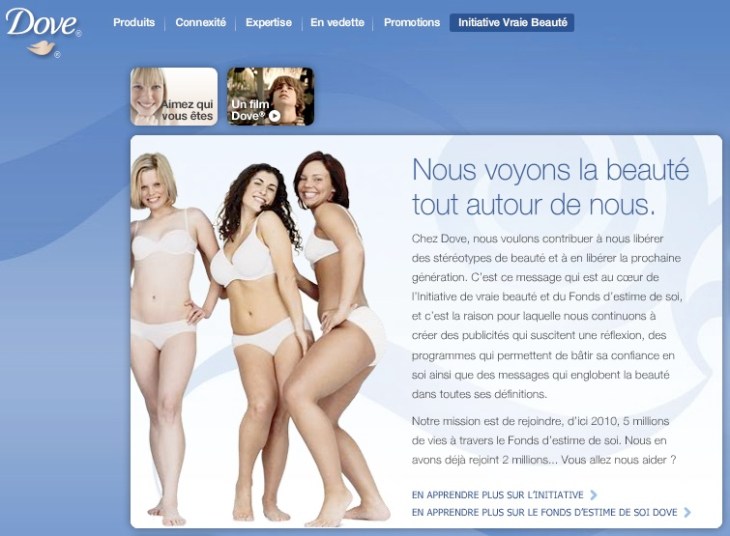
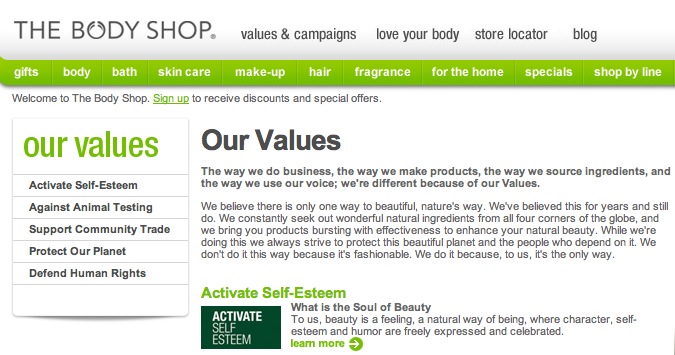
On peut néanmoins se demander s’il y a une différence (et surtout comment elle se manifeste en termes de marketing) entre la connaissance de soi telle qu’elle est évoquée dans cette étude, et l’image de soi telle que le Mercator l’aborde dans son approche du comportement des consommateurs. Les publicitaires jouent déjà sur cette image de soi, notamment en tentant d’améliorer l’estime qu’ont les consommateurs d’eux-mêmes. Exemples, dans la cosmétique :

Le Dove Self Esteem Fund

Une des cinq valeurs de Body Shop
Researchers develop a tool to track brand reputation on the web

The article is taken from the Journal of Retailing 85 (2, 2009, pages 145 to 158). The initial problem is pointed by the authors (Praveen Aggarwal and Rajiv Vaidyanathan from the University of Minnesota and Alladi Venkatesh from the University of California) is that with the wast amount of information available on the internet, there is no scientific method to analyse a brand’s reputation, based on what people (bloggers, reveiwers, retailers etc.) say about it. In this article called “Using Lexical Semantic Analysis to Derive Online Brand Positions : An Application to Retail Marketing Research”, the three researchers propose a “simple-to-use method that managers can utilize to assess their brand’s positionning“. More after the break.
Praveen Aggarval is PhD at the Marketing Department of the University of Minnestota (Labovitz School of Business & Economics, named after Joel Labovitz, businessman and patron from Duluth, MN), and Rajiv Vaidyanathan is Marketing Professor in the very same business school. Together with Alladi Venkatesh, Professor of Management and IT-expert from the University of California in Irvine, they stated the following problem : how can a product manager monitor, in a scientific way and based on the web content, the positioning of a brand?
Positioning a brand is, in marketing, the process of creating an identity and an image to a particular product or brand in order to differenciate it from its competitors. As we said in a previous article about the evolution of the brand-customer relationship, the web plays an increasing role in todays marketing, but this implies certain risks, which can be contra-productive. Without saying that product managers are losing control of their brands and products, they certainly have to deal with the multiplication of information sources about their products : blogs, customer reviews, retailer comments, comparative websites, tests etc. The retail industry is particularly competitive, that’s why branding is absolutely essential for managers (national brands as well as private brands).
In order to overcome these difficulties, the three specialists based their method on the semantic web (Berners-Lee, Hendler & Lassila 2001 ; Leuf 2006). Even if computers can’t understand text information, an analysis of the co-occurence of an adjective and a noun (brand, product) clearly give an insight of the web-users’ perception. To that extent, “the goal is to get a sense of the evaluation of brands in subjective sentences (…) by examining the association between the brand and various carefully selected adjectives or descriptors“. The aim therefore is to draw conclusions about the “brand’s online persona” based on a brand name + a certain adjective + a context.

To get the results, the three researchers basically used a beta version of Google’s API (Application Program Interface), which can be seen as the open-source part Google’s research program. The results returned (I leave the technical details aside, but the principle is to count pages that contain the brand name, and then those that contain the brand-adjective association) allow the draw a perceptual map, where differents brands can be compared. The analysis of P&G detergents reveal, for example, that Dreft and Ivory Snow (often associated with “baby”, rarely with “power”) seem to be perceived differently than Bold andEra (opposite results). The exception is the brand Cheer, to which both word are often associated. For Cheer and Era, we can note that the can design is identical, only te colour and the marketing “message” changes (typography, slogan etc.), which is apparently sufficient to differentiate the product images.


Further analysis is possible, for example on perfumes. The marketing researchers chose this particular product because of the importance of image and brand personality, “carefully crafted by marketers to position brands in a competitive marketplace“. Here, they point out the marketing efforts of brand managers. The method is particularly usefull for these marketers because of the “longitudinal analysis of a brand’s personality” that such monitoring permits. The conclusion states that their method does not account for negative qualifiers, what is quite suprising. I indeed wonder how such a study can be conducted if the tool does not differentiate “reliable”, “somewhat reliable” and “not reliable” ! But the authors ensure that “previous research has shown that the effects (of the polarity of the statements) are marginal (Pang et al. 2002)“. Very surprising…
Anyway, the method that the researchers developped enables marketing executives to track the positionning of their brands, particularly taking into consideration the dynamic nature of the web. In a moving environment, longitudinal tracking seems to become more and more important, and consumer understanding can be improved. Coped with consumer interaction, these means are strategic tools for web-based marketing.