Should Creative Crowdsourcing Participants Get Working Contracts And Salaries?

For one year, there have been two important legal events that could shape the future of the crowdsourcing landscape. First, on October 26th 2012, one-time Crowdflower worker Christopher Otey filed a lawsuit (PDF) against Crowdflower alleging that the platform violated the U.S. Fair Labor Standards Act. Second, on October 22nd 2013, a group of Yelp reviewers filed a class-action lawsuit (PDF) against the business review site, claiming that they are unpaid writers who are vital to the company’s existence. These two lawsuits are claiming Labor law applications to micro-task crowdsourcing activities.

Could this happen in creative crowdsourcing?

Up to this day, neither of these lawsuits -which have very similar claims- have been closed, which shrouds the entire crowdsourcing industry in a big question mark. In this post, I briefly describe these cases, clarify the legal situation in the U.S. and in France, and tell whether creative crowdsourcing participants should get working contracts with platforms and sponsors – or not. Continue reading →
To End 2013, Some Stats From The Crowdsourcing Timeline

Click to access timeline

Click to access timeline

It’s been a little more than a year that I started curating crowdsourcing initiatives by the World’s Best Global Brands on this timeline. As I write this, there are now 479 examples of crowdsourcing listed, with information about the initiatiors, objectives and results of each initiative – at least I try to keep it updated to the best I can! I’m extremely humbled that some of the brightest minds in business and academia (@lindegaard, @jtwinsor, @bogers, @klakhani, @masscustom)  also appreciate this timeline. As we are ending 2013 these days, and starting 2014, let me just share some facts based on this timeline’s data. Just scroll down and let the visualizations speak by themselves. Continue reading →

News Coverage About Crowdsourcing

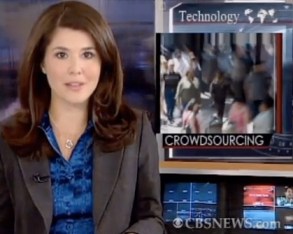
what is crowdsourcing CBS news

On this blog I’ve gathered academic representations of crowdsourcing, whitepapers about the same, or videos about crowdsourcing platforms by OVC – all of which I try to update regularly. But let’s be honest, this is mainly niche content that interests academics, thought leaders or crowdsourcing participants, and does not tell much how the rest of the world perceives crowdsourcing.

Yet, in a world where crowdsourcing is getting mainstream, it might be even more interesting to broaden our perspectives a bit, and to see how mainstream media treats the topic. If you look up “crowdsourcing” on YouTube you will find lots of conferences, panels, student projects and explainer videos. But what about real media coverage about crowdsourcing? Here’s a list of clips that discussed crowdsourcing in the news (mainly on TV), presented in chronological order (years). I will try to keep it updated.

Continue reading →

My Review of “How Emerging Market Brands Will Go Global”

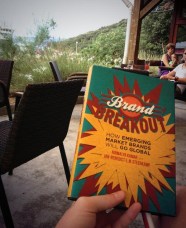
brand-breakout-bookIn October 2009, I covered the publication of the Best Global Brands ranking, underlining that none of the 100 brands came from emerging market countries in 2009. In one part of the report, called “Tomorrow’s Brand Leaders, Up-and-Coming Global Brands,” Interbrand China’s Jonathan Chajet nevertheless listed a couple of brands that could become global in a near future, like companies from China (Lenovo, Haier, Tsingtao), India (Tata, Reliance, ArcelorMittal), Russia (Kaspersky Lab, Aeroflot, Gazprom), South Africa (MTN, Anglo-American, SABMiller) and Brazil (Itaù, Vale, Natura). You can see some of them in my post (even if it’s written in German).

Some of these brands, like Lenovo, Haier, or Natura, are presented in a fascinating book called Brand Breakout: How Emerging Market Brands Will Go Global, by N. Kumar (London Business School) and J-B. Steenkamp (University of North Carolina), which I just finished reading. Based on extensive field and desk research, the authors present 8 strategies that brands are taking to go global (the Brand Aquisition Route for Lenovo, the Asian Tortoise Route for Haier or the Natural Resources Route for Natura, for example).

Continue reading →

The concept of the crowd: From troublemaker to problem-solver

Obama speaking in front of a crowd

Imagie via mrsmart.wordpress.com

What exactly is a crowd? Wikipedia says it’s “a large and definable group of people,” underlining that it’s a different concept than the mob (the so-called lower orders of people in general) or the masses (everybody in the context of general public). This post is not about the concept of the crowd in general, but about an academic paper that examined how the sociological concept of the crowd evolved over time. In Reconfiguring the sociology of the crowd: Exploring crowdsourcing, Mark N. Wexler from Simon Fraser University (Vancouver, Canada) discusses the way in which the crowdsourcing trend reconfigures the classical sociological treatment of the crowd.
Continue reading →

The Four Crowdsourcing Mergers & Acquisitions of 2012

pacman-illustration

I know some people don’t like calling it an industry, but let’s just use the term to coin the companies that use a crowdsourcing- based business-model. There are a lot of such companies, the first ones have been created in the early 2000’s, and platforms are still appearing today. Even though it seems tough to make money with crowdsourcing today, there is a variety possible strategies to generate revenue: taking a commission on transactions (like 99designs), developing and selling goods (like Quirky), invoicing on a project basis (like Zooppa)… for investors, there’s also the option on an IPO (like Blur Group) or an aquisition by another firm. It turns out that the latter has happened 4 times this year, with established actors purchasing stakes in smaller crowdsourcing firms. Let me describe these three cases, in three parts, and ignite a discussion about what’s next! Continue reading →

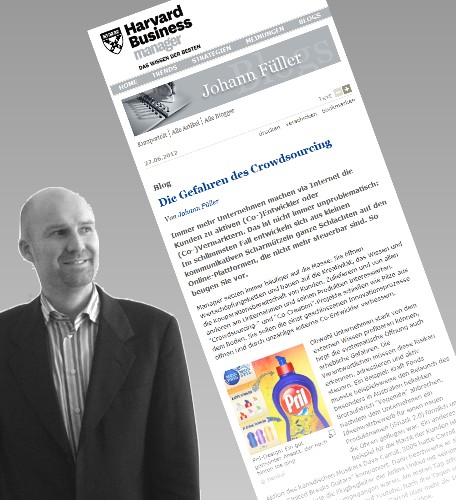
The dangers of crowdsourcing (Johann Füller’s post on Harvard Business Manager)

harvard-business-manager-blog-post

Johann Füller is CEO of Hyve AG, a company that organizes crowdsourcing for co-creation and/or open innovation purposes, and professor at the University of Innsbruck (Austria)

I already blogged about academic articles in French that should have been translated into English, because they’re pretty darn interesting and useful for people interested in co-creation or user innovation. This post is about a blog post that Johann Füller, an experienced researcher and businessman, wrote in German on Harvard Business Manager. It’s called Die Gefahren des Crowdsourcing (The Dangers of Crowdsourcing) and highlights some of the dangers that brands should be aware of before kicking off a crowdsourcing campaign. Not only does he give some examples, but he also cites 3 often encountered sources of crowd-resistance, as well as 5 ways to avoid failures. This post is an unedited translation, I only changed the illustrations and added a couple of links in the text. Continue reading →