Genius Crowds, Another Company That Failed to Turn Co-Creation Into a Profit

Genius Crowds is Out of Business

In May 2011, I covered the French platform Crowdspirit, and tried to discuss the reasons of its failure. In August of the same year, I wrote a blog post about the costs of co-creation, underlining that there are substantial costs to orchestrate crowdsourcing and/or organize co-creation, and that profitable platforms are actually rare. Well, very recently, crowdsourcing.org announced that a US-based crowdsourcing company, Genius Crowds, had to close its doors. Why? Because Genius Crowds was not able to turn their co-creative model into a profit.

“As a small startup, we frankly didn’t have enough resources to do the job of business development that we wanted to be able to do” (C.J. Kettler, CEO and co-founder) Continue reading →

Two Growing Crowdsourcing Start-Ups from France: Creads and Studyka

logos

The French start-up ecosystem is highly active and dynamic, comprising several crowdsourcing businesses (Creads, eYeka, Graphiste, Studyka, Wilogo are some of them). Some crowdsourcing platforms have vanished (Crowdspirit), some have just appeared (99designs.fr), and some have been silently growing since their foundation in the late 2000’s. I met the co-founders of two high-performers of the French crowdsourcing industry: Creads, which calls itself the participatory agency, and Studyka, which organizes challenges targeting students and young professionals. Here’s what they told me (it’s a long post ;-)) Continue reading →

The role of randomness in crowdsourcing

app-contest-dice illustration

I’ve just read a very interesting paper about crowdsourcing, authored by four researchers from Vienna (Austria). It’s called “Does god play dice?” Randomness vs. deterministic explanations of idea originality in crowdsourcing (PDF), will be presented in June at the 35th DRUID Celebration Conference in Barcelona (Spain), and argues that the originality of ideas in crowdsourcing contests is largely random (not determined by skills, expertise, creativity or motivations of participants or other deterministic factors). To come up with these results, they simulated an app contest sponsored by Apple and Orange.

Continue reading →

Comment Heineken utilise le crowdsourcing pour l’innovation et le marketing

How beer brands are driving growth

J’ai récemment lu une interview de Ellen Bark, responsable innovation chez Heineken, parlant de la stratégie d’innovation ouverte au sein de l’entreprise. Cette interview est publiée sur PSFK, en anglais, et je trouvais intéressant de la traduire en français pour la rendre accessible à davantage de personnes. Ce qu’elle dit est intéressant dans le sens où Heineken utilise le crowdsourcing via divers plateformes, comme je soulignais déjà en septembre 2011. Depuis, d’autres plateformes ont été lancées, et l’interview révèle bien la maturité de la marque lorsqu’il s’agit d’utiliser les idées de la foule pour le marketing et l’innovation. Voici la traduction de l’entretien (les illustrations ont été ajoutées a posteriori). Continue reading →

A review of “Crowdstorm: The Future of Innovation, Ideas and Problem Solving”

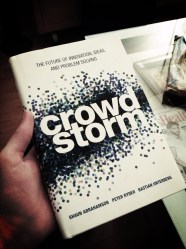
The crowdstorm book cover

If you’re a reader of this blog, you know my interest for marketing, innovation and the internet (see also my twitter words). In recent years, I’ve been increasingly blogging about co-creation and crowdsourcing, the latter being an innovative way to use the internet for marketing and innovation-related business issues. Crowdsourcing has become a widely applied technique, used in a variety of ways and for different organizational needs… but testimonials from those who actually do crowdsource are scarce (they exist, but there are still few of them).

Ross Dawson’s Getting Results from Crowds is one of the latest books… but the latest piece to fill the puzzle is Crowdstorm (“The Future of Innovation, Ideas and Problem Solving“), a book written by Shaun Abrahamson, investor and advisor, Pete Ryder, investor, athor and former director or Jovoto in America, and Bastian Unterberg, founder and CEO of Jovoto.

Shaun was kind enough to send me a signed version of the freshly pressed book (I love personalized stuff!), and here’s my review. I received Crowdstorm on Monday and finished reading it on Tuesday evening, that’s how much I liked it. Here’s my review.

Continue reading →

Companies increasingly use crowdsourcing strategicaly: Cisco’s I-Prize

crowdsourcing-design-competitions-representation

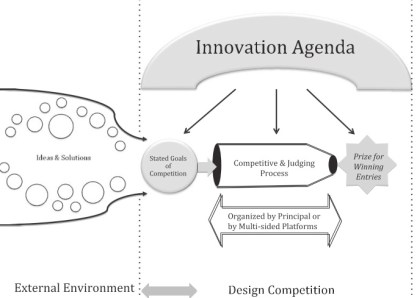
The visualization of “design competitions” as described by Lampel, Jha & Bhalla (2012)

Actually both brands and companies increasingly use crowdsourcing in their strategies: brands do it often for marketing and communication, companies do in for innovation. The latter has been described in a recently published article: Test-Driving the Future: How Design Competitions Are Changing Innovation, written by three London researchers, and published in Academy of Management Perspectives. It focuses on innovation-related crowdsourcing, like Cisco’s and GE’s challenges. Let me give some information about the former in this post. Continue reading →

The first (crowdsourced) timeline of crowdsourcing by brands

bubble-timeline-illustration

I’m happy to present the first visualization of the use of crowdsourcingby brands over time. This interactive timeline, called Crowdsourcing by World’s Best Global Brands, is built on Tiki-Toki, a tool to create timelines. Tiki-Toki turned out to be a good way to show how the use of crowdsourcing has exploded since the early 2000’s. The objective was indeed to have a rich and visual representation of how brands increasingly use of crowdsourcing to pursue marketing- and innovation-related business objectives. And the best part is: it will be crowdsourced. Continue reading →