One brand, different platforms (part 6) – GE embraces open innovation

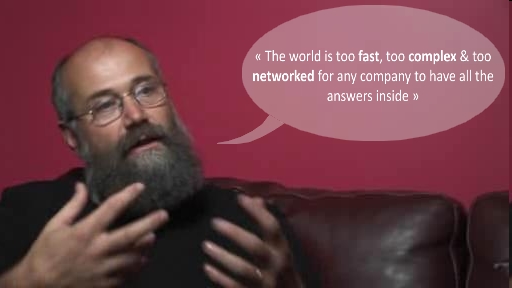
The world is too fast, complex and networked for any company to have all the answers inside

Yochai Benkler, author of The Wealth Of Networks

After our focus on Siemens’ online co-creation initiatives, where the focus seems to be on co-creating the future cities together, let’s have a look an another engineering giant: General Electric. GE is a very powerful brand, it ranked 5th in the last Interbrand ranking, but its position towards opening its business seems quite ambiguous to me. As you’ll read after the break, GE’s business is a particular (and diverse) one. Exactly like Siemens, GE has grown into a multi-activity conglomerate with a wide diversity of businesses, from which not everything can be opened-up somehow. Let’s have a look at how GE engaged in co-creation initiatives via the internet.


logo-big

Continue reading →

“La culture en clandestins”, le livre sur la rénovation de l’horloge du Panthéon

coupole et livre

La coupole du Panthéon, vu du coin droit en remontant la rue Soufflot. Sur la photo, on peut voir une voiture de la préfecture de police... dont l'UX se moque tant dans le livre

Ça fait longtemps que je n’avais plus écrit un billet en français sur ce blog, surtout concernant autre chose que la co-création, les plateformes communautaires ou mes poissons d’avril. Mais voilà, je suis maintenant parisien, et je voulais partager quelques passages d’un livre superbe sur Paris: La Culture en clandestins. L’UX. En fait, j’ai déjà abordé l’UX dans un billet précédent sur les marques de communautés, qui avaient été abordés dans un très bon livre de Bernard Cova. Vous n’avez put-être pas encore entendu parler de l’UX, mais peut-être avez-vous entendu parler de la rénovation (clandestine) de l’horloge du Panthéon, de 2005 à 2006? Partant du principe qu’une autorisation officielle serait trop longue et compliquée à obtenir, un groupe de passionnés du patrimoine a décidé de rénover cette partie invisible du patrimoine, au nez et à la barbe de l’administration du patrimoine. Dans ce livre, le porte-parole de ce groupe, raconte cette passionnante aventure… en se moquant de l’ignorance des responsables officiels! Continue reading →

A great read: Community Building on the Web

book cover

Old graphics on the book cover (the book is from 2000), but some very relevant content!

There’s a lot being said and written about communities on the web. Especially today, in the age of social networks and subscribtion-based websites… everything is communities! In a book from last year, La Communaué Illusoire, French sociologist Marc Augé argues that (1) the term “community” is overused, (2) that they are only meaningful if they’re meaningful to their members, and (3) that, rather than building communities with frontiers, we should think about building communities to encourage exchange and communication.

Anyway, web-based communities are now ubiquitous, and one of the first books that has been written about them is Community Building on the Web: Secret Strategies for Successful Online Communities (Kim, 2000). Let me share some excerpt.

Continue reading →

Indian crowdsourcing-platform JadeMagnet bets on franchising to fuel its growth

portrait-in-street

Manik Kinra, on the left, is Chief Marketing Officer of Jade Magnet (via businesstoday.com)

Today, renown graphic design platforms include Crowdspring (USA), Creads (France), 99designs or Designcrowd (both Australia). An Indian challenger, who recently expanded to the US, the UK and is making inroads into the Middle-East, is pushing with a community of 15,000 creatives – and an innovative growth model. I talked to Manik Kinra, who founded Jade Magnet about two years ago with his friend Sitashwa Srivastava. Here are some excerpts of an interesting conversation about crowdsourcing, local cultural knowledge and ambitions for growth. Continue reading →

Three great articles about consumer innovation that should have been written in English !

engraving

Gustave Doré’s éngraving The Confusion of Tongues (1865) is a wonderful illustration of the Tower of Babel (in the back)

As a young PhD student, I’m reading quite a lot of papers about co-creation, crowdsourcing, creativity etc. I have the luck to be able to read in French, German and English, which broadens the scope of papers immensely! In this post, I want to share a couple of papers that have not been published in English… but definitely should have! One example is this paper about types of customer co-creation, which has first been published in German, making it unavailable to all those who don’t speak Goethe’s language! Luckily, it has recently been published in English one year later, and it’s even available for free in this book. Unfortunately, I can think of other papers that would probably help a lot of people if they had been translated into English! Here are some of their findings. Continue reading →

One company, different platforms (Part 5) Unilever manages co-creation for its various brands

The world is too fast, complex and networked for any company to have all the answers inside

Yochai Benkler, author of The Wealth Of Networks


In the previous posts of this series (about Danone, Heineken, Coca-Cola and Siemens), I used the expression “One brand, different platforms” to talk about brands’ online co-creation efforts. This time, it’s more appropriate to say “One company, different platforms“, because Unilever is not really a brand for the general public, much more known are brands like Axe, Sunsilk, Becel or Knorr. Well all of these brands have engaged in a form of co-creation in a way… and here’s how.


logo

To find out more about Unilever's logo, click on the image

Continue reading →

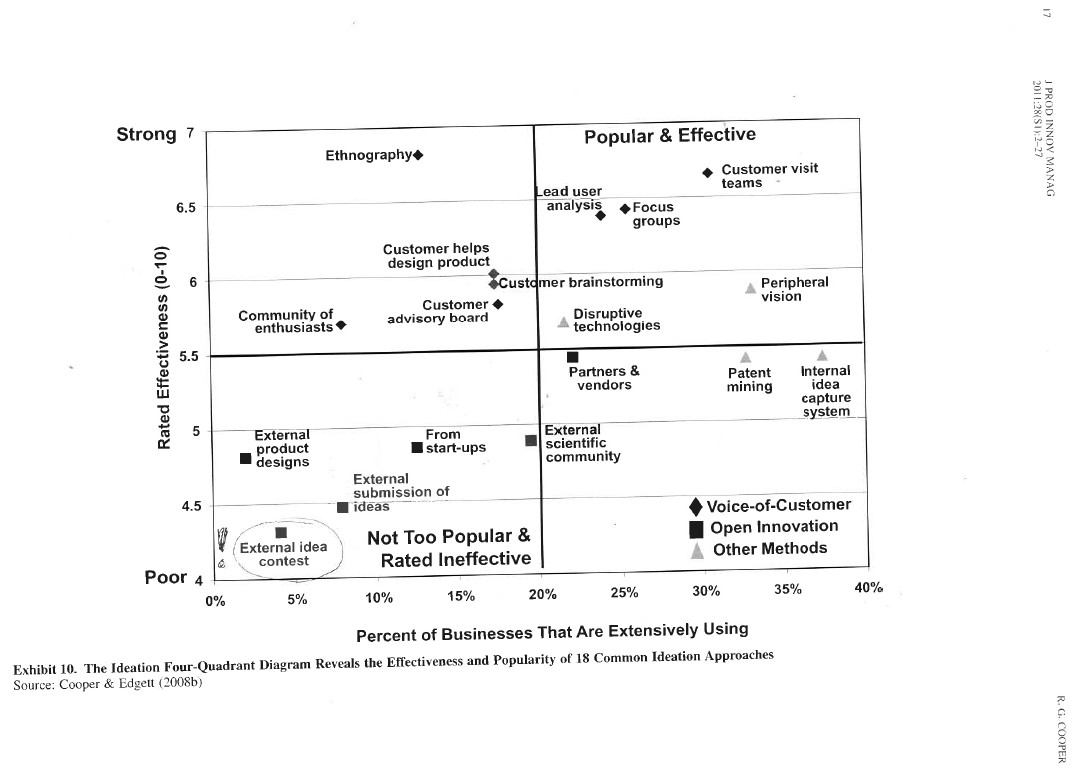
Are external idea contests really unpopular and uneffective?

diagram

Robert G. Cooper's diagram on common ideation approaches


In the last issue of The Journal of Product Innovation Management, Robert G. Cooper, inventor of the Stage-Gate process for new product development, ranks 18 popular ideation approaches according to popularity and effectiveness. In his article called The Innovation Dilemma, it’s interesting to read that he says that “few of the open innovation methods were found to be either particularly popular or effective” before highlighting that “the fact that open innovation is relatively new and is yet to be proven over time“.  He also says that “seeking ideas from outside […] applies best to a handful of industries, such as consumer goods“…

Continue reading →