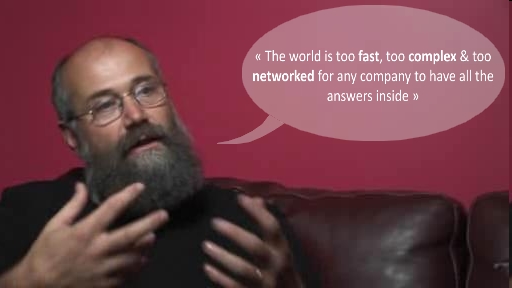
Crowdsourcing is a lot less anxiogenic than actual co-creation – Bernard Cova’s critical and insightful perspective

portrait

When you think about co-creation litterature, depending on what type of litterature you read, you might think of academic publications like SD-Logic or  Co-Creation Experiences, or you might think about business publications like The Future of Competition or The Power of Co-Creation. These types of publications are not opposed to one another, rather are they complementary in the emergence of trends, says Bernard Cova, professor at Euromed Management Marseille. According to him, there is a general pattern of amplification in consumer research: post-modern sociologists like Michel de Certeau describe general consumption trends, marketing-sociologists (or socio-marketers) like Patricia Seybold illustrate these trends with updated examples and approaches, and new marketing propagators like Venkat Ramaswamy spread the word to broader audiences like the mass media and business (Cova & Cova, 2009). I recently spoke to Bernard Cova about his view of co-creation. Continue reading →
When co-creation turns sour: upset co-creators and deceiving results

never underestimate the power of stupid people in large groups

A couple of weeks ago, I attended an interesting conference by Geoff Mulgan about social innovation. Before leaving, I briefly asked him what he thought about the Open Innovation pendant of social innovation, and he replied in substance that “it’s an interesting approach, but it hasn’t made its proofs on the large scale. Also, there nothing out there about failed co-creative initiatives, which is nots“. And indeed, there’s not a lot of self-criticism among co-creation / crowdsourcing / open innovation actors, which – I think – would be a wise and healthy initiative. Before waiting this to happen, let’s take a look at some unfortunate initiatives… and see how these cases can improve co-creation efforts. Continue reading →

Academic representations of crowdsourcing, co-creation and open innovation

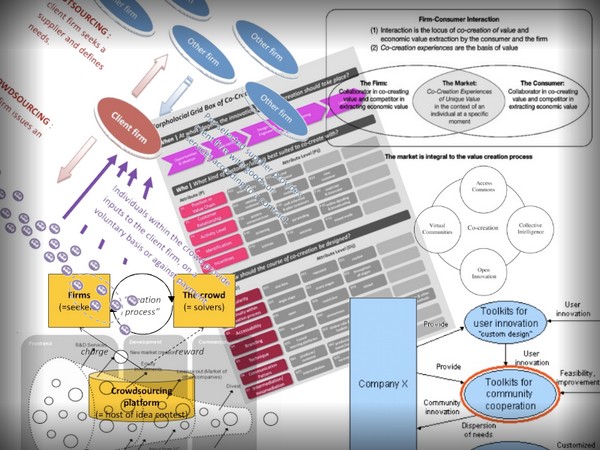
mixed-visualizations

As part of my work as a PhD student, I read lots of papers about open innovation and/or participative marketing. These papers are highly interesting but, I must admit, sometimes a little repelling with huge chunks of texts, references and citations. Visualizations of the described phenomena are greatly helpful to understand some of this information… I thought it would be interesting to gather a couple of visualizations of my research interests: crowdsourcing, co-creation and open innovation in a blog post ! This is not only quite entertaining, but might help people out there find new sources. Here we go… [this post was last updated on October 6th 2015] Continue reading →

One brand, different platforms (Part 4) Siemens wants people to reinvent cities

The world is too fast, complex and networked for any company to have all the answers inside

Yochai Benkler, author of The Wealth Of Networks

After Danone, Heineken and Coca-Cola, who all have fairly different approches to engage consumers via de internet, this post is about the German conglomerate Siemens. Siemens does A LOT of things: from consumer products to communication networks, from healthcare to financial solutions, from lighting to hearing solutions… quite a lot of potential to co-create upon! Siemens sttarted with an internal knowledge management system called ShareNet in 2002, let’s now have a look at how Siemens pilots its innovation efforts by opening up to external knowlegde.

logo Continue reading →

What creative consumers craft with old bikes: my favorites of the Scraplab Design Contest

banner

(Image via scraplab-community.com)

The crafting movement is taking off since a couple of years now. Websites like Etsy or Sugru are examples of communities that gather around modifying and showcasing creative peoples’ crafts, recycled objects of self-designed decoration (you might also want to check out IKEA Hackers, the blog). On this blog, I’ve already covered this trend through a book review of Marke Eigenbau (“Brand DIY” in German) or a documentary about Arduino electronics. In the last two and a-half months, an online contest was organized to gather these creative peoples’ crafts and objects: the Scraplab Design Contest. As a fan of cycling, I wanted to showcase the most interesting cycling-related designs/crafts that came up. Continue reading →

With the b’Twin Lab, Oxylane launches its first branded co-creation platform (dedicated to cycling)

iphone-app

The b'Twin club of riders, which is accessible on the web and on smartphones, now has it's co-creation pendant du fuel innovation


The Oxylane group, (still) known as Décathlon, is one of the most innovative actors in sports, whether it is in designing, engineering and retailing great products that appeal to a large market. Led by designers such as Philippe Picaud, the French manufacturer and retailer not only innovates with very popular products, but they also succeeded in building private brands with a strong identity and high appeal. Today, “Oxylane’s global strategy is to open up the innovation process towards those who do sports and use all these products in their practice“, told me Sylvain Venant, Brand Innovation Manager for b’Twin (the cycling brand of Oxylane). A first step had been taken with the creation of a b’Twin Village  in the north of France in November 2010: it’s a venue that could be described as a mixture between a shop, a design center and playing field, where customers meet and interact with product managers and designers (and, of course, salespeople!). Now, a second step is the opening of a dedicated co-creation space called b’Twin Lab. Continue reading →

When co-creation is more entertainment than social product development: Quirky “reinvents the bicycle” in 24 hours


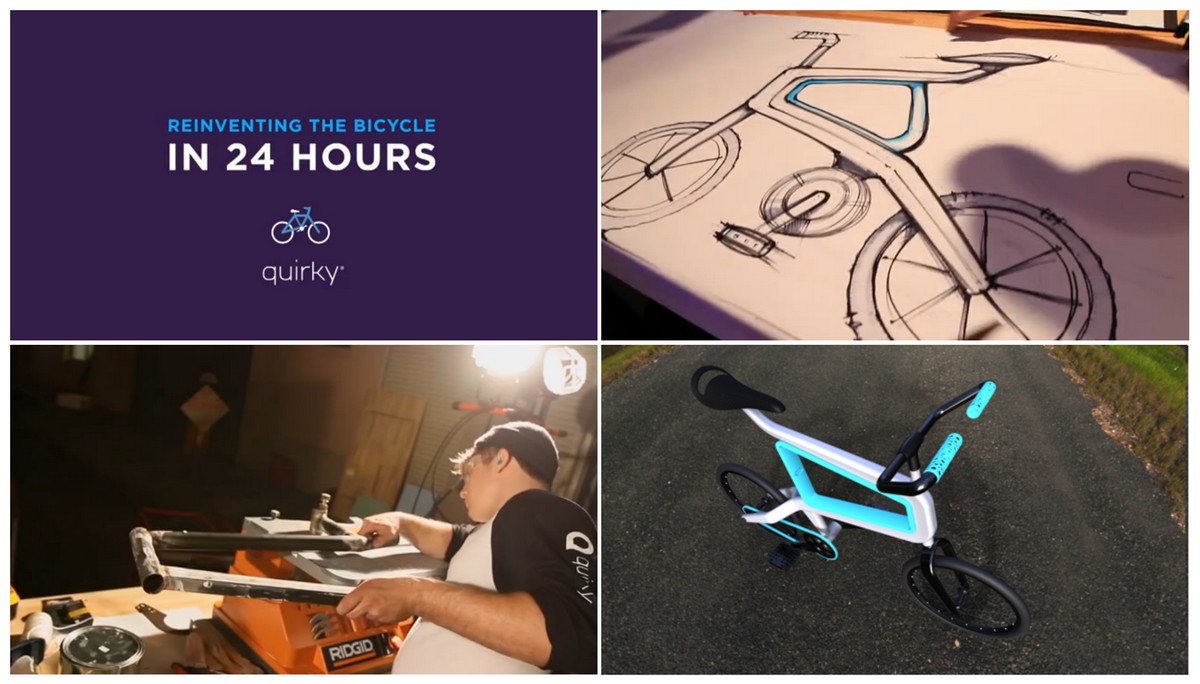
Nowadays, bikes are trendy. The industry is growing, mainly thanks to trends like eBikes and fixies, that broaden the target audience of cycling conciderably. The popular social product development platform Quirky recently decided to Reinvent The Bicyle in a 24h brainstorm on its platform, and the above image shows the outcome of the brainstorm, designed by Quirky’s design team in San Francisco, CA. Let’s have a look at the process… and the resulting bike, Modus. Continue reading →