The concept of the crowd: From troublemaker to problem-solver

Obama speaking in front of a crowd

Imagie via mrsmart.wordpress.com

What exactly is a crowd? Wikipedia says it’s “a large and definable group of people,” underlining that it’s a different concept than the mob (the so-called lower orders of people in general) or the masses (everybody in the context of general public). This post is not about the concept of the crowd in general, but about an academic paper that examined how the sociological concept of the crowd evolved over time. In Reconfiguring the sociology of the crowd: Exploring crowdsourcing, Mark N. Wexler from Simon Fraser University (Vancouver, Canada) discusses the way in which the crowdsourcing trend reconfigures the classical sociological treatment of the crowd.
Continue reading →


Skoda launches co-creation platform to crowdsource insights in China

skoda co-creation platforms screenshot

Click to get to the platform

As articles on Campaign disappear after a couple of days, being only available to paid subscribers, I thought I would do a blog post about Skoda’s latest co-creation/crowdsourcing initiative in China: the www.congmingzhuyi.com platform. It’s Campaign China that reports about this initiative, orchestrated by Leo Burnett Shanghai, that aims to gather consumer ideas about making driving, both inside and outside of the vehicle, more fun. Continue reading →

The Four Crowdsourcing Mergers & Acquisitions of 2012

pacman-illustration

I know some people don’t like calling it an industry, but let’s just use the term to coin the companies that use a crowdsourcing- based business-model. There are a lot of such companies, the first ones have been created in the early 2000’s, and platforms are still appearing today. Even though it seems tough to make money with crowdsourcing today, there is a variety possible strategies to generate revenue: taking a commission on transactions (like 99designs), developing and selling goods (like Quirky), invoicing on a project basis (like Zooppa)… for investors, there’s also the option on an IPO (like Blur Group) or an aquisition by another firm. It turns out that the latter has happened 4 times this year, with established actors purchasing stakes in smaller crowdsourcing firms. Let me describe these three cases, in three parts, and ignite a discussion about what’s next! Continue reading →

Does Common Culture Affect Work Attribution in Crowdsourcing?

screenshot

Click to see the working paper

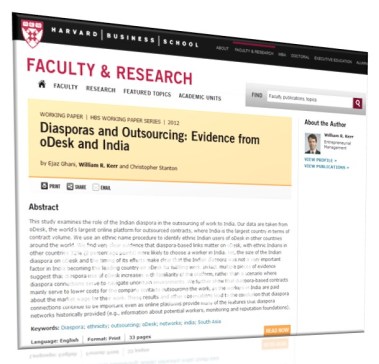
Crowdsourcing fundamentally transforms the way we work, particularly in creative industries or – on the other hand – in the execution of low-qualification tasks with platforms such as MTurk or oDesk. I’ve recently read a working paper about the latter, the marketplace for work oDesk (which has an army of researchers, mostly to analyze log data, see these cool visualizations). This paper particularly seeks to understand how culture impacts the attribution of work to people via oDesk. Or in other words: Do Indians from abroad attribute work more to Indians from the home country than to others, with similar qualification? Continue reading →

Ross Dawson’s Second Edition of “Getting Results From Crowds”

book cover photo

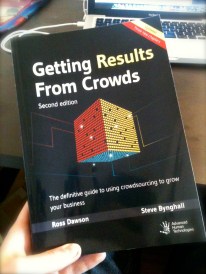
Ross Dawson, one of the most active (and objective) promoters of crowdsourcing, has recently announced the launch of the second edition of his book, Getting Results From Crowds, co-authored with Steve Bynghall. I already have the first edition, but purchased this one anyway as it has three new chapters about possible applications of crowdsourcing: Crowdsourcing for small companies vs. big corporations, crowdsourcing for marketing, and crowdsourcing for media and content. Here’s a very brief review of the book. Continue reading →

Présentation sur le crowdsourcing à La Cantine Numérique Rennaise

J’ai eu le plaisir d’intervenir à La Cantine Numérique Rennaise hier, dans le cadre d’une rencontre sur le crowdsourcing organisée par le Social Media Club de Rennes. Je viens de mettre ma présentation en ligne:

La rencontre était organisée par Anthony Chénais, et une présentation intéressante a également été faite par Nicolas Kayser-Bril sur le crowdsourcing dans le journalisme et les mouvements citoyens ; passionnant! Merci à tous ceux qui sont venus nous écouter et échanger avec nous, n’hésitez pas à me contacter si vous avez des questions ou des remarques.

Juste quelques liens utiles (tirés de ma présentation, puisque Slideshare ne copie pas les liens hypertexte visiblement):

How Pepsi engaged the Chinese youth with creative crowdsourcing

screenshots

The world’s first timeline of crowdsourcing by brands is being constantly updated with past and present cases, and there are now more than 200 crowdsourcing initiatives featured – lots more to come (I just need to find the time…)! In this post, I’d like to present one of the first crowdsourcing examples that has been of strategic importance for a brand in a local market: Pepsi’s Creative Challenges in China. Even before the well-known Pepsi Refresh Project, this series of crowdsourcing initiatives have allowed the brand to get consumers’ attention in the country. Here’s how. Continue reading →