Cyclisme : courir en compétition aux Etats-Unis

riders

"Pimp My Bike" : des LEDs sur la fourche du vélo pour un critérium nocturne, la classe !

Avant de partir aux Etats-Unis (Floride) pour mon semestre académique, j’ai longtemps cherché des informations sur les courses cyclistes et la possibilité de courir en compétition dans le pays de l’Oncle Sam. N’ayant rien trouvé sur le site de la Fédération Française de Cyclisme, ni sur le site d’USA Cycling, je vous donne là quelques informations pour les français (ou autres étrangers) voulant courir aux USA avec une licence étrangère.

  • Les catégories

En France, les catégories sont les suivantes, par ordre croissant : Pass’Cyclisme, 3ème catégorie, 2ème catégorie, 1ère catégorie puis élite. Il n’est possible de courir des courses FFC qu’en étant affilié à cette fédération, et donc de faire partie d’une de ces catégories. D’autres possibilités que je me permets de décrire comme des catégories “loisir” existent également, mais il n’est pas possible de courir des courses officielles FFC avec ce type de licence.

Aux Etats-Unis, les catégories de compétiteurs sont très similaires. Par ordre croissant encore : Category 5, category 4, category 3, category 2, category 1 puis pro. Il est courant là-bas de commencer la compétition en “cat.5” et de monter au fur et à mesure que les résultats s’améliorent (et que – donc – les points USA Cycling augmentent). Les “cat.5” et “cat.4” correspondent donc aux Pass’Cyclisme en France, les “cat.3” aux 3ème catégorie etc. Pour un coureur étranger, français dans mon cas, il est donc recommandé de courir dans la catégorie qui est indiquée sur la licence française. Dans mon cas (je suis 2ème catégorie en France), je courrais donc des courses auxquelles les “cat.2” avaient le droit de participer.

start

L'arrière du peloton cat.3/cat.4 au départ des championnats de Floride 2010 de critérium à Lakeland, FL

Attention, les catégories de VTT (X-Country) sont différentes : elles vont par ordre croissant de category 3 à category 1, jusqu’à pro. Il est possible d’être “cat.1” en VTT et d’être “cat.5” sur route, par exemple, lorsque le coureur est meilleur en VTT que sur la route (c’était le cas d’un coureur que je connais là-bas)

Dites-moi si je me trompe, mais il me semble que cette classification s’applique au pays entier, quel que soit l’état dans lequel on se trouve. Ça paraît logique.

  • Les clubs

Pour courir sur les courses labellisées USA Cycling, il est nécessaire de posséder une licence de compétition, qu’elle soit américaine ou étrangère. Les clubs sont, comme en France, affiliés à la fédération nationale USA Cycling et je n’ai pas remarqué de différences majeures avec le système des clubs français. Une petite différence est  qu’il n’y a pas de structures équivalentes à nos DN1/DN2, les très bons coureurs se trouvent soit en “cat.1”, soit dans une équipe “domestic pro” comme UnitedHealthCare, JellyBelly, Kenda etc. Il y a aussi les “developement teams” comme Trek-Livestrong-U23 ou Hincapie Developement Team où courent de très bons coureurs juniors et/ou espoirs.

Dans la ville (Pensacola, FL) dans laquelle se trouve l’université (UWF) dans laquelle je suis allé étudier, il y avait deux clubs de compétiteurs : Subaru-TSCyclones (route et VTT) et Weber Sports Racing (route). Ces deux équipes avaient des coureurs de catégories 5 à 2, jeunes et anciens, hommes et femmes. J’ai moi-même couru pour la deuxième équipe, puisque le hasard des rencontre l’a voulu comme-ça, mais j’ai couru aussi avec la très sympathique équipe Subaru. Pour la liste complète des clubs de Floride, cliquez ici.

Comme en France, il existe aussi des clubs plus cyclosportifs qui participent à des courses de bienfaisance ou autres événements cyclistes. A Pensacola, un de ces clubs est celui des West Florida Wheelmen.

  • Les courses

Au Sud-Est des Etats-Unis, où j’ai couru, il y principalement 2 types de courses : les “races” et les “rides”.

Ce qui est le plus proche de nos courses FFC en France sont les “races” que l’on peut trouver sur USACycling.org, qui sont soit des critériums, des courses sur circuit ou en ligne, ou des courses par étapes plus ou moins longues. En général, le même événement permet à toutes les catégories de participer, et ce dans différentes course qui regroupent des coureurs de niveau similaire.

road

Une des courses du Sunny King Criterium 2010 dans la journée du samedi 17 avril

Un exemple : le Sunny King Criterium rassemble des coureurs de toutes les catégories, de tous les âges et des deux sexes sur une journée de course dans le centre-ville d’Anniston, dans l’Alabama. Tôt dans la journée il y a les courses pour les jeunes, puis il y a celles des masters, celles des cat.4/cat.5 et cat.2/cat.3, et finalement celles des pro/cat.1 (femmes puis hommes). Un même concurrent peut, s’il le veut, participer à différentes courses le même jour s’il en a le droit. Étant donné que les critériums sont très courts (de 30 minutes pour les cat.4 ou cat.5 à 80 minutes pour les pro/cat.1). Sachez aussi que les frais d’inscription sont assez élevés sur ces courses, souvent plusieurs dizaines de dollars. Les inscriptions se font en ligne via des sites comme SportBaseOnline ou BikeReg.

Les “rides”, quant à eux, sont des cyclosportives rassemblant des coureurs licenciés et non-licenciés. Des exemples là où j’ai couru sont Rouge-Roubaix (Louisiane) ou encore le Cheaha Challenge (Alabama), deux courses assez mythiques dans le sud du pays. Ce sont là deux “century-rides”, ce qui fait référence à la longueur du parcours : 100 miles (autour de 165 km). Le niveau peut être très relevé comme l’était celui de Rouge-Roubaix en 2010, auquel j’ai participé.

Piedmont-Alabama

Le départ du Cheaha Challenge 2010

  • Le niveau

On peut se demander comment est le niveau des courses de l’autre côté de l’atlantique, par rapport au vieux continent (du cyclisme). Et bien j’ai trouvé que les catégories similaires aux nôtres reflétaient bien le niveau des coureurs. Les catégories 4 et 5 rassemblent les débutants et le niveau augmente avec les catégories. Il m’a semblé que les cat.3/cat.2/cat.1 étaient assez équivalentes à nos 3ème, 2ème et 1ère catégories. Par contre, j’ai eu l’impression que les “domestic pro” n’avaient pas le niveau des coureurs d’équipes “continentales pro” en France. J’étais étonné de me retrouver parmi les meilleurs de la Foothills Road Race (le même jour que le Cheaha Challenge) avec les pros, peut-être n’aiment-ils pas les bosses du parcours…

Cela est peut-être lié au fait que les courses étaient courtes et que les américains se spécialisent davantage sur les critériums (courts) que sur les courses en circuit ou en ligne. Je ne suis pas sûr… Pour terminer, j’ai remarqué quelques différences de niveau entre états dans lesquels on a couru : les cyclistes de Géorgie et de Floride du Sud semblent avoir un niveau plus élevé que ceux de l’Alabama ou du Mississippi. Encore une fois, ce n’est qu’un ressenti et cela se limite aux courses auxquelles j’ai participé.

peloton

Les meilleurs se retrouvent rapidement dans un premier peloton dans Rouge-Roubaix, ici à l'entrée de la 2ème des 3 sections de chemins de terre

What caused Shimano’s Coasting-program to fail ?

A couple of weeks ago, I noticed that the Coasting-website (coasting.com) was not online anymore and that the landing page was Shimano’s corporate website, Shimano.com. Just before writing this, I googled it again and there is shimanocoasting.com again, on the bottom of the page, just behind the link to my blog post (results may vary from country to country) ! Did I make a mistake, in March, when I was looking for the website ? Did I just miss it ?

But more interestingly, what bugs me is : What caused the Coasting program to fail ?

transmissions

Looks cool, but didn't sell. Why ? (photo from ohgizmo.com)

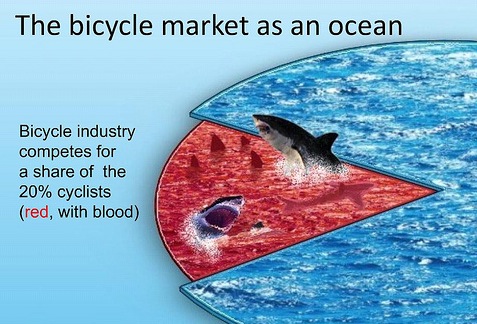
In a very interesting guest post on BicycleDesign.net, designer Mark Sanders basically talks about the cycling market as bunch of companies which sell high-priced bicycles to enthusiast cyclists (he calls them red oceans of enthusiasts). On the other hand, you have the mass-merchandisers selling very low-priced bikes in chain stores and supermarkets, targeting the mass of shoppers. Since these two approaches make companies compete on very “crowded” markets with low margins, we can indeed talk about red oceans that Kim & Mauborgne’s describe in their theory on business strategy, the Blue Ocean Strategy. In this theory, companies achieve growth by creating innovative ways to satisfy customers’ needs (differentiation), thus avoiding the high costs that incurr in highly competitive markets, and also driving up value for these customers. So is the cycling industry an unattractive industry ? According to Sanders, yes. I also think about an interview (in Institutional Investor of April 2005) of Martin Schwartz, CEO of Dorel Industries that I read when I got interested in Schwinn’s history ; he says that “bikes, it’s true, is not a great industry, but someone has to be the best, and Pacific (bike division of Dorel, ed) is the best by far“. Shimano seemed to having recognized that, and that’s where the industry-giant worked with IDEO, a global design consulting firm, to find a solution : Coasting.

pie-chart

Illustration by Mark Sanders (www.cyclelicio.us)

The previous paragraph relates to both the Blue Ocean theory (2005) and the Design Thinking theory (2008) to describe Shimano’s initiative. IDEO is even run by the guy who wrote the HBR-article on Design Thinking, Tim Brown. So Shimano was basically advised by one of the leading strategists in the world, but about 3 years after the lauch of the Coasting product-line, the program was abandoned because it didn’t generate the expected commercial success that Shimano hoped for. The program thrilled the design-community (California Design Biennal Award for Giant in 2007, International Design Excellence Award in 2008), was praised by journalists and commentators (L.A. Times or Cyclingnews.com in 2007), but sales didn’t follow. Why ?

Several reasons cross my mind, and I’d like to have your feedback to contribute to the discussion…

  • Design process ?

Shimano’s brief for IDEO was more or less as follows : help it create a $1,000, tech-laden bike that would lure baby boomers and their loose change off the couch (bicycling.com). It is very common in the design process that the consulting firm reformulates this brief, and it indeed proved to be necessary. Aaron Slar, social engineer for IDEO, and David Lawrence, marketing manager for Shimano travelled to different U.S. cities to find out what people think about bikes and biking and discovered all these things about people being intimidated by technology and basically wanting to get the feel-good biking experience they remember from their childhood. The prototype had grinded lugs and cable routers, a coaster brake and, more importantly, an invisible shifting mechanism. When IDEO presented their findings and recommendations to Shimano in Japan, “there was a long pause on the conference call. And it wasn’t just because of the translation“, says Lawrence. But the company rapidly got convinced, and started seeking partners within the industry.

screenshot

An extract from Tim Brown's HBR-article on Design Thinking. Inspiration, ideation & implementation are represented here by examples

This design process seems to have gone through the traditional steps, from understanding to prototyping and testing. Actually, I found few information about this “testing”-step. Who did Shimano and IDEO work with when they testes their prototype(s) ? Where there improved V2 and/or V3 versions based on customers’ feedback ? This would be interesting to know.

  • Industry involvement ?

According to Daniel Gross, manufacturers associated in the Coasting-project (3 in the first year, 10 the year after) were rapidly found and seemed enthusiatic about the idea. Giant adapted bikes from its Suede product-line, Trek & Raleigh created bikes, the Lime and the Coasting. Today, the Shimano Coasting website shows 7 models from 7 different brands : Schwinn, K2, Phat, Fuji and the 3 brands that started with Shimano. I wonder what caused the number of manufacturers to drop ? They were indeed 10 in 2008, why did Sun, Jamis & Electra quit the program ? One possibility is that Shimano could not handle working closely with these 10 manufacturers and needed to skim off the least motivated ones… While some talk about a synergy between this major supplier and manufacturers, I wonder if the manufacturer’s didn’t think that Shimano would get too powerful if Coasting was a success ? Would have one single bike manufacturer have been more successful with the Coasting-approach ?

group

The Shimano Coasting automatic transmission-group (photo shimano.com)

Shimano’s goal was to get 1,000 U.S. retailers involved the first year. In 2008, two years after the lanch of the group, industry consultant Jay Townley of Gluskin Townley Group said retailers were still hesitant to adopt the new product. To improve this situation, Shimano sent them an explanatory DVD and did set up a dedicated website, sellingcoasting.com. But even this kind of initiatives did not make sales take off. When I talked to a bike dealer here in Pensacola he wasn’t very convinced by the Lime’s (Trek’s Coasting-model) ability to reach a new target of customers. If bike vendors don’t grasp it, the customer probably won’t either…

  • Marketing mix ?

PRODUCT : Did the consumer know what was actually sold by Shimano ? The company only sells the transmission and shifting-system by its Coasting group. This product is then mounted on the bikes by manufacturers, who sell the bicycle through independent bicycle dealers (IBD) in the United States. But Coasting is also a concept, a lifestyle, a new way of designing riding experience. I think it was made too hard for the customer to identify what he was actually buying : did he buy a Trek ? a “Coasting” ? a Shimano ? Who made what on this bicycle ? Why change the shifting-system ? I think it was not Shimano’s role to directly adress the customer, it is still the bike brands’ job to sell their products.

PRICE : The 3 initial Coasting bikes sold between 400$ and 700$. The Trek Lime’s retail price was roughly 500$, which is a fair price for a quality bicycle. It is half the price of what Shimano initially suggested to IDEO in the design brief. The aim of this pricing strategy was obviously to make bikes affordable to a large public who doesn’t ride bikes. I think the price was not a reason for failure, it was more that Shimano and, more importantly, the manufacturers were not able to communicate the benefits of Coasting to retailers and customers.

bike

The K2 Easy Roller is (was?) available at 600$. Quite a bit for a bike with no handlebar-brakes (photo from besportier.com)

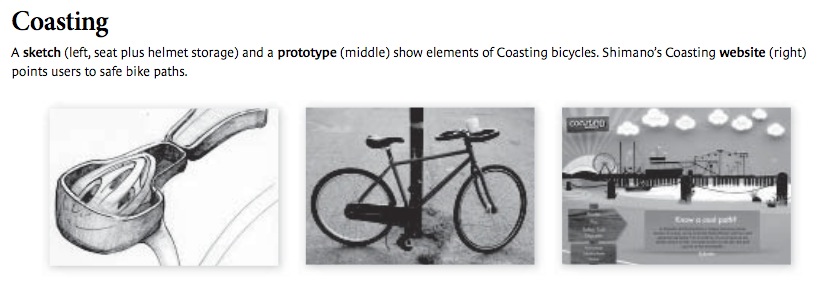
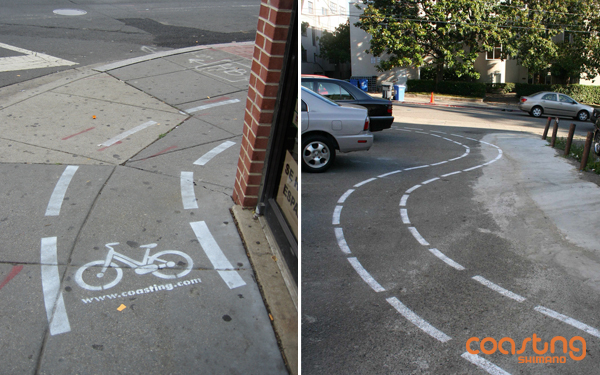
PROMOTION : The promotional strategy was intended to convey this feeling of freedom of riding a bicycle and to draw non-cyclists to the stores that sold Coasting. Newspaper advertising and guerilla marketing were used to increase awareness of Coasting, and the website Coasting.com was central to explain the concept and present bikes to consumers. The design of this flash-based website is fun and interactive, storytelling is used to involve the visitor (storytelling is part of the Design Thinking process, according to Tim Brown) and content encourages people to get on their bikes. Ideally Coasting bikes. Beside this, a demo-tour was also organized in several U.S.-cities to bring the bikes to the poeple and encourage PR & publicity.

bike-lanes

The Fineline used outdoor stencils (with environmentally friendly spray chalk) to create life sized coasting paths everywhere (photo from the-fineline.net)

PLACE : Coasting was intended to the U.S.-market only, and it has been launched in cities like Orlando or Phoenix before the whole country was covered in 2008. Shimano and the bike brands chose to sell their products exclusively at IBDs. I think this is one of the reasons that caused Coasting’s failure : while the website is a good way of presenting the concept/product/bikes, poeple are often unfamiliar with the specialized bike stores and bike-enthusiastic vendors. Why not selling through the web ? Was the reliance on a retailing network so important ? It might have avoided some obstacles too… But more than seeing problems on the U.S. market, I think that Shimano should have tried to introduce Coasting (or a similar technology, with a different marketing approach) into less mature markets like China, India and other emerging countries. Or even (very) mature markets like Scandinavian countries and the Netherlands, where product acceptance might have been higher.

VERDICT ?

The future of Shimano’s Coasting is unclear. On the internet, Coasting.com vanished and ShimanoCoasting.com has appeared, the content is unchanged. As I said in a previous post, the program has been abandoned by Shimano because sales never attained the expected figures. I think there was a huge potential in this approach, and this post explains some points that could have led to Coasting’s deceiving results.

What do you think ? Do you have more informations ? More ideas ?

Prison Valley, ‘Prison-nomics’ in Cañon City, Colorado (web-documentary)

logo

It’s exam period at UWF and I am studying my various courses : Marketing Strategy, Information Sources for Business Decisions, International Business and Current Social Problems. In the course material of the two last ones, I read content that made me want to watch that documentary I had heard about a couple of times now : Prison Valley. While we extensivelly discusses the crime issue in our Current Social Problems-class, the part of our International Business-class about privatization of public services as a way of achieving growth in global service industries (like prison management) pushed me to type http://prisonvalley.arte.tv/ into my browser. Here’s what it’s about… and what I think about it.

In Cañon City, Colorado (36,000 inhabitants, 13 prisons), prisons are part of people’s daily lives. There’s even a sense of pride to being host-city of this industry : orange, the color of the inmates’ uniforms, is overrepresented on the streets. The Riviera Motel, in which David Dufresne and Philippe Brault, the two producers of the web-documentary, stayed during their journey, is all orange.

One in six employees of Colorado’s Department of Corrections works in the small Fremont County, the county of Cañon City. But the importance of the prison industry is not a local, nor a statewide specificity : it is a national issue. While in Germany there are 93 prisoners per 100,000 country residents and in France they are 103 per 100,000 people, in the United States they are 750 ! This is more than 1 in 100 adults… I see this as a social problem, and some of Canon City’s inhabitants share the same opinion, including the sheriff. However, this stream of prisoners brings jobs to this small city too, and they’re recession-proof jobs too.

licenseplate

Colorado's State prisons manufacture license plates

But, with 13 prisons in a single county, there must be more than just philantropy towards the locals. In the county, public prisons are mixed to private, or for-profit prisons. Not that the State of Colorado stopped building prisons… in fact, there’s one new facility currently being finalized and supposed to open in August 2010 : Colorado State Penitentiary II. Lobbyists working for private companies have convinced the State the following deal : the private sector finances the construction of the facility, and the State provides a constant flow of inmates to be held in jail. Sounds crazy, but that’s basically how the system works. Of course, the longer the prisonners’ stay, the more money goes to the (private) prison-facility. And the documentary points out another side of the system : inmate labor. For example, all of Colorado’s license plates are manufactured in the State’s prisons. It’s one of the best paid jobs for inmates, they make 50$ a month stamping them. Some of the new state prison’s cells are also welded and assembled by inmates of the Fremont Correctional Facility, and that’s how the circle closes : prison inmates (employed by Unicor, which is the trade name of the Federal Prison Industries) provide cheap labor to build for-profit prisons ; in other words, the customer becomes the supplier, who provides labor at unbeatable prices.

cartoon-job

Cartoon by John Jonik

In Europe, prisoners work too, but outsourcing the whole prison management seems unthinkable to us Europeans. We might not have the best system either. In France, for instance, prisons are so overcrwded that the European Committee for the Prevention of Torture calls in “inhuman and degrading treatment“. The web-documentary utilizes the potential of the web2.0 to educate us about the social problem of crime and, more specifically, emprisonment. You don’t have to visit every discussion forum that is proposed to you between the different parts of the movie, nor do you have to read one of the explanatory websites that give deeper insight into the movie’s subject. But it is definitelly worthwhile watching… just don’t grab a bowl of popcorn, because this web-documentary is designed to be (very) interactive.

Marke Eigenbau, Holm Friebe & Thomas Ramge, Campus Verlag

desk

Schon das Cover hat es in sich : jedes Buch wurde mit der Schablone per Hand gesprüht - meines ist Dunkelgrün

Ich muss schon sagen : dieses Buch ist eines der faszinierenden Bücher die ich in den letzten Jahren gelesen habe ! In “Marke Eigenbau, Der Aufstand der Massen gegen die Massenproduktion” heben die beiden Autoren, Holm Friebe und Thomas Ramge, viele aktuelle Trends hervor, die die Zukunft des Konsums bestimmen werden. Es geht hier aber nicht nur um Marken und deren Schicksal, dass in der Zukunft immer mehr vom Konsumenten abhängen wird, sondern auch um die sich ändernde Gesellschaft, Arbeitswelt und Weltmärkte.

Die Theorie des Buches ist, dass eine “kleinteilig strukturierte und dennoch global vernetzte Ökonomie” die glaubenwürdigste Alternative zur aktuellen Globalisation ist. Das hört sich an, als ob Marke Eigenbau ein weiteres Hippie-Manifest ist, dass uns überzeugen will, im Garten oder auf dem Balkon Gemüse anzubauen und Schmuck aus Flaschenresten zu fertigen. Auch wenn dem “Crafting” ein Teil des Buches gewidmet ist (seht euch zum Beispiel etsy.com an), handelt es sich jedoch nicht darum. Es geht vorallem darum, dass das Internet die wichtigste (R)evolution der Menschheit darstellt, und wie tiefgreifend die Veränderungen sein werden, die dadurch entstehen, fangen wir erst an zu verstehen.

studio

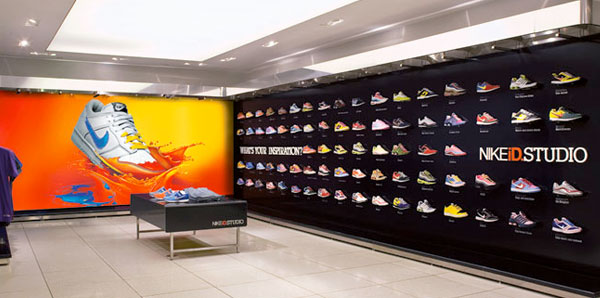
Auch wenn der Kunde für sein Modell die Farben auswählen kann, ganz "Open-Source-Marketing" ist Nike ID nicht (Foto aus http://www.heyhush.com)

Eines meiner Lieblingsthemen ist die “kundengerechte Anfertigung”, oder Customization. Es gilt als erwiesen, dass die Zahlungsbereitschaft von Kunden für individuell angepasste Produkte höher ist, weil diese “genau auf spezielle Kundenbedürfnisse zugeschnitten [sind]“. Es würde also nahe liegen, das der Kunde in die Entwicklung und das Design eines Produktes mit einbezogen wird, um Wert für ihn und das Unternehmen zu schaffen. Einiges spricht jedoch gegen eine solche Entwicklung, zumindest kurzfristig : Kunden können nicht immer ausdrücken, was sie wirklich wollen, und manchmal möchten sie es auch nicht ; sie haben einfach nicht die Zeit und die Lust dazu. Auf der anderen Seite gibt es auch bei den Vertreibern Widerstand : den Autoren zufolge wird das Mass-Customization Programm Nike ID bewusst klein gehalten, weil es “die herkömmlichen Geschäftsabläufe radikal infrage stellt“. Vom Einkauf bis zum Vertrieb und zur Kommunikation gibt es in der Tat einige, die bei dem Konzept verlieren…

Amazon und eBay sind zwei Beispiele dafür, dass Nutzer einen Teil dem produzieren, was sie consumieren und/oder kaufen. Bei eBay macht der User einen enormen Teil der Wertschöpfungskette aus : er beschreibt das Angebot, beantwortet Fragen der Interessenten, nimmt die Bezahlung an, verschickt das Produkt une bewertet auch den Käufer. Dafür bezahlt er dann gerne. Das Geschäftsmodell ist erstaunlich, doch die Plattform bietet ein effizientes Vertriebssystem. User schätzen das ; der Vorstand auch. Meg Whitman, CEO des Unternehmens von 1998 bis 2008 bemerkt dass eBay “gut bedient ist, indem es andere darüber nachdenken lässt, die Plattform noch stärker zu machen“.

reprap

Dieses Projekt eines MIT-Studenten ist ein "RepRap", eine auf Open-Source-Software basierte Maschine die in der Lage sein soll, sich selbst zu reproduzieren (Foto aus http://fab.cba.mit.edu)

Eines der bemerkenswertesten Themen ist das “Fabbing” (digitale Herstellungverfahren, oder, um es etwas intuitiver auszudrücken, 3D drucken), dass in diesem Fast Company-Artikel sehr gut beschrieben wird. Im Media Lab des MIT arbeiten Wissenschaftler daran, “Computerdaten in dreidimensionale Gegenstände zu transformieren und umgekehrt“, und die Technologie ist auf gutem Wege, sich zu demokratisieren. Warum das revolutionär ist ? Eine Antwort ist, dass das Fabbing in der Entwicklungshilfe eine grosse Rolle spielen kann (siehe social design), denn “gebaut wird strikt nach lokalen Anforderungen und nicht nach Bedürfnissen des Weltmarkts“. Zum Beispiel werden in Ghana Buschmesser, Autoteile uns Ackergeräte hergestellt.Ob wir zur “Fabbing Society” gelangen werden, ist unklar, es würde jedenfalls rein wirtschschaftstheoretisch eine Revolution darstellen.

Es gibt eine Menge anderer interessanter Themen in diesem Buch. Die Autoren zeigen mit einer Fülle von Beispielen, wie sich die Welt im Moment ändert. Schade nur, dass der Titel so deutsch klingt… denn es würde sich definitiv lohnen, es in andere Sprachen zu übersetzen ! Ich habe letztes Jahr Marketing Anatomy gelesen, dass von Nicolas Riou, einem französischen Professor der Elite-Business-School HEC, geschrieben wurde. Auch wenn der Titel versprechender klingt, habe ich in Marke Eigenbau mehr gelernt… und werde das Buch für meine Diplmoarbeit auf dem Schreibtisch liegen haben !

L’analyse sémiologique (QualiQuanti)

Une présentation très intéressante sur par le cabinet d’études QualiQuanti sur l’analyse sémiologique des espaces et de la publicité. Cela me rappelle une séminaire intitulé “Sémiologie de l’image” que nous avons eu à l’ESSCA. C’était Pol Corvez, sémiologue à l’Université d’Angers, qui nous avait introduit à cette discipline très intéressante.

Shimano and associated bicycle manufacturers drop the Coasting program

logo

I don’t know if you recently visited Coasting.com, the website dedicated to the innovation program initiated by Shimano with several bicycle brands like Giant, Trek, Fuji, K2 and even Schwinn (2008). Developped with the innovation firm IDEO, this project intended to bring new consumers to cycling, those who didn’t identify themselves with the technology-driven world of copmetitive cycling. Well, the website now directly brings you to Shimano’s corporate website, Shimano.com.

After contacting Shimano, I found out the whole program had been abandoned – or at least temporarilly stopped. According the Shimano France‘s Mathieu Arrambourg, who was the first to answer my questions, the marketing efforts didn’t generate the expected sales, revealing that customers (and distributors?) were not interested enough in the products. The program, which was exclusively directed to the Northern American market, started in 2007 with Giant, Trek and Raleigh, seven other manufacturers joined the movement in 2008. Heather Abraham from Trek told me that the Lime, Trek’s Coasting model, “is no longer being produced” and that, at this time “nothing new is happening with the Coasting program“.

Julie

Shimano rolled-out the program across North America, this is a photo from one of Shimano's Coasting Tour stages in Portland (retrieved from http://www.momentumplanet.com/blog/glorious/north-americas-1st-ciclov)

The Californian headquarters of Giant and Shimano USA haven’t made any statement yet. I understood that the announcement was made to Coasting’s member companies during Taiwan’s Taipei Cycle trade show, and that product managers and other marketing executives couldn not yet communicate on the issue. What ever the statements will look like, I hope that this promising approach of cycling’s marketing won’t be definitively abandonned, because it had (has!) market potential. Imagine what potential there would be in emerging markets like india and China… Or do they really just want cheap cars ?

Feel free to comment or to react !

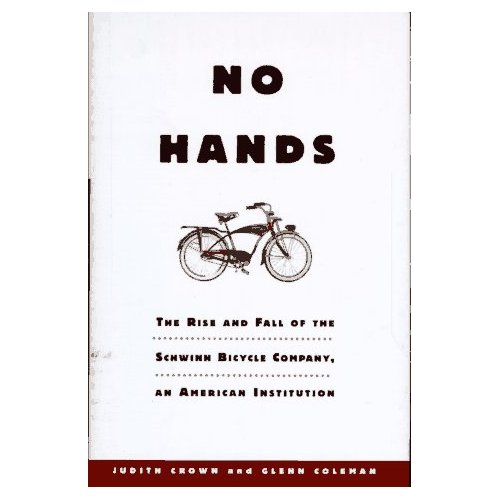
No hands: The rise and fall of the Schwinn Bicycles Company: an American institution, Judith Crown & Glenn Coleman, Henry Holt&Co.

When I arrived in Florida in early January I noticed all these Schwinn-bikes on campus, in the gym and in the supermarkets. This aroused my curiosity about this brand I already heard of, but who still was misterious to me ; that’s why I lended No Hands: The rise and fall of the Schwinn Bicycle Company: an American institution in the UWF Library. And here’s what I learned in the book, that was published in 1996 (and therefore does not cover Schwinn’s most recent history).

Judith Crown, who is a senior correspondent for BusinessWeek in Chicago and worked for Crain’s Chicago Business, started the book in 1992 after she heard that Schwinn was in serious financial trouble. With Glenn Coleman from Crain’s New York Business, they started investigating the reasons for the turmoil of America’s most notorious cycling brand.

picture

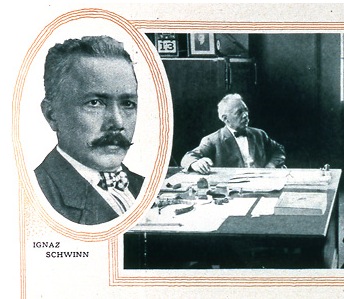
Ignaz Schwinn, co-founder of Arnold, Schwinn & Company (retrieved from http://www.motorcyclemuseum.org)

Ignaz Schwinn emigrated to the United States in 1891 and make profit from the late XIXth century’s bicycle boom to create a successful bicycle manufacturing company with an American partner, the Arnold, Schwinn & Co. The turn of the century and the start of the automotive era (Ernest Pfennig bought the first Ford T in 1903) saw a wave of consolidations in the bicycle business, out of which Schwinn emerged weakened – but even more ambitious. Various takeover made Schwinn one on the big players, and retailing through mass merchants allowed the Chicago-based company to achieve big sales. In 1928, the in-house brand for motorcycles that had been acquired in 1912 and 1917, Excelsior-Henderson, even ranked 3rd in the national motorcycle industry.

advertisement

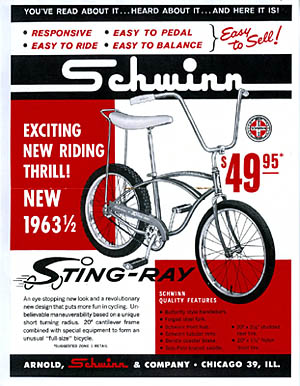
This advertisement for Schwinn's Sting-Ray is from 1963 (retrieved from http://www.raleighronsclassics.com)

During the following decades, Schwinn built up a (very) strong brand. The best example certainly is the success of the Sting-Ray that originated from the Californian kids’ street culture (at that time, Schwinn listened to its customers…). Sociologist Arthur Asa Berger saw it in a bit more, let’s say, austere way : “[the Sting-Ray] symbolizes a perversion of values, a somewhat monstruous application of merchandising and salesmanship that… has led to grave distortions in American society“. His vision may be exagerated, but what he said about Schwinn’s marketing efforts gets to the heart of the company’s success : they mastered selective distribution and franchising better than any other consumer product company at the time. Furthermore, Schwinn’s “customers around the country were true believers“, as the book states on page 75, and owning a Schwinn was considered a status symbol in the 60’s.

ride

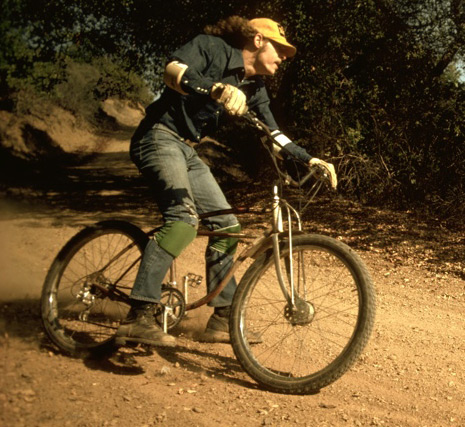
The mountain-bike pioneers started on converted Schwinns, recognize the frame ? (retrieved from sanfrancisco.about.com)

In the 70’s, Soutern California kids started following new trends (the BMX), just like the kids created the Sting-Ray culture during the sixties. This time, however, Schwinn decided not to engage into the movement, maily because the company saw the sport as too dangerous and unsuitable with Schwinn’s quality image. The same happened with the mountain-bike culture of the 80’s pioneered by Northern California riders like Michael Sinyard (founder of Specialized), Tom Ritchey and Gary Fisher. What Schwinn didn’t recognize is that trends are often set by minority thinkers, and not by the Number One.

Giant Store Amsterdam

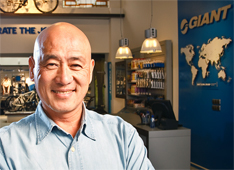
In 1988, Giant Manufacturing produced 82% of Schwinn's bicycles, nowadays it is the world's leading bicycle manufacturer (retrieved from http://www.bike-eu.com)

But what eventually drove Schwinn into the turmoil that led the company to file for Chapter 11 in 1992 was it’s inability to cope with management and quality problems, as well as some unsuccessful investments. Basically, the company had to choose in where to produce bicycles at a more competitive prices. The Schwinns decided to turn to Taiwan and China, but even though suppliers like Tony Lo’s Giant Manufacturing (photo) made high quality products, unlucky sourcing desisions led to supply shortage, angry retailers and receding customers. Edward Schwinn, CEO, just wasn’t as passionate about bicycles as his ancestors were. Yoshi Shimano, who was Edward Schwinn’s personal translator during his business trips to Asia, described him as “a nice fellow“, who “had a lower degree of interest for the business“.

advertisement

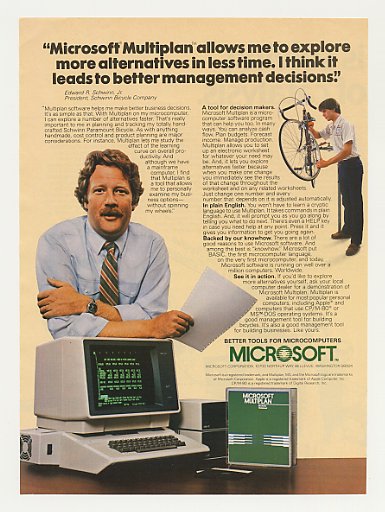
If only Microsoft had helped Schwinn taking better strategic decisions... (advertisement from 1982, retrieved from aroundme.fr)

In 1992, Schwinn filed for bankruptcy. Ed Schwinn looked for an investor during the difficult years that preceded this sad ending, but this reveals a part of the problem : instead of an investor that would provide funds to keep the business running, Ed Schwinn should have found a buyer, which implies that this buyer would have taken control of the company – what the Schwinns wouldn’t accept. When the company was too damaged to be saved, the company and name were sold to the Zell/Chilmark Fund, an investment group, in 1993.

To conclude, let me just quote very hard words that Judith Crown writes about Ed Schwinn, in the introduction of the book : “Most of all, it is a tale of a young CEO who alienated just about everyone he needed – from relatives, employees, and longtime dealers to lenders, lawyers, suppliers and bidders – with a mix of arrogance and ignorance that only can be described as hubris

He now runs a cheese shop in Wisconsin, so he certainly won’t destroy another American institution !