Interview of @ChrisKuech (Frito-Lay) About Crash The Super Bowl VIII

Chris Kuechenmeister, one of "40 under 40 to watch" in 2011, according to PRweekUS.com

In 2011, PRweekUS.com cited Chris Kuechenmeister as one of “40 under 40” to watch in public relations

A week ago, PepsiCo launched the 8th edition of the Crash The Super Bowl contest, probably the world’s most famous, open-to-all video advertising competition. For the eight year, PepsiCo invites individuals to compete to have their own Doritos ads air in front of millions during Super Bowl XLVIII, the pinnacle of television advertising. What’s new this year? Doritos is opening Crash The Super Bowl (CTSB) up to the whole world, or at least to any of the 46 countries where Doritos are sold.

To talk about this latest evolution, but also about the general strategy of relying on consumers for the production of advertising content, I had the great pleasure to talk to Chris Kuechenmeister, Senior Director of Public Relations at Frito-Lay North America (which is part of PepsiCo). He kindly replied to my tweet and we had a very interesting chat on Monday. Here’s his insider perspective on this pioneering crowdsourcing initiative. One question a day. Continue reading →


La plateforme de co-création Quirky se lance en France (et en français)

En décembre 2012, Auchan et Quirky, la plateforme d’invention et de développement d’idées par les internautes, ont annoncé la signature d’un partenariat. Le distributeur français s’engageait à offrir à Quirky et à ses produits une certaine visibilité via la distribution de huit produits en magasin, et permettrait aux consommateurs français de déposer des idées gratuitement sur fr.quirky.com (voir mon billet Les distributeurs français se mettraient-ils à la co-création?). “We will open the Quirky platform for French speaking people. This launch will take place on September 11, 2013,” expliquait Quirky dans un billet de blog à l’époque. Promesse tenue, le site vient d’être lancé. Continue reading →

OnlineVideoContests.com Features Crowdsourcing Platforms in Short Videos

OVC banner

The video contest directory OnlineVideoContests.com (OVC), which gathers all video contests on one great site (“#1 most updated video contest site on the web!“) and newsletter, has started the “OVC Spotlight” series. It’s an ongoing series of two-and-a-half-minute YouTube videos that describe different video crowdsourcing platforms (eYeka, Mofilm, Poptent ProjectED, Tongal, Zooppa…) is a clear, short and crisp manner. Marissa from OVC told me that:

We decided to create these Spotlight videos as a service to our community, so our creators could better understand all the video crowdsourcing platforms in the space Continue reading →

Interactive Ad or Crowdsourcing? Audi Australia’s “Land of Quattro” Campaign

Australia Audi Land Of Quattro

Audi’s latest global brand platform, “Land of Quattro” and has been rolled out in several countries like India, Germany, New Zealand, and Australia. For the latter, Audi Australia has imagined a participative campaigned designed to involve consumers with the brand. “In Australia, Audi has worked with its newly-appointed agency Holler to produce […] an innovative digital execution that allows the public to ‘remix’ the TVC to direct their own commercial,Marketingmag.com.au explains. A typical example of a crowdsourced advertising campaign, right?

CSW’s tweet got me thinking. It links to this article, where Anna Burgdorf, general manager of Audi corporate communications, says “we don’t see it as crowdsourcing, we see it as another way to watch a commercial and be involved in a brand campaign.” Looking at the campaign created by Holler, I see a creative brief, a deadline, a reward… so it’s crowdsourcing, right? Let’s look at it in more detail! Continue reading →

“Crowdsourcing Works Because of the Freshness and Naivety,” says Santawen

rabah-brahimiIn my quest to better understand creative crowdsourcing participants, I recently interviewed Santawen alias Rabah Brahimi, a French filmmaker, director and graphic designer. Santawen often participates in online contests on websites like eYeka (he was features as creator of the month of June 2012) and took some time to sit down and chat about his participation in online video contests.

I don’t have any professional equipment, just an affordable camera and a lot of free time.

His views about the evolving world of advertising and the advent of creative crowdsourcing were particularly interesting, as he worked numerous years as an agency creative. Here are some excerpts of our conversation. Continue reading →

@DBrabham’s “Crowdsourcing” Book

daren-brabham-crowdsourcing-books-photoSince Jeff Howe’s article (2006) and book (2008) on crowdsourcing, journalists and researchers have widely been using the term. In every article I read, from blog posts to academic writings, Howe is always given as a reference. The fact that most people relied on a magazine article and a business book gave birth to a variety of conflicting definitions of crowdsourcing (with or without Wikipedia, Linux, or YouTube) which made it really hard to understand for the layperson who didn’t have time to make her/his own opinion.

But one researcher, who wrote his doctoral dissertation about crowdsourcing, provided a clear definition from the start (which was as early as 2008): Daren Brabham. assistant professor in the School of Journalism & Mass Communication at the University of North Carolina at Chapel Hill.  He just wrote a book, simply called Crowdsourcing, published in MIT Press’ Essential Knowledge Series, about what crowdsourcing is, and what it isn’t. I hope it will be used next to Howe’s article (2006) and book (2008) in forthcoming writings about crowdsourcing, because it clearly dots the i’s.

Continue reading →

Genius Crowds, Another Company That Failed to Turn Co-Creation Into a Profit

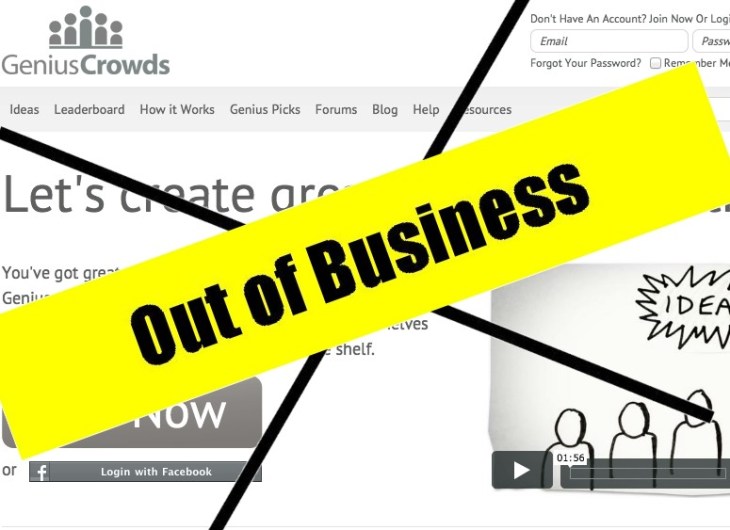
Genius Crowds is Out of Business

In May 2011, I covered the French platform Crowdspirit, and tried to discuss the reasons of its failure. In August of the same year, I wrote a blog post about the costs of co-creation, underlining that there are substantial costs to orchestrate crowdsourcing and/or organize co-creation, and that profitable platforms are actually rare. Well, very recently, crowdsourcing.org announced that a US-based crowdsourcing company, Genius Crowds, had to close its doors. Why? Because Genius Crowds was not able to turn their co-creative model into a profit.

“As a small startup, we frankly didn’t have enough resources to do the job of business development that we wanted to be able to do” (C.J. Kettler, CEO and co-founder) Continue reading →