What caused Shimano’s Coasting-program to fail ?

A couple of weeks ago, I noticed that the Coasting-website (coasting.com) was not online anymore and that the landing page was Shimano’s corporate website, Shimano.com. Just before writing this, I googled it again and there is shimanocoasting.com again, on the bottom of the page, just behind the link to my blog post (results may vary from country to country) ! Did I make a mistake, in March, when I was looking for the website ? Did I just miss it ?

But more interestingly, what bugs me is : What caused the Coasting program to fail ?

transmissions

Looks cool, but didn't sell. Why ? (photo from ohgizmo.com)

In a very interesting guest post on BicycleDesign.net, designer Mark Sanders basically talks about the cycling market as bunch of companies which sell high-priced bicycles to enthusiast cyclists (he calls them red oceans of enthusiasts). On the other hand, you have the mass-merchandisers selling very low-priced bikes in chain stores and supermarkets, targeting the mass of shoppers. Since these two approaches make companies compete on very “crowded” markets with low margins, we can indeed talk about red oceans that Kim & Mauborgne’s describe in their theory on business strategy, the Blue Ocean Strategy. In this theory, companies achieve growth by creating innovative ways to satisfy customers’ needs (differentiation), thus avoiding the high costs that incurr in highly competitive markets, and also driving up value for these customers. So is the cycling industry an unattractive industry ? According to Sanders, yes. I also think about an interview (in Institutional Investor of April 2005) of Martin Schwartz, CEO of Dorel Industries that I read when I got interested in Schwinn’s history ; he says that “bikes, it’s true, is not a great industry, but someone has to be the best, and Pacific (bike division of Dorel, ed) is the best by far“. Shimano seemed to having recognized that, and that’s where the industry-giant worked with IDEO, a global design consulting firm, to find a solution : Coasting.
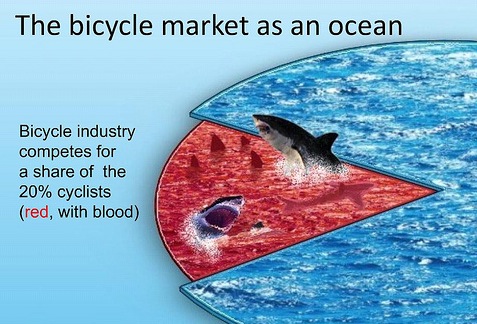
pie-chart

Illustration by Mark Sanders (www.cyclelicio.us)

The previous paragraph relates to both the Blue Ocean theory (2005) and the Design Thinking theory (2008) to describe Shimano’s initiative. IDEO is even run by the guy who wrote the HBR-article on Design Thinking, Tim Brown. So Shimano was basically advised by one of the leading strategists in the world, but about 3 years after the lauch of the Coasting product-line, the program was abandoned because it didn’t generate the expected commercial success that Shimano hoped for. The program thrilled the design-community (California Design Biennal Award for Giant in 2007, International Design Excellence Award in 2008), was praised by journalists and commentators (L.A. Times or Cyclingnews.com in 2007), but sales didn’t follow. Why ?

Several reasons cross my mind, and I’d like to have your feedback to contribute to the discussion…

  • Design process ?

Shimano’s brief for IDEO was more or less as follows : help it create a $1,000, tech-laden bike that would lure baby boomers and their loose change off the couch (bicycling.com). It is very common in the design process that the consulting firm reformulates this brief, and it indeed proved to be necessary. Aaron Slar, social engineer for IDEO, and David Lawrence, marketing manager for Shimano travelled to different U.S. cities to find out what people think about bikes and biking and discovered all these things about people being intimidated by technology and basically wanting to get the feel-good biking experience they remember from their childhood. The prototype had grinded lugs and cable routers, a coaster brake and, more importantly, an invisible shifting mechanism. When IDEO presented their findings and recommendations to Shimano in Japan, “there was a long pause on the conference call. And it wasn’t just because of the translation“, says Lawrence. But the company rapidly got convinced, and started seeking partners within the industry.
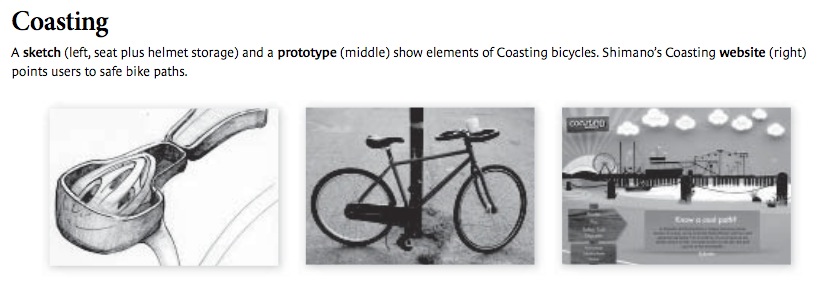
screenshot

An extract from Tim Brown's HBR-article on Design Thinking. Inspiration, ideation & implementation are represented here by examples

This design process seems to have gone through the traditional steps, from understanding to prototyping and testing. Actually, I found few information about this “testing”-step. Who did Shimano and IDEO work with when they testes their prototype(s) ? Where there improved V2 and/or V3 versions based on customers’ feedback ? This would be interesting to know.

  • Industry involvement ?

According to Daniel Gross, manufacturers associated in the Coasting-project (3 in the first year, 10 the year after) were rapidly found and seemed enthusiatic about the idea. Giant adapted bikes from its Suede product-line, Trek & Raleigh created bikes, the Lime and the Coasting. Today, the Shimano Coasting website shows 7 models from 7 different brands : Schwinn, K2, Phat, Fuji and the 3 brands that started with Shimano. I wonder what caused the number of manufacturers to drop ? They were indeed 10 in 2008, why did Sun, Jamis & Electra quit the program ? One possibility is that Shimano could not handle working closely with these 10 manufacturers and needed to skim off the least motivated ones… While some talk about a synergy between this major supplier and manufacturers, I wonder if the manufacturer’s didn’t think that Shimano would get too powerful if Coasting was a success ? Would have one single bike manufacturer have been more successful with the Coasting-approach ?

group

The Shimano Coasting automatic transmission-group (photo shimano.com)

Shimano’s goal was to get 1,000 U.S. retailers involved the first year. In 2008, two years after the lanch of the group, industry consultant Jay Townley of Gluskin Townley Group said retailers were still hesitant to adopt the new product. To improve this situation, Shimano sent them an explanatory DVD and did set up a dedicated website, sellingcoasting.com. But even this kind of initiatives did not make sales take off. When I talked to a bike dealer here in Pensacola he wasn’t very convinced by the Lime’s (Trek’s Coasting-model) ability to reach a new target of customers. If bike vendors don’t grasp it, the customer probably won’t either…

  • Marketing mix ?

PRODUCT : Did the consumer know what was actually sold by Shimano ? The company only sells the transmission and shifting-system by its Coasting group. This product is then mounted on the bikes by manufacturers, who sell the bicycle through independent bicycle dealers (IBD) in the United States. But Coasting is also a concept, a lifestyle, a new way of designing riding experience. I think it was made too hard for the customer to identify what he was actually buying : did he buy a Trek ? a “Coasting” ? a Shimano ? Who made what on this bicycle ? Why change the shifting-system ? I think it was not Shimano’s role to directly adress the customer, it is still the bike brands’ job to sell their products.

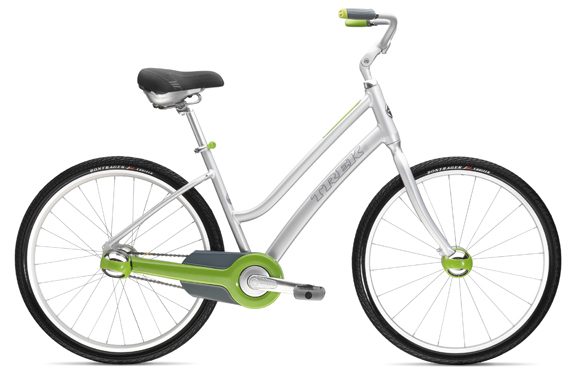
PRICE : The 3 initial Coasting bikes sold between 400$ and 700$. The Trek Lime’s retail price was roughly 500$, which is a fair price for a quality bicycle. It is half the price of what Shimano initially suggested to IDEO in the design brief. The aim of this pricing strategy was obviously to make bikes affordable to a large public who doesn’t ride bikes. I think the price was not a reason for failure, it was more that Shimano and, more importantly, the manufacturers were not able to communicate the benefits of Coasting to retailers and customers.

bike

The K2 Easy Roller is (was?) available at 600$. Quite a bit for a bike with no handlebar-brakes (photo from besportier.com)

PROMOTION : The promotional strategy was intended to convey this feeling of freedom of riding a bicycle and to draw non-cyclists to the stores that sold Coasting. Newspaper advertising and guerilla marketing were used to increase awareness of Coasting, and the website Coasting.com was central to explain the concept and present bikes to consumers. The design of this flash-based website is fun and interactive, storytelling is used to involve the visitor (storytelling is part of the Design Thinking process, according to Tim Brown) and content encourages people to get on their bikes. Ideally Coasting bikes. Beside this, a demo-tour was also organized in several U.S.-cities to bring the bikes to the poeple and encourage PR & publicity.
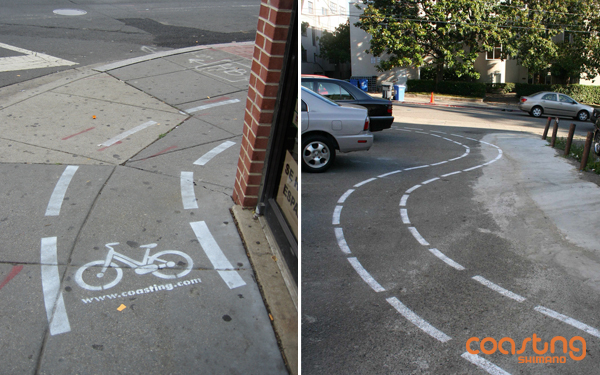
bike-lanes

The Fineline used outdoor stencils (with environmentally friendly spray chalk) to create life sized coasting paths everywhere (photo from the-fineline.net)

PLACE : Coasting was intended to the U.S.-market only, and it has been launched in cities like Orlando or Phoenix before the whole country was covered in 2008. Shimano and the bike brands chose to sell their products exclusively at IBDs. I think this is one of the reasons that caused Coasting’s failure : while the website is a good way of presenting the concept/product/bikes, poeple are often unfamiliar with the specialized bike stores and bike-enthusiastic vendors. Why not selling through the web ? Was the reliance on a retailing network so important ? It might have avoided some obstacles too… But more than seeing problems on the U.S. market, I think that Shimano should have tried to introduce Coasting (or a similar technology, with a different marketing approach) into less mature markets like China, India and other emerging countries. Or even (very) mature markets like Scandinavian countries and the Netherlands, where product acceptance might have been higher.

VERDICT ?

The future of Shimano’s Coasting is unclear. On the internet, Coasting.com vanished and ShimanoCoasting.com has appeared, the content is unchanged. As I said in a previous post, the program has been abandoned by Shimano because sales never attained the expected figures. I think there was a huge potential in this approach, and this post explains some points that could have led to Coasting’s deceiving results.

What do you think ? Do you have more informations ? More ideas ?
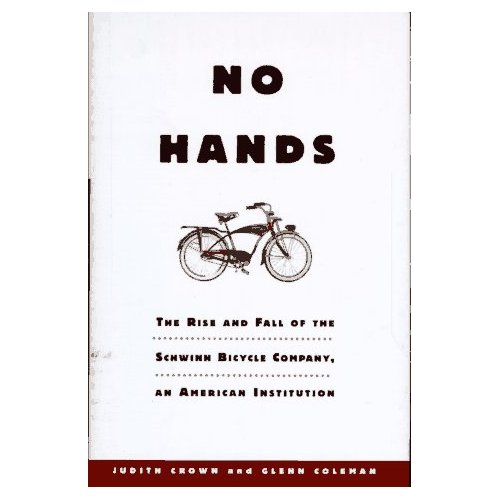
No hands: The rise and fall of the Schwinn Bicycles Company: an American institution, Judith Crown & Glenn Coleman, Henry Holt&Co.

When I arrived in Florida in early January I noticed all these Schwinn-bikes on campus, in the gym and in the supermarkets. This aroused my curiosity about this brand I already heard of, but who still was misterious to me ; that’s why I lended No Hands: The rise and fall of the Schwinn Bicycle Company: an American institution in the UWF Library. And here’s what I learned in the book, that was published in 1996 (and therefore does not cover Schwinn’s most recent history).

Judith Crown, who is a senior correspondent for BusinessWeek in Chicago and worked for Crain’s Chicago Business, started the book in 1992 after she heard that Schwinn was in serious financial trouble. With Glenn Coleman from Crain’s New York Business, they started investigating the reasons for the turmoil of America’s most notorious cycling brand.

picture

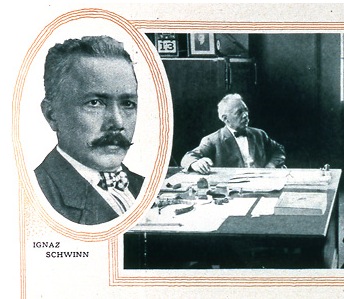
Ignaz Schwinn, co-founder of Arnold, Schwinn & Company (retrieved from http://www.motorcyclemuseum.org)

Ignaz Schwinn emigrated to the United States in 1891 and make profit from the late XIXth century’s bicycle boom to create a successful bicycle manufacturing company with an American partner, the Arnold, Schwinn & Co. The turn of the century and the start of the automotive era (Ernest Pfennig bought the first Ford T in 1903) saw a wave of consolidations in the bicycle business, out of which Schwinn emerged weakened – but even more ambitious. Various takeover made Schwinn one on the big players, and retailing through mass merchants allowed the Chicago-based company to achieve big sales. In 1928, the in-house brand for motorcycles that had been acquired in 1912 and 1917, Excelsior-Henderson, even ranked 3rd in the national motorcycle industry.

advertisement

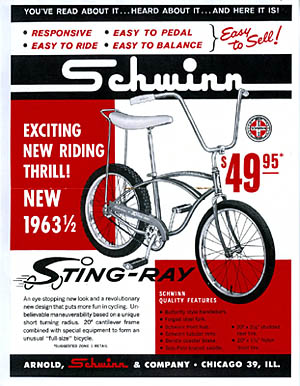
This advertisement for Schwinn's Sting-Ray is from 1963 (retrieved from http://www.raleighronsclassics.com)

During the following decades, Schwinn built up a (very) strong brand. The best example certainly is the success of the Sting-Ray that originated from the Californian kids’ street culture (at that time, Schwinn listened to its customers…). Sociologist Arthur Asa Berger saw it in a bit more, let’s say, austere way : “[the Sting-Ray] symbolizes a perversion of values, a somewhat monstruous application of merchandising and salesmanship that… has led to grave distortions in American society“. His vision may be exagerated, but what he said about Schwinn’s marketing efforts gets to the heart of the company’s success : they mastered selective distribution and franchising better than any other consumer product company at the time. Furthermore, Schwinn’s “customers around the country were true believers“, as the book states on page 75, and owning a Schwinn was considered a status symbol in the 60’s.

ride

The mountain-bike pioneers started on converted Schwinns, recognize the frame ? (retrieved from sanfrancisco.about.com)

In the 70’s, Soutern California kids started following new trends (the BMX), just like the kids created the Sting-Ray culture during the sixties. This time, however, Schwinn decided not to engage into the movement, maily because the company saw the sport as too dangerous and unsuitable with Schwinn’s quality image. The same happened with the mountain-bike culture of the 80’s pioneered by Northern California riders like Michael Sinyard (founder of Specialized), Tom Ritchey and Gary Fisher. What Schwinn didn’t recognize is that trends are often set by minority thinkers, and not by the Number One.

Giant Store Amsterdam

In 1988, Giant Manufacturing produced 82% of Schwinn's bicycles, nowadays it is the world's leading bicycle manufacturer (retrieved from http://www.bike-eu.com)

But what eventually drove Schwinn into the turmoil that led the company to file for Chapter 11 in 1992 was it’s inability to cope with management and quality problems, as well as some unsuccessful investments. Basically, the company had to choose in where to produce bicycles at a more competitive prices. The Schwinns decided to turn to Taiwan and China, but even though suppliers like Tony Lo’s Giant Manufacturing (photo) made high quality products, unlucky sourcing desisions led to supply shortage, angry retailers and receding customers. Edward Schwinn, CEO, just wasn’t as passionate about bicycles as his ancestors were. Yoshi Shimano, who was Edward Schwinn’s personal translator during his business trips to Asia, described him as “a nice fellow“, who “had a lower degree of interest for the business“.

advertisement

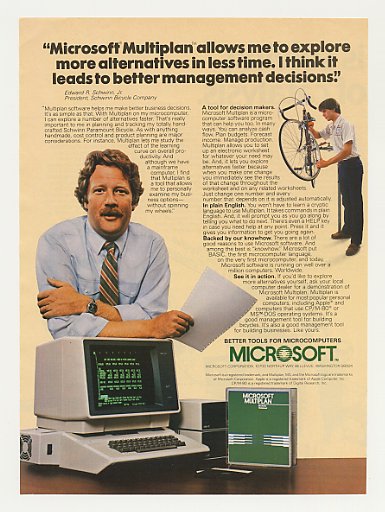
If only Microsoft had helped Schwinn taking better strategic decisions... (advertisement from 1982, retrieved from aroundme.fr)

In 1992, Schwinn filed for bankruptcy. Ed Schwinn looked for an investor during the difficult years that preceded this sad ending, but this reveals a part of the problem : instead of an investor that would provide funds to keep the business running, Ed Schwinn should have found a buyer, which implies that this buyer would have taken control of the company – what the Schwinns wouldn’t accept. When the company was too damaged to be saved, the company and name were sold to the Zell/Chilmark Fund, an investment group, in 1993.

To conclude, let me just quote very hard words that Judith Crown writes about Ed Schwinn, in the introduction of the book : “Most of all, it is a tale of a young CEO who alienated just about everyone he needed – from relatives, employees, and longtime dealers to lenders, lawyers, suppliers and bidders – with a mix of arrogance and ignorance that only can be described as hubris

He now runs a cheese shop in Wisconsin, so he certainly won’t destroy another American institution !

Fighter Brands : perverted marketing ?

My desk today @ the UWF Starbucks

Currently studying at the University of West Florida, I’m enrolled into the Marketing Strategy course from Dr. Keller one a subject we’ll discuss is the concept of Fighter Brands (or Finghting Brands). In Should You Launch A Fighter Brand?, Mark Ritson from the Melbourne Business School says that “a fighter brand is designed to combat, and ideally eliminate, low-price competitors while protecting an organization’s premium-price offerings” (it is therefore different  than the “marque combat” as defined by the Georges Chétochine). Successfull fighter brands are examples such as Busch Bavarian beer, Intel Celeron processors, Logan by Renault etc.

Qantas launched Jetstar, the "perfect fighter brand" according to Mark Ritson (Picture retrieved from the Sydney Morning Herald website : http://www.smh.com.au)

Different evolutions may explain the emergence of fighter brands : the growing market share of private labels, the trends of low-cost products, the infidelity of customers, their ever-changing expectations or simply the current economic crisis… At school we attented a presentation of the French research and survey organization CREDOC in which we were told that the French’s appreciation of low-priced products compared to branded products sank in 2009. Even if sales of private labels now reaches 34% of the supermarkets’ sales in France, brands’ products are still perceived better quality. This shows that consumers still trust brands and value their products, but may don’t necessarily ask for premium products (anymore) : an insoluble equation ?

No, they launch their fighter brands ! This post from another wordpress-blog (lowcostattitude, in French) gives some example of “popular products” launched by Nestlé, Danone &co. As our CEDOC-lecturer told us in his presentation too, we can see that the middle of the product ranges are deserted in favor of premium and low-cost products, using the hourglass-analogy. Brands have to keep customers tempted by low-cost and/or private label products as well as recuperate those who already deserted… but it’s far more complicated than that : Will it cannibalize the other brand’s portofolio’s products ? What should I highlight in the new alternative that I offer ? Will customers be lost ? How much does it cost to launch a fighter brand ?

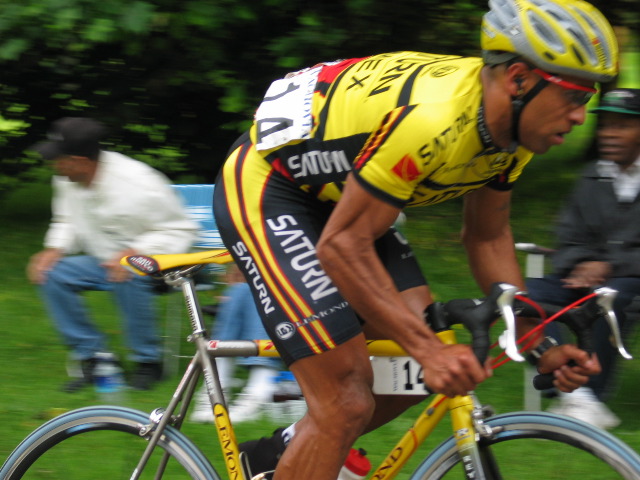
Saturn cars' sales pulled up immediately in 1990... but GM's company -who was a long-time sponsor of cycling : here's Ivan Dominguez riding for Saturn-Timex in 2003- was a financial disaster. (Picture retrieved from dailypeloton.com)

One example is the automotive brand Saturn, launched by General Motors in 1985 to counter the Asian competition making affordable and practical, fuel-efficient cars. As described by Mark Ritson in his article published on October 2009 in the Harvard Business Review, the cars “proved an immediate success and quickly achieved the highest repurchase rates and customer satisfaction scores in the industry“. The cars were cheaper than GM’s products… but were far too expensive to actuallty produce. Very high develoment costs, an expensive production plant, dedicated dealer-network and an independent marketing & branding budget : the business model simply wasn’t profitable !By 2000, despite continuing sales success, Saturn was losing $3,000 for every car it sold“, says professor Ritson in his article. General Motors eventually reformed the whole brand, amongst which was the higher integration of the brand into GM, “and then sales dropped off“. The current crisis, striking GM as hard as the other Big Three, will lead to the definitive shut down of Saturn by October 2010. Renault is doing better with it’s Logan brand…

Why perverted marketing ?

As my Marketing Management book states : “the marketing concept means that an organization should seek to make a profit by serving the needs of customer groups“. Therefore, marketing originates with the unfulfilled need of customers to offer them a product which suits their expectations (eventually the company will promote the product, measure the ROI etc.). Fighter brands emerge from the success of (or the threat posed by) a competitor to which a company creates an alternative offer. In other words : it has a product-oriented vision, dazzled by someone else’s success to push a product in the market. That’s not marketing. And that’s why some companies fail in that strategy ; Kodak launched Funtime, a cheap alternative to its Gold Plus film aimed to counter Fujicolor’s Super G film, but Funtime’s sales cannibalized Gold Plus more than it damaged Super G. Kodak eventually withdrew the product. Jetstar is an example of a successful fighter brand : deep analysis of the market allowed them to create a concept aligned with the customers’ needs.

If you are interested in the subject and seek a deeper insight, read Mark Ritson’s article in HBR. Highly interesting !

Shimano Coasting, design-thinking applied to the cycling industry

I’m just reading Tim Brown’s article on design-thinking in the Harvard Business Review on June 08, and having a complicated mind, I’m thinking of another subject I love : cycling. In a year-or-so, I’ll have to write my Master and I’m desperately trying to find a way to associate these two passions of mine. Actually, I haven’t found the answer to that very question, but IDEO‘s founder’s article gave me a pleasant surprise that will postpone my reading… just until I finish this post ! An example given by the father of design-thinking to back up his reasoning is the “Coasting”-project led by Shimano since 2004, but let’s come back on it in sequence.

Source : Innovation Through Design, by Bill Moggridge (@IDCC)

Shimano is world-famous for manufacturing bicycle components, especially shifting and transmission systems (like its competitor, SRAM). By sponsoring numerous professional teams around the world and being official supplier of the UCI, the japanese company proves his leadership in the sector. High-end segments in both road-racing and mountain-bike segments provides solid growth, what leads Shimano to think about the development of a product for a “high-end casual bike“. IDEO is asked to collaborate on the project.

During the first phase of the design-thinking process praised by Brown (Inspiration, Ideation and Implementation), the stakeholders realize that it would be smarter to target a larger audience than the tech-freaks who would by an expensive commuting bike. The reasons are simple : they discovered that a lot of Americans are “intimidated by cycling“, the reasons being various (roads, technology, culture etc.). Long story short, Shimano decided to tackle this problem by proposing “a whole new category of bicycling [that] might be able to reconnect American consumers to their experiences […] while also dealing with the root causes of their feelings of intimidation“. The concept Coasting was born.

You can find an extensive case study of the project on IDEO’s website, but basically Coasting means that the bike is simple and fun to ride, user friendly and technologies like the automoatic shifting are well-hidden. Branding was built on enjoying life on a bike and promotion was partly based on public relations (local governments, cycling organizations) that promoted safe and easy riding for everyone. At the begining (launch in 2007), only three major manufacturers decided to follow Shimano on the coast path : Giant, Raleigh Bicycles and Trek Bikes.

The Lime, Trek's Coasting bike designed by Chad Price (source : bike.shimano.com)

On Shimano North-America’s website, where the above picture is taken from, there are ten manufacturers listed for the 2008 launch of the Coasting Bikes, Trek being one of them. On the current website of the Coasting project, there are still 7 : Giant, K2 (my bike brand!), Phat Bicycles, Raleigh, Schwinn, Trek and Fuji. However, the idea of designing futuristic but simple-looking cruisers for the masses (at a price of USD 700!) worked : Coasting won the Gold Idea Award for Design Exclellence (Industrial Designers Society of America and BusinessWeek) in 2008 and earned a lot of applause since. Brands like Cannondale are thinking about developping similar concepts, as this “concept-bike” by Dutch industrial designer Wytze Van Mansum shows.

La Dimension Design, par Christopher Lorenz

La Dimension Design (C. Lorenz)

Dans son livre “La Dimension Design, Un Atout Concurrentiel Décisif”, il défend la place du design dans l’entreprise en tant que moteur de l’innovation et prend exemple d’entreprises dont la politique d’intégration du design industriel dans la démarche de création des produits est selon lui un facteur important de leur succès économique : Olivetti, John Deere, Sony, Ford, Philips et Baker Perkins. A la fin de l’ouvrage, il dresse un bref portrait du designer Kenneth Grange, consultant en design ayant créé sa propre agence, Pentagram.

Dans un article paru dans le premier numéro de Décisions Marketing (1994), Bernard Cova reprend les trois fonctions majeures de l’entreprise impliquées dans la création industrielle : la R&D, le marketing et le design, ce dernier ayant le rôle de “traducteur socio-technique”, à la convergence des tendances sociétales, des besoins et des attentes de l’utilisateur. Le design a effectivement un rôle d’agrégation, et Christopher Lorenz défend le “potentiel commercial du design industriel“. Selon lui, cette fonction de l’entreprise doit être mise sur un pied d’égalité avec les deux autres fonctions citées ci-dessus. Ainsi, selon lui, “l’esprit de synthèse et d’entreprise du designer industriel doivent avoir autant de poids que les compétences de l’ingénieur, du contrôleur financier ou du spécialiste du marketing“.

En parlant de marketing, il est intéressant d’observer que l’auteur défend l’importance d’une fonction peu courante dans les années 80, mais quasi-institutionnelle aujourd’hui : celle de chef de produit. Selon lui, son rôle de pivot entre les différentes fonctions de la société et sa connaissance du marché et du produit font d’un chef de produit un acteur privilégié dans les processus de conception et d’innovation. De plus, un fait amusant est relaté lorsqu’il fait allusion à la trop grande importance accordée aux études de marché, qui sont des aides à la décision et non pas des plans d’action à suivre aveuglément. Il évoque effectivement que dans une étude commandée par General Electric en 1960, le rapport conclut que “la portabilité n’était pas une priorité pour les consommateurs“. La société abandonna alors d’investir davantage dans les téléviseurs portables monochromes. Sony présenta un modèle deux semaines plus tard, modèle vendu à 250 $ qui “connut un tel succès que d’autres fabricants japonais s’empressèrent de développer leur propre version“. Et la portabilité, aujourd’hui, on sait quelle importance elle a aux yeux des consommateurs…

sony_8-301w_side

Le modèle Sony 8-301W, premier téléviseur de Sony (© tvhistory.tv)

La deuxième partie du livre est consacrée aux exemples d’entreprises qui, selon Christopher Lorenz, ont tiré un avantage compétitif important grâce à leur investissement dans le design (dont Sony). Souvent, trois facteurs apparaissent lorsqu’on regarde les raisons qui poussent une entreprise à investir dans une stratégie intégrant le design : l’échec de la stratégie “marketing” (nous avons vu que cette stratégie peut être mal menée), la nécessité de stimuler le développement de nouveaux produits et/ou l’arrivée d’une personnalité forte au sein de l’entreprise, souvent le directeur, qui accorde une place importante au design industriel dans l’innovation. Prenons l’exemple de Ford qui, dans le chapitre “Briser le carcan“, est prise en exemple.

L’exemple de Ford

Comme beaucoup de constructeur de Detroit, Ford a souffert de l’arrivée de modèles japonais, et le design y est peut-être pour quelque chose : formes aérodynamiques mais extravagantes, plaintes chromées… des “sculptures animées“. En commençant dans les années 70 en Europe, Ford redéfinit les priorités : qualité, aérodynamisme, confort et sécurité. La Ford Escort est lancée en Europe en 1980 et “connut un succès retentissant sur pratiquement tous les marchés européens“. Fort de ce succès, Uwe Bahnsen, alors directeur adjoint au design, a acquis une certaine crédibilité auprès des responsables de la planification et des ingénieurs.

Pub - Ford Sierra - 1987 (Large)

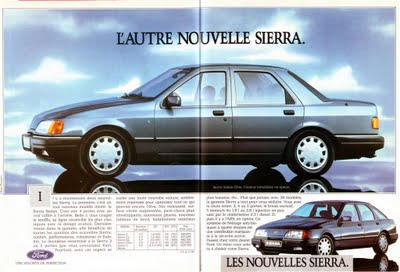
La Ford Sierra, bien accueillie en Allemagne, déçut en Grande-Bretagne (© http://fabvt.blogspot.com)

Pour diverses raisons, Ford n’a pas utilisé la Sierra mais l’Escort pour servir de modèle dans le développement de deux modèles à destination du marché américain : Tempo et Topaz. Suivies par la Ford Taunus ou la Sable, ces modèles ont contribué à la révolution-design chez Ford. Le magazine Fortune écrivait en décembre 1985 que “la renaissance de Ford US est due en premier lieu à la toute nouvelle sobriété de son design“. En interne, cette renaissance était appliquée par l’élévation du design au même rang que d’autres fonctions comme l’ingénierie. Ce qui était auparavant vu comme du “styling” était alors apprécié à sa juste valeur : esthétique fonctionnelle, études de faisabilité, évaluation des projets etc.

Cet ouvrage de référence, publié en 1986 pose les bases du design management, c’est à dire l’intégration du design dans la démarche d’innovation et de développement au même niveau que la R&D et le marketing, et non pas à la fin du processus, limitant son rôle au simple “habillage”. Il conviendra maintenant de se pencher sur de la lecture plus récente puisque les entreprises “exemplaires” dans les années 80 ne sont plus les leaders d’aujourd’hui (Sony, Ford, Olivetti).

Petit à petit, Look fait son nid

  • Il s’intéresse à Rossignol parce qu’il est “un passionné de sport” ?
  • Quel savoir-faire Look, “avec sa technologie carbone“, apportera-t-il au textile de Rossignol ?
  • Quels type de produits une “filiale commune autour des produits de Look” avec Quicksilver aurait-elle pu vendre ?

Look Cycle reprend le textile Rossignol


22/10/2009 | Mise à jour : 12:23
|

Les activités textiles de Rossignol resteront dans le giron d’un groupe français. Dominique Bergin, président de Look Cycle, a signé le 8 octobre l’accord de reprise de la filiale vêtements de la marque de montagne, pour un montant resté confidentiel. Look Cycle, spécialiste des cadres et accessoires de vélo en carbone et élue PME la plus innovante de France en 2009, a réalisé 32 millions d’euros de chiffre d’affaires lors du dernier exercice. Elle s’engage à conserver les 15 emplois de la branche qu’elle acquiert et dont l’activité s’est élevée en 2008 à environ 10 millions d’euros. Pour redynamiser la collection, Look Cycle investira près de 2 millions et fera appel au créateur Jean-Charles de Castelbajac. En revanche, la transaction ne concerne pas les fixations de ski de Rossignol, pourtant elles aussi de marque Look.

Le PDG de Look s’intéresse
à Rossignol

Christine Lagoutte
26/03/2008 | Mise à jour : 07:47
|

Depuis son entrée dans le giron de Quiksilver, la marque Rossignol n’a cessé de perdre de l’argent et de voir ses ventes reculer.

C’est une course contre la montre qu’entame Dominique Bergin, le président du spécialiste du cycle haut de gamme Look International. Le contrat avec la Fédération cycliste chinoise pour équiper sa centaine d’athlètes à Pékin bat son plein, avec à la clé la fourniture d’ici à l’été de 200 vélos.

Mais, ce qui occupe avant tout l’emploi du temps de l’ancien dirigeant de cliniques privées reconverti dans l’industrie, c’est l’offre de reprise qu’il compte présenter avec un fonds d’investissement sur le spécialiste mondial du ski Rossignol, mis en vente par son propriétaire américain Quiksilver, trois ans seulement après l’avoir racheté pour 360 millions d’euros. Le processus de vente, piloté par la banque JPMorgan, devrait démarrer début avril.

«Pourquoi je m’intéresse à Rossignol ? Parce que je suis un passionné de sport, que Rossignol est une très belle marque synonyme de performance, et que Look, avec sa technologie carbone, peut lui apporter un savoir-faire» , explique cet adepte du ski et de la petite reine. Les deux entreprises ont aussi une histoire en commun, Rossignol ayant racheté en 1994 le département fixations de ski de Look (son activité d’origine avant qu’elle n’entre dans le cycle au milieu des années 1980).

Protéger le «made in France»

«J’étudie des dossiers de reprise tous les ans, car mon ambition est de créer un groupe d’outdoor d’envergure internationale à partir du vélo» , souligne Dominique Bergin qui a redressé Look en dix ans, après une quasi-faillite. Alors que la Chine fournit 80% des vélos mis sur le marché dans le monde, Look continue de privilégier le «made in France» dans l’usine de Nevers qui emploie 180 personnes.

Cette volonté sociale de conserver l’emploi en France alors que les coûts de fabrication sont beaucoup plus favorables à l’étranger donne aujourd’hui à Dominique Bergin une certaine légitimité à regarder le dossier Rossignol. «Nous avions approché Quiksilver il y a quelque temps pour monter une filiale commune autour des produits de Look, mais le projet n’avait pas abouti», rappelle-t-il.

Combien est-il prêt à mettre sur la table ? Trop tôt pour le dire, reconnaît le patron de Look. Il estime que l’environnement financier actuel peut jouer en sa faveur : la contraction du crédit risque de réduire le nombre de candidats au rachat. Quant à Quiksilver il est pressé de vendre pour tirer un trait le plus vite possible sur cette aventure dans le ski et regagner les faveurs de la Bourse. Aujourd’hui, la marque Rossignol est toujours prestigieuse, mais sa situation financière est difficile. Depuis son entrée dans le giron de Quiksilver, elle n’a cessé de perdre de l’argent et de voir ses ventes reculer. En 2007, le chiffre d’affaires du pôle sports d’hiver a généré 379,2 millions de dollars, en baisse de 22% sur un an. Quant à l’endettement du groupe, il atteignait 120 millions d’euros lors du rachat en 2005 et aurait plus que doublé depuis.

Ceci étant dit, Rossignol a maintenant un magnifique siège social à Moirans (Rossignol a trouvé son nidVisite du siège de Rossignol), dans l’Isère (38) :

Rossignol-moirans-hq-world

Der Halo-Effekt, Phil Rosenzweig, Gabal Verlag

Halo Effekt Cover-jpg

Schon längere Zeit habe ich dieses Buch gesucht, und nun habe ich es endlich in Köln gefunden. Der Autor ist Phil Rosenzweig, der in Wharton promovierte und sechs Jahre lang an der Harvard Business Scool lehrte. Heute ist er am Institute of Management Development (IMD) in Lausanne tätig, In dem Buch „Der Halo-Effekt“ legt er den Finger auf die verschidenen Irrtümern „die uns den Blick für die Wahren Faktoren der Unternehmensperformance verstellen“.  Der Ursprung unseren verzerrten Wahrnehmung hinsichtlich der Unternehmensperformance ist oft auf ein Phänomen zurückzuführen : dem Halo-Effekt.

Seien es Studien von renommierten Professoren oder Zeitungsartikel aus der Wirtschaftspresse : sehr viele von ihnen stützen sich auf Daten, die vom Halo-Effekt befahlen sind. Mit diesem Ausdruck meint der Autor, dass unsere Wahrnehmung der Unternehmensperformance verschiedenen Faktoren unterliegt. Das erste Beispiel ist sehr aussagekräftig: Cisco Systems. Am Ende der neunziger Jahre wurde das von John Chambers geleitete Unternehmen in verschiedensten Wirtschhaftszeitschriften für seinen Erfolg gelobt. Dank seiner Kundenorientierung, seiner herausragenden Unternehmenskultur, der gezielten Akquisitionspolitik oder auch seinem CEO John Chambers, kam Cisco Systems an die Stelle wo es damals stand : an die Spitze. Als sich ab dem Jahr 2000 die Auftragslage schwindet und der Aktienkurs zu fallen beginnt, ändert sich auch der Ton der Spezialisten : Bei Fortune wurde aus Kundenorientierung “Arroganz“, bei der Unternehmenskultur sprach mann vom “Bad einer Kultur der Zuversicht” und die Akquisitionspolitik sei einer der Felder wo “das Unternehmen im Verlauf des vergangenen Jahres [nicht] geglänzt [hat]“. Dabei erwähnt keine dieser Zeitschriften irgendwelche Veränderungen, sei es im Führungsstil, in der Vorgehensweise des Unternehmens oder im Wettbewerbsumfeld.Fazit : unsere Wahrnehmung eines Unternehmens wird stark von seiner Performance beeinflusst.

John Chambers unterstützt die NY Yankees-jpg

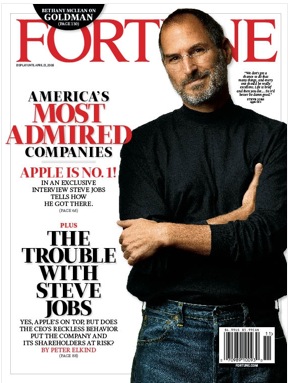
Der Ausdruck wurde zum ersten Mal vom Psychologen Edward Thorndike verwendet, als dieser während des Ersten Weltkriegs die Tendenz “schönen” Soldaten bessere Fähigkeiten zuzumuten als anderen zu erklären versuchte. Doch auch heute ist der Halo-Effekt sehr Präsent : in Umfragen, bei der Bewertung von Mitarbeitern, von Führungskräften usw. Zum Beispiel ist das FortuneRanking der meistbewunderten Unternehmen der Welt sehr stark vom Halo-Effekt betroffen : Phil Rosenzweig sagt in seinem Buch dass “wenn […] ein Unternehmen hohe Gewinne […] meldet, ist die Versuche für die von Fortune Interviewten groβ, dem Unternehmen auch gleich noch eine hohe Produkt- und Dienstleistungsqualität, Innovationsfreude, ein gutes Management, eine Ausgeprägte Attraktivität als Arbeitgeber usw. zu attestieren“.

Steve-jobs-cover-jpg

Doch der Halo-Effekt sei nicht die einzige Täuschung denen wir bei der Bewertung von Unternehmen untersetzt sind. Zum Beispiel erwähnt Phil Rosenzweig unsere Tendenz, einen einzigen Faktor für eine gute Unternehmensperformance verantwortlich machen zu wollen (“Die Illusion der einzig wahren Erklärung“), oder dass wir dazu neigen universelle Lösungen finden zu wollen (“Die trügerische Metapher von den Naturgesetzen der Unternehmensführung“). Und dabei spricht er nicht nur von Journalisten und Managementgurus, aber auch von renommierten Professoren aus Harvard oder Stanford.

Um diesen Fehlern vorzubeugen gibt der Autor keine neuen Erklährungen, sondern er erwähnt zwei wichtige Punkte der Unternehmensführung : dass strategische Entscheidungen immer mit einem gewissen Risiko verbunden sind, und dass die Ausführung einer gewählten Strategie gewissen Zufallsfaktoren nicht entweichen kann. In anderen Worten, “nichts funktioniert wirklich” ! Mit einem Hauch Optimismus endet das Buch dennoch, unzwar indem Phil Rosenzweig drei vorbildliche Manager erwähnt : Robert Rubin mit seinem “Wahrscheinlichkeitsmanagement”, Andy Grove der Intel zum Erfolg brachte und Guerrino de Luca, CEO von Logitech. Für mich ist die Gemeinsamkeit dieser drei Manager jene der Bescheidenheit. Es gibt keine Wunderrezepte, es wird nie welche geben und der Erfolg eines Unternehmens ist relativ und zeitbegrenzt.