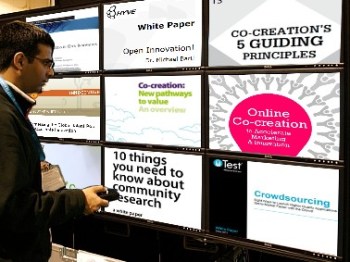
Whitepapers about crowdsourcing, co-creation and open innovation

screens in tiles layout

Last year, I compiled a selection of academic representations of crowdsourcing, co-creation and open innovation. The post is one of the most popular one of this blog, which indicates that there’s quite some interest in these topics. Now, let me share some whitepapers in a similar manner. Generally speaking, a whitepaper is an authoritative report or guide that helps solve a problem (Wikipedia). It is very common for companies to write commercial whitepapers today, designed to promote their products or services. Leading actors in the fields of crowdsourcing, co-creation and open innovation have written numerous whitepapers to promote their respective categories, and here’s a selection of them.

I only selected whitepapers that have been written and published by actors of the field, like consultancies and platforms, leaving aside brand-initiated documents. Also, the whitepapers are listed in some categories (crowdsourcing/co-creation /open innovation), but the companies might also be associated to several of then (for example, eYeka positions itself on co-creation, but uses crowdsourcing and is sometimes also associated to open innovation) Continue reading →
A series of books about experience design: J’ADOOORE

j'adooore

Patricia Gallot-Lavallée calls herself an experience designer. She leads a consulting firm called Kenazart Experience Designers and is currently promoting a 6-part book called J’adooore – Six ingredients that create fans. The objective is to highlight what it is that make brands and products desirable:

  • Beauty
  • Scarcity
  • Suspense
  • Surprise
  • Humor
  • A “secret ingredient”

She was kind enough to send me the two first parts of the series (1) beauty and (2) scarcity. It features a very diverse set of examples and interviews, and the overall  idea if recognizing patterns of brand success is also interesting. However, I must say that I was surprised by the almost autobiographic tone of the book. The author speaks a lot about herself, about well-known brands and not-so-well-known experts. Surprisingly, she doesn’t feature a lot of examples of her own consulting work neither, which would have been good to promote her expertise. I’m curious how the next “ingredients” will be explained, and what the “secret ingredient will” be!

Is there a Chinese sense of creativity?

what chinese want book cover

Don’t expect an extensive literature review about the Chinese people 😉 This is just a post based on a book review of What Chinese Want, Tom Doctoroff’s last book about – guess what – Chinese culture. Tom Doctoroff is CEO of the Chinese branch of adverising giant JWT, lives in Shanghai and has dealt with a lot of Chinese companies. In his book, he shares his view of the modern Chinese consumer, underlining the cultural challenges that arise when companies want to target the Chinese market. This blog post especially focuses on the passages about creativity and advertising, which are topics that particularly interest me! Continue reading →

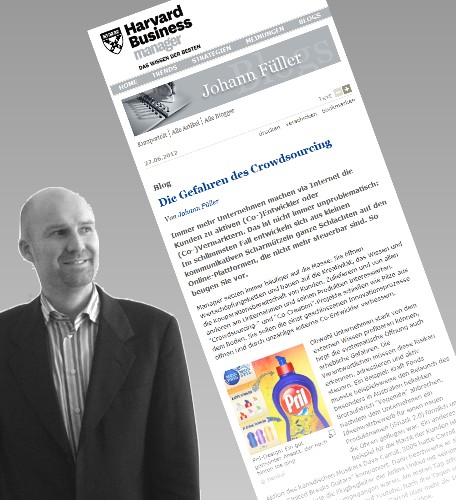
The dangers of crowdsourcing (Johann Füller’s post on Harvard Business Manager)

harvard-business-manager-blog-post

Johann Füller is CEO of Hyve AG, a company that organizes crowdsourcing for co-creation and/or open innovation purposes, and professor at the University of Innsbruck (Austria)

I already blogged about academic articles in French that should have been translated into English, because they’re pretty darn interesting and useful for people interested in co-creation or user innovation. This post is about a blog post that Johann Füller, an experienced researcher and businessman, wrote in German on Harvard Business Manager. It’s called Die Gefahren des Crowdsourcing (The Dangers of Crowdsourcing) and highlights some of the dangers that brands should be aware of before kicking off a crowdsourcing campaign. Not only does he give some examples, but he also cites 3 often encountered sources of crowd-resistance, as well as 5 ways to avoid failures. This post is an unedited translation, I only changed the illustrations and added a couple of links in the text. Continue reading →

Defining creative crowdsourcing (crowdsourcing of creative activities)

creatividad

“Creatividad”, an ad for an insurance company from Peru (via adsoftheworld.com)

In the first year of writing a PhD thesis, you’re basically asked to define key terms and to set up a research question. I’m particularly interested in crowdsourcing, and more particularly crowdsourcing of creative tasks. This post proposes to define the term creative crowdsourcing, or crowdsourcing of creative activities, as it hasn’t been defined yet (to my knowledge). I would love to have your thoughts about the proposed definition, it can only help me refining it in order to improve my doctoral dissertation! Continue reading →

Crowdsourcing and Marketing: Should companies try to target specific audiences?

crowds

Crowdsourcing and marketing, a tough equation to solve. Why? Because crowdsourcing is about openness whereas marketing is about targeting; crowdsourcing offers serendipity when marketing is looking for predictability. Brands often want to target a specific target audience: “Can you only ask Chinese people to participate?” or “Is it possible to accept only the users of my product?” or even “I want only ideas from women from 25 to 35 years, is that possible?” are questions that often get asked while discussing the possibility to launch a crowdsourcing project. The truth is that the internet is a global medium and that everyone can potentially participate in a crowdsourcing challenge. Targeting is difficult, and only few succeeded. Continue reading →

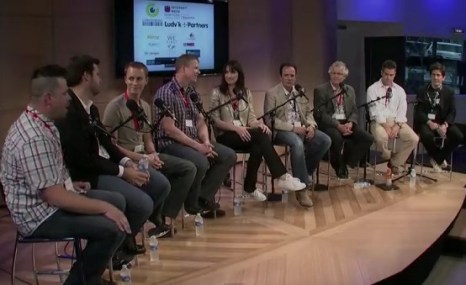
How crowdsourcing is changing advertising: insights from an expert panel

internet week 2011 expert panel

The experts on stage during Internet Week 2011: Mike Martoccia, Peter LaMotte, Epirot Ludvik Nekaj

I already blogged about the evolution of creative crowdsourcing plateforms, saying that companies mostly adopt one of 3 models: agencies, platforms & crowd-sources. To catch up on this, I’d love to share some very interesting excerpts of last year’s Internet Week panel about creative crowdsourcing. The debate focused on how crowdsourcing was changing the advertising landscape, and was moderated by Mike Martoccia. Intendees were GeniusRocket’s CEO Peter Lamotte, 99design’s co-founder Matt Mickiewicz, AdHack’s CEO James Sherrett, Victors&Spoils’ COO Claudia Batten, Collective Bias’ CEO Johan Andrews, Chaordix’s VP of Business Development Randy Corke, Tongal’s CEO Rob Salvatore and Ludvik+Parters’ CEO Epirot Ludvik Nekaj. Continue reading →