My Favorites Of October: Singapore’s Tight Data Surveillance, Google’s Investment In Cinematic Reality & 7 Advantages A PhD

Image via FlickrIn October, which I spent in Singapore for work, I read and watched a couple of interesting things (note that I changed this series from “My Favorite Readings…” to “My Favorites …” because I’ll feature more images, videos and interactive sites rather than just articles from now on).

One of the articles is a great Foreign Policy article about Singapore’s electronic surveillance policy, explaining how the government is watching Big Data to “protect national security [and] engineer a more harmonious society.”

Other topics include articles about the specificities of the academic job market, a start-up innovation program launched by Coca-Cola, a documentary about the creative brief, a cool creative filmmaking project launched in 3 world cities (including Paris), Google’s latest investment and more.


Continue reading →

Discussion With LEGO’s Community Strategist, Yun Mi Antorini

Yun Mi Antorini

LEGO, one of the most creative and loved brands in the world, attributes a big part of its success to its thriving fan community. Almost 10 million Facebook fans, over 180,000 Twitter followers or a 10,000+ member LEGO Ideas community show that the brand and its product have huge traction among kids and adults alike (watch this TED talk to have a short impression of the phenomenon). The company has not only recognized the power of this fanbase, realized how valuable it is, but they actively encourage its development and look for its well-being – from a passive observer to an active promoter.

I’ve already blogged about community management in a crowdsourcing setting, now here’s an interview of LEGO’s “Community Strategist,” Yun Mi Antorini, whose job is – basically- to make that community happy (how cool is that?). Continue reading →

How Do Countries’ Cultural Norms Impact Global Creativity? (Paper Forthcoming in @ASQJournal)

The cover of an ASQ issue from June 2012, which I chose only because of the bicycle! (Image via ManagementINK)

The cover of an ASQ issue from 2012, which I chose only because of the bicycle

Here it is, my (our) first publication in a peer-reviewed management journal. We have just received our acceptance letter from Administrative Science Quarterly (ASQ), a prestigious quarterly journal that publishes the theoretical and empirical papers on organizational studies, for our paper “How Culture Impacts Creativity: Cultural Tightness, Cultural Distance, and Global Creative Work.

To make it short, the paper looks at the effect of culture (the extent to which countries have strong cultural norms and enforce them strictly) on peoples’ likelihood to participate in, and succeed at, global creative tasks. It advances a new theoretical model, the “Cultural Alignment Model of Global Creativity,” to understand how culture impacts creativity in a global context.

Here’s a bit more about the paper, and about the publication process – which I went through for the first time. Continue reading →

Does Crowdsourcing Deliver On Its Promise (For Creatives)?

Video Contest Website Landing Pages

Recently, in a thread of email exchanges with a successful video contest participant who won numerous contests for many prestigious brands, I was struck by this person’s response to my “how are things going?” question. That person replied: “Unfortunately while I wish I had gotten some ‘real’ work all these contests haven’t had any effect on my professional career and I’m still struggling to get work!

This bugged me, because professional advancement and career opportunities are a big part of the promises of crowdsourcing. My experience and research confirms that many crowd members participate with this in mind (some call it hope labor), so I wanted to know more. “I’m a little bugged by [the fact that he was still looking after all these wins, does it mean that crowdsourcing doesn’t deliver on its promise?” I asked. Here’s the response from the filmmaker, and a call for discussion.

Continue reading →

My Favorite Readings in August: The Creative Process Illustrated, Cycling Across The USA & PhD After 40

Photo by Golem13.fr

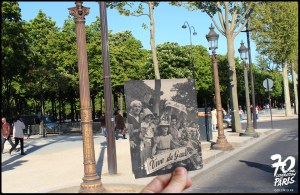
Some of the tweets shared in this post feature memorabilia. Hence this photo of Paris in the summer with a photo of 1944 (click to see 49 more)

This month marked the 70th anniversary of the liberation of Paris. The photo on the left is one of many others that the blog Golem 13 has published on June this year, morphing old photographs into the exact same photo – 70 years later. A great project.

This month, I’ve read many interesting things about innovation, academic education, creative inspiration, object conservation or patriotic dedication. The very last tweet wraps up the post nicely with another Paris-themed illustration, an animated one. Continue reading →

My Favorite Readings in June: Tough Academic World, Corporate Tweeting & Wikipedia Across Cultures

The very first IKEA catalog. One of my favorite reads this month is about IKEA (image via ikea.com)

This month, many things caught my eye and attention. Here’s a selection of news, events and articles that I enjoyed this month. A couple of them deal with academia, again, including people who complain about the toughness of the job. Others relate to social media, the internet of objects, consumer creativity or American politics. Just browse through it and see what catches your eyes.

Also – self-promotion is your friend – make sure to read my latest blog post which I published on Medium. Medium is a sleek-looking new publishing platform, very easy to use, and highly aesthetic. Continue reading →

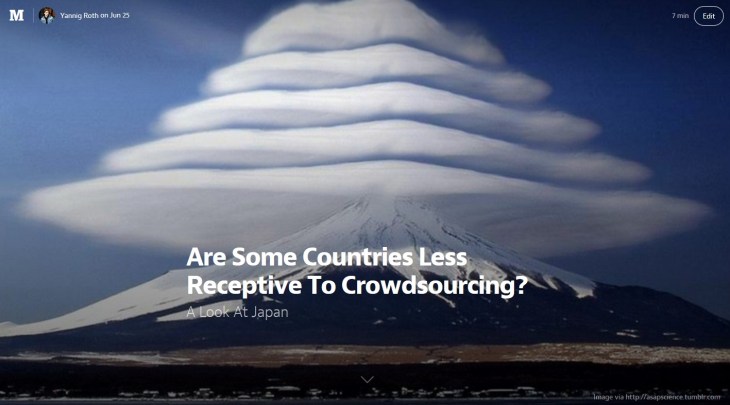
Are Some Countries Less Receptive To The Idea Of Crowdsourcing? A Look At Japan

Crowdsourcing Japan

Click on the image to read my post on Medium

Technology is global, companies and individuals are globally connected, and crowdsourcing is a global phenomenon. Anecdotal evidence shows that Europe and the U.S. are well-populated with crowdsourcing participants (see also here), but that still doesn’t say much about potential differences in acceptance of crowdsourcing across the globe (that could be an entire thesis!). I wanted to focus on one country: Japan. Is there something about the idea of crowdsourcing that could repell Japanese people?

As a nation, Japan scores high in cultural tightness and uncertainty avoidance, two cultural constructs that may lower willingness to embrace change and to take risks… But let’s not get into these academic cultural indices, let’s be pragmatic. I did a little bit of desk research to find out more, and shared my thoughts on Medium..

Read my post here