Design Thinking for social innovation, the “third way” to empower the Third World

The issue of the Stanford Social Innovation Review was on a corner of my desk for a while, but I finally managed to find the time to read this article which makes the cover-story of Stanford’s journal : Design Thinking for Social Innovation, by Tim Brown and Jocelyn Wyatt. Both are executives at IDEO, a global Design design firm which has worked with notorious companies like Kaiser Permanente or Shimano (see this previous blog post). In this article, the authors highlight the social scope of Design Thinking, explaining in what way it can help very poor people to improve their lives.

catalog

Design For The Other 90%, an exhibition gathering numerous social design projects in New York's Cooper-Hewitt National Design Museum (retrieved from other90.cooperhewitt.org)

There’s maybe no other domain in which human-centered design is as important as in social issues. As the article says, “social challenges require systemic solutions“, because these problems are wicked, and demand to adress peoples’ real needs, in the most effective possible way. Look at d.light, created by two students of Stanford’s Institute of Design : what started as a way to provide affordable and safe light for people without access to electricity has now become a global company with an efficient distribution, sales & marketing strategy. And they want to “have improved the quality of life of 100 million people” by 2020.

“Design thinkers […] consider what we call the adges, the places where “extreme” people live differently”

But in what is Design Thinking responsible for improving poor peoples’ lives ? The innovation approach has already been embraced by successful companies like Procter & Gamble or RIM (Blackberry), as one of the theory’s fathers Roger L. Martin describes in his book The Design of Business. Nonprofit organizations are discovering Design Thinking as a way to find “high-impact solutions [that] bubble up from below rather than being imposed from the top“. An interesting example is provided by the authors when they depict Jerry and Monique Sternin‘s approach to decrease malnutrition in Vietnam in the 90’s. They found so-called “positive deviants“, people whose behaviors revealed a viable solution to overcome nutritional flaws : they added tiny shrimps, crabs and snails from rice paddies to the food, and they fed the children multiple smaller meals. By offering cooking courses to families, 80% of the 1,000 enrolled children became adequately nourished. Design Thinking is about finding creative ideas, including those of deviants who may have viable solutions to problems too.

The approach relies on thinkers being “T-shaped“, an expression introduced by Berkeley-professor Morten T. Hansen (the article was already published in Harvard Business School’s Working Knowledge in 2001). This means that beside having a deep knowledge of a specific field, the design thinkers has a broad understanding of other disciplines, as well as being open, curious, optimistic and practice-oriented. This last point is important because the implementation-part of the problem-solving system requires prototyping and trial-and-error experimentation to get to a solution. When VisionSpring asked IDEO designers to help them to design a low-cost eye-screening process for children in India, it took them long to discover that the children were intimidated by the pressure of the experience. The system was designed accordingly and VisionSpring since conducts numerous screenings with children and adults. “VisionSpring’s design efforts included everything other than the design of the glasses”, say Brown & Wyatt, thus focusing on marketing and implimenting their program.

modelling

The automotive industry has adopted a Design Thinking approach since decades, spending tromendous amounts of money in prototyping and testing. Here's the interior clay-modelling process of Audi's Le Mans Quattro presented in 2003 (retrieved March 2nd from http://www.carbodydesign.com)

This culture of testing with prototypes aims to find the best possible solution by finding unforeseen problems and anticipating unintended consequences in order to achieve a viable product. In has book The Designful Company, Marty Neumeier encourages companies to think wrong, because “hundreds of ideas ranging from the absurd to the obvious” finally make up a team’s strength and creativity. Sponsored by the Bill & Melinda Gates Foundation in 2008, IDEO designers developped a methodology by which organizations can apply Design Thinking themselves. You can download the Human-Centered Design Toolkit free under http://www.ideo.com/work/item/human-centered-design-toolkit/

By the way, the term “third way” used in this post’s title is used in the article to describe the alternative that Design Thinking represents to:

  1. Feeling & intuition and
  2. Rationality & analytical thinking.

Check out the Wikipedia article if you want to find out more… or read Tim Brown’s Change by Design.


The Dumbest Generation, Mark Bauerlein, Penguin

Book cover

The book came out first in May 2008

As I walked around in the UWF Bookstore a couple of days ago, I fell on this book with the provocative title “The Dumbest Generation, How the Digital Age Stupefies Young Americans and Jeopardizes Our Future (or, don’t trust anyone under 30)“. Labelled national bestseller and praised by renown newspapers all over the front & back covers, I wanted to find out more. Not only that I’m curious and that I want to discover what American academics think about my peers, but also because that stuff certainly applies to us Europeans ! By the way, the title “The Dumbest Generation” comes from Philip Roth’s novel The Human Stain, published in 2000.

Public lecture

Mark Bauerlein at Augusta State University in November 2009 - Retrieved from asupr.com on February 2010

The author is Mark Bauerlein, English professor at Emory University in Atlanta, Georgia, where he lives with his family. He was appointed director of Research & Analysis at the National Endowment for the Arts (NEA) in 2004, which is a cultural federal agency promoting fine arts and litterature among Americans. He also writes for various newspapers like the Wall Street Journal, The Washington Post, The Chronicle of Higher Education and other periodicals like The Yale Review or the Publications of the Modern Language Association (PMLA). He seems to be highly engaged in education and litterature research as I figured out while reading his book (see here, here or there).

The message that Bauerlein wants to deliver is the following : how come that the youth has so little knowledge while surrounded by so much information ? Based on a lot of survey & study results like Reading at Risk (which he oversaw while at the NEA), the statement basically says that young Americans “don’t know any more history or civics, economics or science, litterature or current events“. According to the book, Generation Y spends stunning $172 billion a year while saving only $39 billion… “marketers had better be ready for it“, it says – regretting that material possessions matter more than intellectual possessions.

“What do you think of student ignorance and apathy ? the interviewer asks the sophomore. “I dunno and I don’t care”

American universities still have the world’s best engineering programs, he says, but more than half of all the doctorates come from abroad, and it’s no secret that in a couple of decades knowledge will shift to the Asian continent. The XIXth century was European and the XXth century was American, the XXIst will be the Asian century. The knowledge deficits cover various disciplines like history, civics, science and fine arts according to Bauerlein. The 2006 National Survey of Student Engagement reported that 27% of first-year college students “never” attended an art exhibit, gallery, play, dance or other theater performance.

Adolescents

"The sole book event, qualifies more as a social happening than a reading trend" (about the Harry Potter phenomenon) - Picture retrieved from bbc.co.uk on February 2010

Generation Y is the first one to ever trumpet what Mark Bauerlein calls a-literacy : knowing how to read, but choosing not to ! It is proven that regular readers score better at knowledge tests and learn at a faster pace than those who don’t – it’s also called the “Matthew Effect” – and young Americans seem to disregard reading today. The question is : does this generation have other, maybe more valuable skills, like some kind of digital literacy or “E-literacy” ?

Some say that nowaday’s youth has a particular mental flexibility, a “general deployment capacity” acquired by multi-tasking and regular handling of information and technology. The author supports that we may be “mentally agile“, but also “culturally ignorant” ! I may not totally agree with that one, at least I think that he underestimates these skills – or overestimates the importance of academic knowledge…

shelf

Laptops (ond now the iPad) to replace books ? - Photo from an Apple Store retrieved from http://www.dynamist.com/weblog/archives/001802.html in February 2010

Is Apple‘s “decisive lifestyle choice” awkward or even damageable for uorselves ? They designed a whole new way of approaching information by making it more visual and pleasurable, and I think that’s not were the problem lies. As Bauerlein implies, the problem is the freedom of choice that we all have (and claim!). Hence, our web-based environment has become “a consumer habitat, not an educational one“, where peer-pressure and peer-judgement matters more than “vertical modeling” such as relations with teachers, parents, employers which is so crucial to gain maturity. The youth downplays tradition, history and experience in favor of short-sightened social interactions, which leads a kind of Peter Principle (“by proceeding in school and social circles without receiving correctives requisite to adult duties and citizenship. They reach a level of incompetence, hit a wall in college or the workplace, and never understand what happened“).

Mark Bauerlein concludes his book by refering to the youth movements of the 60’s and 70’s who “denounced the legacy of their elders […] but at least they knew them well“, which he calls informed rejection of the past. Today, we are facing an “uninformed rejection of the past, and then complete and unworried ignorance of it“. Not that he wants a generation of elite intellectuals, but he highlights the importance of lesser intellectuals whose general knowledge is so important to educate the coming generations – what kind of parents will we be in 20 years ? “If social life has no intellectual content, traditions wither and die“.

A very pleasant book which highlights a worrying evolution of a part of the youth. Sometimes a bit loaded in survey results but well-written and interesting. I definitely recommend it. If you want to find out more, visit dumbestgeneration.com .

Rhodes Scholarships unite academic and sporting excellence

On January 7th the University of Alabama won the Rose Bowl Game against the Texas Longhorns. During on of the numerous breaks, a focus on Alabama’s quarterback Greg McElroy precised that he “applied for Rhodes Scholarship”, I was curious and wanted to know what it was and my friend William told me it was “kind of a particular program for very bright students to go study abroad“. McElroy might go study in one of the world’s most prestigious academic programs at Oxford University in 2011… with a Southeastern Conference Championship ring on his finger.

The Rhodes House on the Oxford Campus. Even Einstein delivered lectures here (in 1931)

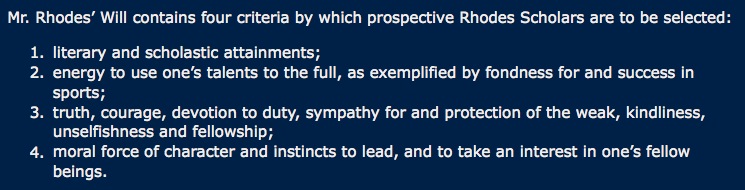
Rhodes Scholarship was created in 1902 after Cecil John Rhodes’ death. His will was to “improve the world through the diffusion of leaders motivated to serve their contemporaries” by bringing bright students from all over the world to study at Oxford. Nowadays, about 80 students are granted Rhodes and go to the famous English university to study various subjects like Medicine, Politics, History, Economics, Philosophy etc. (see the list of 2009’s 32 American Rhodes scholar) According to Cecil Rhodes, who graduated from Oxford before gonig to South Africa where he founded the mining company De Beers, the university offers an optimal environment to learn and become a leader (“Wherever you turn your eye—except in science—an Oxford man is at the top of the tree“). The following is a screen capture of the Rhodes Scholarship’s current website which list general skills that a Rhodes applicant is supposed to have :

Retrieved from RhodesScholar.org/faq on January 28th

In order to get there, quarterback McElroy not only has to be a good sportsman, but he’ll also have to write an essay and pass quizzes on current events, as well as having the full support of his university (written statements, references, transcripts etc.). One of the major steps however is the interview with Oxford Alumni and former Rhodes Scholars to weigh up the student’s motivation, integrity and his real engagement. According to Al.com, the Marketing student had only one single “B” in his college years, which proves the applicant’s academic excellence.

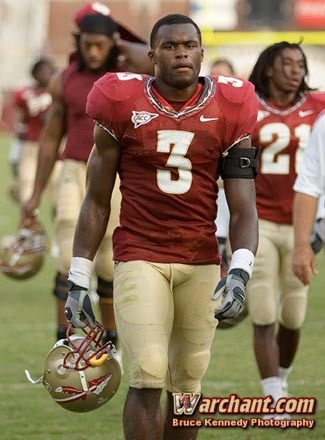
What Alabama’s McElroy would like to achieve, Florida State’s Myron Rolle did it in 2009 : he studied Medical Anthropology. When asked what his goals are (beside being a first pick in the NFL draft), he answers that he wants to attend medical school in order to become a neurosurgeon and help the needy in underdeveloped countries like the Bahamas. This article is from 2009, and I just watched an interview from the very same Myron Rolle on ESPN Sports Center – his answer sounds as convincing as a year ago. His next goal, however, is to catch the NFL scouts’ attention at the SeniorBowl in Mobile (a 60 miles away from Pensacola) this week-end.

And because I’m a passionate cyclist, I can’t get around a last example of a Rhodes Scholar : Rosara Joseph from the University of Canterbury, New Zealand. On the road bike, she is a silver-medalist at the 2006 Commonwealth Games ; on the mountain bike she finished 9th of Beijing’s 2008 Olympic XC-race. At Oxford, she achieved a Bachelor of Civil Law and is currently preparing her PhD to become a lawyer.

Rosara Joseph riding a criterium for the NZ National road cycling team during the 2007 Bay Classic Series - Retrieved from Wikipedia on January 28th

SPORT RULES !

Fighter Brands : perverted marketing ?

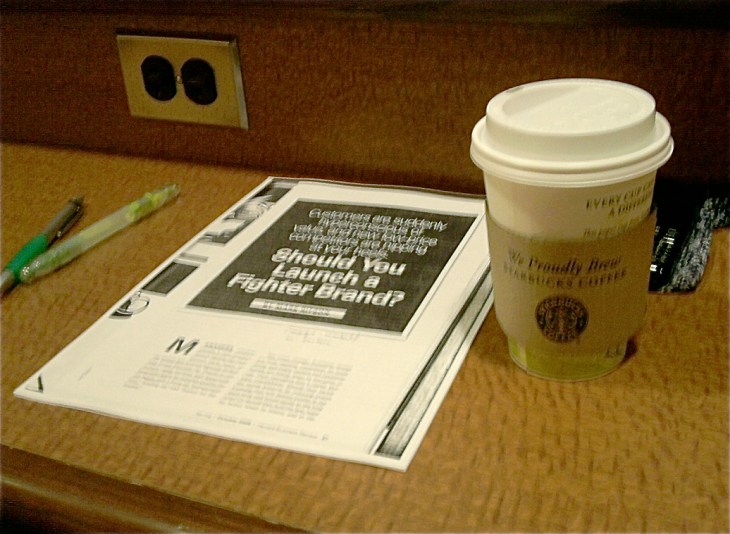
My desk today @ the UWF Starbucks

Currently studying at the University of West Florida, I’m enrolled into the Marketing Strategy course from Dr. Keller one a subject we’ll discuss is the concept of Fighter Brands (or Finghting Brands). In Should You Launch A Fighter Brand?, Mark Ritson from the Melbourne Business School says that “a fighter brand is designed to combat, and ideally eliminate, low-price competitors while protecting an organization’s premium-price offerings” (it is therefore different  than the “marque combat” as defined by the Georges Chétochine). Successfull fighter brands are examples such as Busch Bavarian beer, Intel Celeron processors, Logan by Renault etc.

Qantas launched Jetstar, the "perfect fighter brand" according to Mark Ritson (Picture retrieved from the Sydney Morning Herald website : http://www.smh.com.au)

Different evolutions may explain the emergence of fighter brands : the growing market share of private labels, the trends of low-cost products, the infidelity of customers, their ever-changing expectations or simply the current economic crisis… At school we attented a presentation of the French research and survey organization CREDOC in which we were told that the French’s appreciation of low-priced products compared to branded products sank in 2009. Even if sales of private labels now reaches 34% of the supermarkets’ sales in France, brands’ products are still perceived better quality. This shows that consumers still trust brands and value their products, but may don’t necessarily ask for premium products (anymore) : an insoluble equation ?

No, they launch their fighter brands ! This post from another wordpress-blog (lowcostattitude, in French) gives some example of “popular products” launched by Nestlé, Danone &co. As our CEDOC-lecturer told us in his presentation too, we can see that the middle of the product ranges are deserted in favor of premium and low-cost products, using the hourglass-analogy. Brands have to keep customers tempted by low-cost and/or private label products as well as recuperate those who already deserted… but it’s far more complicated than that : Will it cannibalize the other brand’s portofolio’s products ? What should I highlight in the new alternative that I offer ? Will customers be lost ? How much does it cost to launch a fighter brand ?

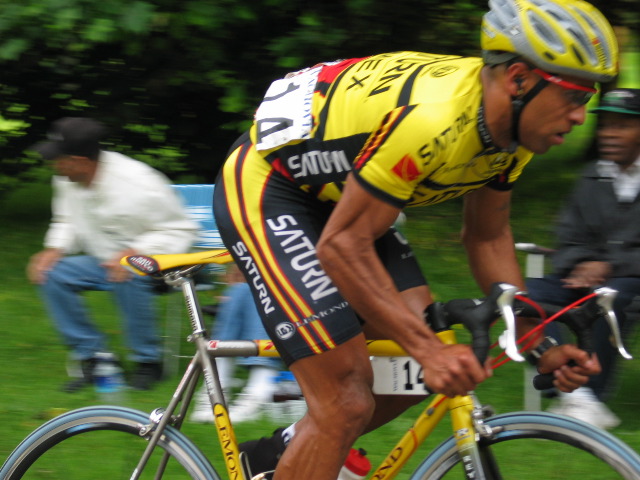
Saturn cars' sales pulled up immediately in 1990... but GM's company -who was a long-time sponsor of cycling : here's Ivan Dominguez riding for Saturn-Timex in 2003- was a financial disaster. (Picture retrieved from dailypeloton.com)

One example is the automotive brand Saturn, launched by General Motors in 1985 to counter the Asian competition making affordable and practical, fuel-efficient cars. As described by Mark Ritson in his article published on October 2009 in the Harvard Business Review, the cars “proved an immediate success and quickly achieved the highest repurchase rates and customer satisfaction scores in the industry“. The cars were cheaper than GM’s products… but were far too expensive to actuallty produce. Very high develoment costs, an expensive production plant, dedicated dealer-network and an independent marketing & branding budget : the business model simply wasn’t profitable !By 2000, despite continuing sales success, Saturn was losing $3,000 for every car it sold“, says professor Ritson in his article. General Motors eventually reformed the whole brand, amongst which was the higher integration of the brand into GM, “and then sales dropped off“. The current crisis, striking GM as hard as the other Big Three, will lead to the definitive shut down of Saturn by October 2010. Renault is doing better with it’s Logan brand…

Why perverted marketing ?

As my Marketing Management book states : “the marketing concept means that an organization should seek to make a profit by serving the needs of customer groups“. Therefore, marketing originates with the unfulfilled need of customers to offer them a product which suits their expectations (eventually the company will promote the product, measure the ROI etc.). Fighter brands emerge from the success of (or the threat posed by) a competitor to which a company creates an alternative offer. In other words : it has a product-oriented vision, dazzled by someone else’s success to push a product in the market. That’s not marketing. And that’s why some companies fail in that strategy ; Kodak launched Funtime, a cheap alternative to its Gold Plus film aimed to counter Fujicolor’s Super G film, but Funtime’s sales cannibalized Gold Plus more than it damaged Super G. Kodak eventually withdrew the product. Jetstar is an example of a successful fighter brand : deep analysis of the market allowed them to create a concept aligned with the customers’ needs.

If you are interested in the subject and seek a deeper insight, read Mark Ritson’s article in HBR. Highly interesting !

Cycleurope refreshes traditional brands Gitane & Peugeot

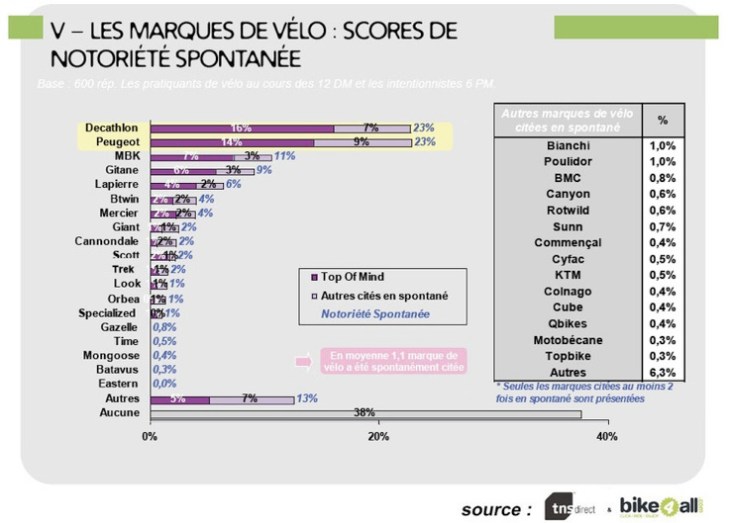
As a survey led in 2008 by TNSDirect for bike4all.com, and related by B2BIKE.com, shows, bicycle brands like Peugeot and Gitane are (still) top-of-mind brands in France. Although these brands stopped selling bikes for several years now, these “traditional” names are quoted by a lot of Frenchmen, one of the reasons might be that Poulidor, Mercier and even Gitane-bikes are sold at very cheap prices in French supermarkets.


Retrieved from B2BIKE.com on January 11th 2009


As the previous histogram shows, brands which don’t exist anymore are very often quoted by the interviewees : Decathlon nowadays sells bikes under the brands B’twin (6th position) and Rockrider (not quoted), Peugeot has marginal bicycle sales and is distributed by about 40 authorized Peugeot-dealers, Gitane and Mercier are currently cheap supermarket bikes and Motobecane doesn’t exist since 1984 at all (the brand MBK survived to Motobécane’s bankruptcy and as a fair spontaneous notoriety).

Even though it reveals that the French bicycle market offers a huge number of brands and that consumers seem to be lost within that abundant offer, Cycleurope tackles this issue in a quite courageous way : they bet on the revival of these brands ! Strengthened by the notoriety of Gitane and Peugeot, and fairly aware of the asset that it represents, the Grimaldi Group (owner of Cycleurope, which already runs brands like Bianchi and Monark) decide to take the plunge and awake Gitane and Peugeot (at the request of Peugeot Cars HQs). The existing Gitane range will indeed be expanded with a top-of-the-range brand called Definitive Gitane, and Peugeot will extent its distribution network and eventually launch a Peugeot e-Bike.


velo

"The One" bike that Definitive Gitane provides to the Saur-Sojasun team. Gorgeous. (photo from http://www.saur-sojasun.com/goodies.php)


To give credit to Gitane’s revival, Cycleurope Industries developped an additional  range of high-performance bikes that meet the competitor’s expectations : cross-country hardtrails and fullies in the MTB-segment, a small range of road bikes topped by “The One“, on which the pro-riders from Saur-Sojasun will compete in 2010. Smaller partnerships were announced like  the creation of the French Team ASPTT Definitive Gitane on the national MTB stage.


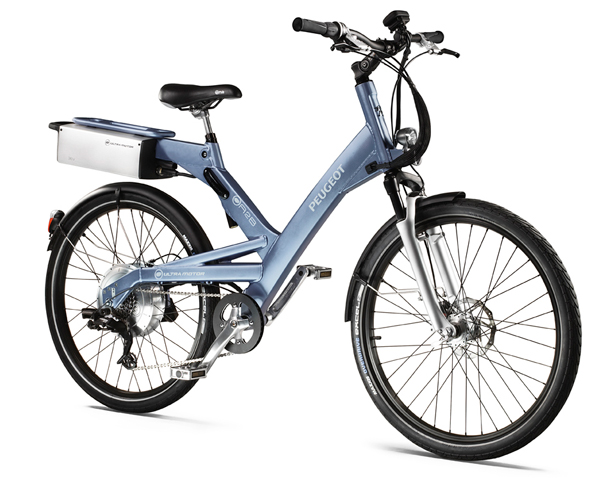
The Peugeot A2B hybrid bike (in blue) developped with Ultra Motor (about 2300€). Retrieved on January 11th 2009 from jepedale.com


Peugeot bikes (the car manufacturer recently unveiled a new logo) will be manufactured in the French factory of Romilly/Seine and will be sold by Cycleurope, as Toni Grimaldi told Bike Europe a couple of days ago at the official launch of Peugeot Bikes, and they will be distributed both in Cycleurope’s dealer-network (France and abroad) and via Peugeot car dealers, although I guess that’s not the distribution channel that brings them the highest number of sales… The range will include a road racer, a mountainbike, a hybrid/trekking and a city bike which will all be painted black&white. As Peugeot now pushes into the market of electric vehicles, they announced the development of an e-Bike with the Amercians from Ultra Motor.

The move is courageous but clever : two brands with a very high awareness among – at least France’s – cyclists make a credible comeback on the front stage. I’ll certainly be watching the Definitive Gitane bikes on the roads at pro races, Peugeot may gain significant market share by flooding Velo & Oxygen-stores in France and Peugeot-dealers worldwide with their tiny bicycle range. Good luck !

Petite philosophie du design, Vilém Flusser, éd. Circé

Alors que je tuais le temps entre deux rendez-vous à Paris dernièrement, je n’ai pas pu m’empêcher à entrer dans la librairie Vrin, qui rassemble une quantité impressionnante de livres sur divers sujets philosophiques. Dans le rayon dédié à l’art et à l’esthétique, je suis tombé sur la Petite philosophie du design du philosophe tchèque Vilém Flusser et je n’ai pas pu m’empêcher de l’emmener. Celui qui a aussi écrit Pour une philosophie de la photographie en 1983 défend la thèse que notre avenir sera affaire de design.

Né à Prague en 1920, l’auteur émigre de son pays natal en 1940 et s’établit à Sao Paolo, où il enseigne notamment la philosophie des sciences puis devient, en 1963, professeur de philosophie de la communication et des médias (à ce sujet, je vous conseille également le livre de Dominique Wolton). Il a passé la fin de sa vie entre la France et l’Allemagne (le texte de l’essai a été traduit de l’allemand) et décède dans un accident de voiture alors qu’il se rendait à une conférence à Prague en 1991. Ses textes sont courts et très simples à lire, comme ce livre qui comprend seulement 85 pages de texte. Mais quel régal.

Après un bref rappel étymologique des origines du mot design (signum, le signe), l’auteur entame sa réflexion en affirmant que le mot design a “investi la brèche et a jeté un pontentre le domaine de la science et celui de l’art, deux domaines qui ont été radicalement opposés par la bourgeoisie moderne. A la fin de son essai, Flusser affirme aussi que cette distinction avait autrefois un sens, mais que ce n’est plus le cas aujourd’hui : les formes sont aujourd’hui des “modèles”, et non plus des “découvertes” (formes vraies) ou des “fictions” (formes fausses) comme à l’époque de la révolution industrielle. Nous vivons dans une économie de la connaissance, et les formes -ou l’apparence de la matière- ont un contenu informationnel qui guide l’utilisation.

Comme l’a aussi abordé Christian Guellerin lors d’un cours donné à l’ESSCA récemment, Flusser se demande si l’industrie de design renferme une éthique, et cette question se trouve être particulièrement pertinente aujourd’hui. Les conflits comme WWII ou la guerre en Irak (celle de 90-91) lui permettent de poser quelques questions : qui du “complexe post-industriel pilote/hélicoptère” est responsable de la mort de civils ayant péri dans le raid aérien ? Les ingénieurs ? Les designers ? Le pilote ? On peut aussi se demander dans quel sens va la relation d’influence dans l’interaction homme/machine… Bref, le fait même de poser ce type de questions “nous permet pourtant d’espérer“.

“Les gens devraient enfin apprendre à calculer”

On peut terminer ce petit billet par l’apologie de la science faite par M. Flusser et qui m’a presque fait regretter de n’avoir que fait le minimum en cours de physique et de mathématique : je ne peux donc pas “partager l’expérience de la beauté et de la profondeur philosophique de quelques équations particulièrement remarquables (par exemple celles d’Einstein)“. En même temps, la magie du numérique nous permet maintenant de transcoder les nombres en couleurs, de les voir, de les entendre : ils sont perceptibles par les sens. Me viennent alors à l’esprit deux exemples de ce type de démarche de design “mathématique” : l’art fractal et l’entreprise Nervous System, fondée par deux étudiants d’Harvard et du MIT.

Un collier Nervous System (©Fast Company)

Je ne peux m’empêcher de cite un dernier extrait, particulièrement adapté à la société actuelle à mon sens : “Exactement comme l’homme primitif qui intervenait dans la nature directement grâce à ses mains et donc fabriquait partout et tout le temps, les fonctionnaires de l’avenir, munis d’appareils petits, minuscules ou même invisibles, seront partout et toujours des fabricants“.