I work in marketing, I love sports, culture, creativity and enjoy helping people. I am thankful for much of what life offers, and am getting better at dealing with the unexpected :-) This blog is a way to share some of my passions, reads and thoughts. Don't hesitate to reach out to me, on this blog or social media.
While I am more familiar with creative crowdsourcing, in this post I’d like to present the findings of a research paper about another form of crowdsourcing: crowdfunding. The paper (“Crowdfunding Creative Ideas: The Dynamics of Project Backers in Kickstarter“) has just been finished by Barry Bayus (whose paper about Dell Ideastorm I also blogged about) and his colleague Venkat Kuppuswamy, both professors at the Kenan Flagler Business School at the University of North Carolina. The authors highlight some interesting facts, revealing how psychology impacts backing behavior on Kickstarter. It hasn’t been published yet, it’s an early working paper, but the findings still hold true! Here are some of them.
If you’re a reader of this blog, you know my interest for marketing, innovation and the internet (see also my twitter words). In recent years, I’ve been increasingly blogging about co-creation and crowdsourcing, the latter being an innovative way to use the internet for marketing and innovation-related business issues. Crowdsourcing has become a widely applied technique, used in a variety of ways and for different organizational needs… but testimonials from those who actually do crowdsource are scarce (they exist, but there are still few of them).
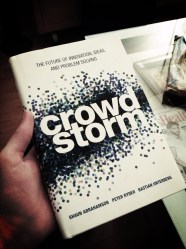
Shaun was kind enough to send me a signed version of the freshly pressed book (I love personalized stuff!), and here’s my review. I received Crowdstorm on Monday and finished reading it on Tuesday evening, that’s how much I liked it. Here’s my review.
Images via adafruit.com, quirky.com and techdirt.com
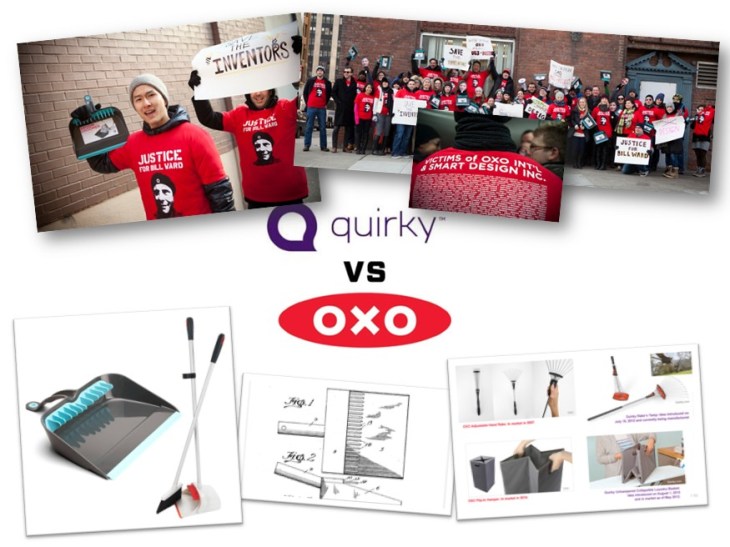
J’ai déjà mentionné à de nombreuses reprises Quirky, présentant l’entreprise américaine, qui a récemment signé un partenariat de distribution avec Auchan, comme un modèle de réussite du modèle de co-création. L’entreprise se base sur des idées venant de la foule d’internautes pour développer et distribuer des produits grand public. S’appuyant sur un effectif important, notamment des designers et d’ingénieurs, Quirky est un exemple spectaculaire de transformation des idées de la foule (crowdsourcing) en produits réels. Mais Quirky est aussi très fort en communication… et son dernier coup de comm’ risque de lui coûter cher. Continue reading →
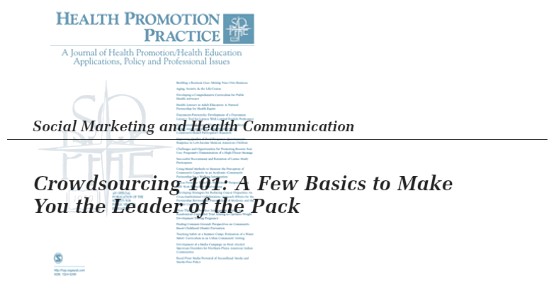
I’d like to share an article that I recently co-authored with Claudia Parvanta (University of the Sciences, Philadelphia, PA, USA) and Heidi Keller (Heidi Keller Consulting, Olympia, WA, USA) that has been published in Health Promotion Practice. It’s called Crowdsourcing 101: A Few Basics to Make You the Leader of the Pack and is a short “how to” article of the social marketing and health communication section (it’s not a reasearch article, but I thought it would be interesting to share anyway).
It includes a definition of crowdsourcing, a description of crowdsourcing in the US public sector, an explanation of the different forms of crowdsourcing (crowd funding, crowd labor, crowd research and creative crowdsourcing) and – last but not least – a set of tips on how to get results from creative crowdsourcing. One of the theories is the 4F motivation theory that comes from my research at eYeka, but we also cite Carl Esposti’s crowdsourcing.org as a great resource for all matters crowdsourcing, and Doug Williams’ Co-Creation Vendors Forrester Wave.
In a previous interview published on Entrepreneur.com, Brett indeed explained that crowdsourcing sites allowed him to gain exposure, cutting through geographic obstacles: “I live in Bangor, Maine. My work wouldn’t have been seen otherwise,” he explained. Contests on platforms like Poptent allow him to apply his talent to big brands (Brett writes the word brands with a capital B, Brands), not only local businesses. You can read more from him on his blog… or you can just read his interview below. Enjoy! Continue reading →
Here’s a great talk by Seth Cooper and Firas Khatib (University of Washington) who describe the massive possibilities of crowdsourced games like Foldit (“Solve Puzzles for Science“) at TEDx Panthéon Sorbonne. Foldit, which results from part of an experimental research project from the University of Washington, is an online puzzle video game about protein folding centered around folding the structure of selected proteins to the best of the player’s ability (see it in action in this video).
It received big coverage recently when Foldit gamers have helped unlock the structure of an AIDS-related enzyme that the scientific community had been unable to unlock for a decade. The resulting research paper, Crystal structure of a monomeric retroviral protease solved by protein folding game players (PDF), has been published in Nature and is co-authored by the participating Foldit teams “Foldit Contenders Group” and “Foldit Void Crushers Group.” A great example of the power of crowd-based collaboration!
Update (Feb 12th 2013): Another research paper has just been published in Nature, showing that using crowdsourcing platforms such as TopCoder, an alternative to Foldit, yields a whopping 970 fold increase in speed for big data genomics sequencing algorithm. Here’s the citation: Lakhani, K. R., Boudreau, K. J., Loh, P.-R., Backstrom, L., Baldwin, C., Lonstein, E., Lydon, M., et al. (2013). Prize-based contests can provide solutions to computational biology problems. Nature biotechnology, 31(2), 108–11. doi:10.1038/nbt.2495
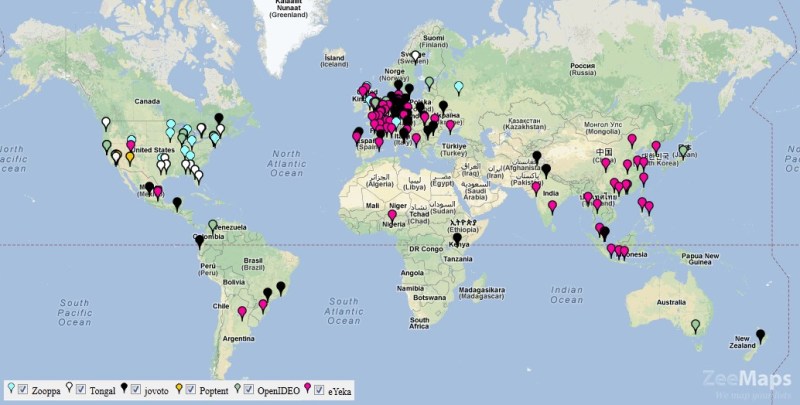
My dissertation on creative crowdsourcing is going along well, and I’d like to share some findings in this post. This is not rocket-science, especially at this early phase of the work 😉 but I thought it would be insightful to share with readers interested in crowdsourcing. Basically, in my quest to find out who creative crowdsourcing participants really are, I analyzed 100+ interviews and was able to have fairly good data about their identity, origin and skills. In this post, let me share some findings about the countries of residence of creatives featured by different crowdsourcing platforms. I’d love to get your comments! Continue reading →

 I’d like to share an article that I recently co-authored with
 Yannig Roth / This is my personal blog