Crowdsourcing has been used for many things since the mid 2000’s and businesses are using it on an almost industrial scale. When it comes to marketing and innovation, the world’s biggest brands use crowdsourcing – asking the global crowd for creative, innovative and/or insightful ideas through online competitions – and use this diverse output to innovate faster or advertise better. Continue reading →
My Favorites Of October: Singapore’s Tight Data Surveillance, Google’s Investment In Cinematic Reality & 7 Advantages A PhD
In October, which I spent in Singapore for work, I read and watched a couple of interesting things (note that I changed this series from “My Favorite Readings…” to “My Favorites …” because I’ll feature more images, videos and interactive sites rather than just articles from now on).
One of the articles is a great Foreign Policy article about Singapore’s electronic surveillance policy, explaining how the government is watching Big Data to “protect national security [and] engineer a more harmonious society.”
Other topics include articles about the specificities of the academic job market, a start-up innovation program launched by Coca-Cola, a documentary about the creative brief, a cool creative filmmaking project launched in 3 world cities (including Paris), Google’s latest investment and more.
What The European Commission’s Reports Say About The Future Of Crowdsourcing
The European Commission has asked PwC to write a series of reports and case studies about innovative businesses and business models, which you can find on Business Innovation Observatory. Two of these reports (Crowdsourced Manufacturing and Customer Incentives and Involvement) – based on research conducted by PwC’s consultants and interviews with CEOs and founders of innovative companies like Shapeways, Quirky or eYeka – talk about the trend of crowdsourcing, outline this trend’s drivers and obstacles, and formulate policy recommendations pertaining its development. Both prove to be very insightful when it comes to the future of crowdsourcing. Continue reading →
Réflexions Sur Un Aspect Juridique Du Crowdsourcing Créatif
Aujourd’hui, à la conférence TIC – Information et Stratégie de Nïmes, nous présentons notre papier “Travail ou pas? L’autonomie des participants au crowdsourcing et ses implications,” co-écrit avec le Professeur Jean-François Lemoine de l’Université Paris 1 Panthéon Sorbonne et l’ESSCA Ecole de Management, et Eric Favreau, juriste chez eYeka. En voici un résumé sur le Journal Du Net, et surtout une riche discussion (en dessous). Continue reading →
My Favorite Readings In September: Advertising Contests, Spoiler-Proof TV Shows & Career-Boosting PhD’s

Click to see “21 Photos Of Nature Winning The Battle Against Civilization.” Here: Paris (boredpanda.com)
Here are my favorite couple of articles and links of the month of September. The first one is not an article but a whole website, curated by a woman whose mother-in-law participated in advertising contests in the 40’s and 50’s, where she shares all the memorabilia of this creative contest activity. A great website to look at, especially if you are interested, like me, in creative contests.
The other links are related to the link between culture and innovation, culture and creativity, crowdsourcing for advertising and academia – fairly classical topics if you are among the followers of this blog. I hope you enjoy this selection of reads.
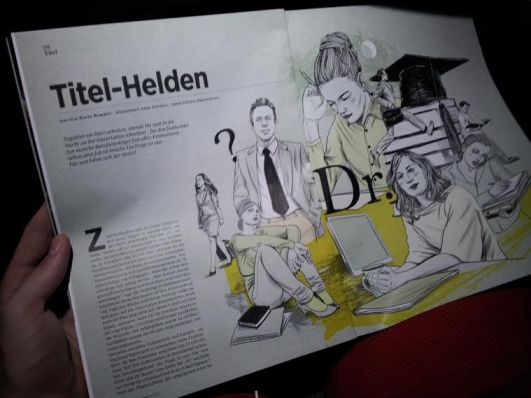
« Title Heroes » – The Benefits Of Doctoral Studies To Boost Corporate Careers
This article is a translation of an article I read in the German magazine Handelsblatt Karriere recently (issue nb 4, year 2014), called “Titel-Helden” (Title Heroes) written by Eva-Maria Hommel. The article addresses the interesting question of working on a PhD early in a corporate career, and I felt it was interesting enough to be shared with an English-speaking audience, beyond the relatively small number of people who speak German in this world. I believe it is an insightful article that shows the German specificity of valuing the PhD beyond academia, which is the case in France or the US, and bridging the gap between both worlds. Note that the translation is an exact translation, which I tried to make as easy to read as possible, just removing a very few passages. Illustrations, links, emphases or bold passages have been added by myself. Continue reading →
Discussion With LEGO’s Community Strategist, Yun Mi Antorini

LEGO, one of the most creative and loved brands in the world, attributes a big part of its success to its thriving fan community. Almost 10 million Facebook fans, over 180,000 Twitter followers or a 10,000+ member LEGO Ideas community show that the brand and its product have huge traction among kids and adults alike (watch this TED talk to have a short impression of the phenomenon). The company has not only recognized the power of this fanbase, realized how valuable it is, but they actively encourage its development and look for its well-being – from a passive observer to an active promoter.
I’ve already blogged about community management in a crowdsourcing setting, now here’s an interview of LEGO’s “Community Strategist,” Yun Mi Antorini, whose job is – basically- to make that community happy (how cool is that?). Continue reading →