How Brazilian bike manufacturer Caloi refined its brand proposition

photos
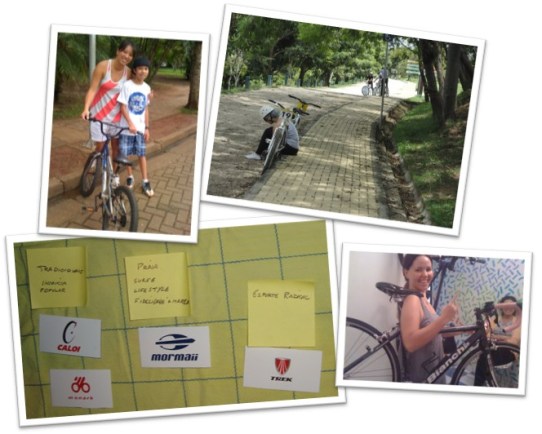
Caloi is a major Brazilian bike manufacturer based in São Paulo, as well a leading brand for over 110 years. Caloi felt they needed to get closer to consumers and to understand what its brand meant to Brazlinian consumers. Together with Brazilian agency CO.R Inovação, they initiated a research project called “Reinventing the two wheels,” designed to understand the role of the bicycle and the Caloi in Brazilian’s lives. Very similarly to the Shimano Coasting initiative conducted by Shimano and IDEO, this project  consisted in meeting consumers of the target  audience in major cities in order to “discover the meaning and the importance a bike has on a biker life.” Explanations from Mariana Loducca Kok, one of the project’s managers at CO.R Inovação. Continue reading →

Impressions of the Co-Creation Awards event ceremony in Utrecht, Netherlands

Last Thursday I was at the CapGemini Campus in Utrecht (The Netherlands) for the 2012 Co-Creation Awards ceremony. Beside announcing the winners of the Awards in each of the four categories, it was also a great place to hold workshops and attend presentations. For example, co-creation expert Gaurav Bhalla presented (via Skype) how co-creation and collaboration go together, then we held a series of workshops around co-creation as well as a panel discussion. And then, of course, the winners were announced.

It was a great event set up by the PDMA, the Co-Creation Association, the Co-Creation Forum, CapGemini and eYeka (for whom I work as a Research Fellow,, just to mention it as a disclaimer). It was also an opportunity to catch up with co-creation-twitter-and-blogging-friend Joyce Van Dijk, who now works at MWM2 as Dialogue Manager. Maybe next year I’ll meet some more people there? Don’t hesitate to follow the event’s twitter account to stay tuned.


The concept of the crowd: From troublemaker to problem-solver

Obama speaking in front of a crowd

Imagie via mrsmart.wordpress.com

What exactly is a crowd? Wikipedia says it’s “a large and definable group of people,” underlining that it’s a different concept than the mob (the so-called lower orders of people in general) or the masses (everybody in the context of general public). This post is not about the concept of the crowd in general, but about an academic paper that examined how the sociological concept of the crowd evolved over time. In Reconfiguring the sociology of the crowd: Exploring crowdsourcing, Mark N. Wexler from Simon Fraser University (Vancouver, Canada) discusses the way in which the crowdsourcing trend reconfigures the classical sociological treatment of the crowd.
Continue reading →

Skoda launches co-creation platform to crowdsource insights in China

skoda co-creation platforms screenshot

Click to get to the platform

As articles on Campaign disappear after a couple of days, being only available to paid subscribers, I thought I would do a blog post about Skoda’s latest co-creation/crowdsourcing initiative in China: the www.congmingzhuyi.com platform. It’s Campaign China that reports about this initiative, orchestrated by Leo Burnett Shanghai, that aims to gather consumer ideas about making driving, both inside and outside of the vehicle, more fun. Continue reading →

The Four Crowdsourcing Mergers & Acquisitions of 2012

pacman-illustration

I know some people don’t like calling it an industry, but let’s just use the term to coin the companies that use a crowdsourcing- based business-model. There are a lot of such companies, the first ones have been created in the early 2000’s, and platforms are still appearing today. Even though it seems tough to make money with crowdsourcing today, there is a variety possible strategies to generate revenue: taking a commission on transactions (like 99designs), developing and selling goods (like Quirky), invoicing on a project basis (like Zooppa)… for investors, there’s also the option on an IPO (like Blur Group) or an aquisition by another firm. It turns out that the latter has happened 4 times this year, with established actors purchasing stakes in smaller crowdsourcing firms. Let me describe these three cases, in three parts, and ignite a discussion about what’s next! Continue reading →

Just me and my bike (by @TheBikerist)

the bikerist thumbnail photos

The French cycling blog The Bikerist, which published portraits of Parisian cyclists, has recently released the photos that we did together, this summer. The photos are black & white and picture me with my very first racing bike, a Giant TCR-2, that I transformed into a commuting bike. I bought it second hand from a friend in Brittany, and transformed it step by step to make it a decent racing bike… before I bought a carbon bike.

Here’s what the text says:

He uses his bike every day to commute through Paris. Sportsman, good runner and cyclist, Yannig has had the luck to win races in France, Europe and the United States. He has several bikes, and chose to come [to the shooting] with his his original bike, and the stories associated to it, because it’s the bike that he started racing with in 2006, and with which he won his first race in Brittany in 2008.

A great set of photos, it’s an honor to be featured on such a high-quality blog, thanks The Bikerist! Check them out here… and if you’re a Paris-based cyclist willing to appear on The Bikerist, I’d be glad to put you in touch!

Does Common Culture Affect Work Attribution in Crowdsourcing?

screenshot

Click to see the working paper

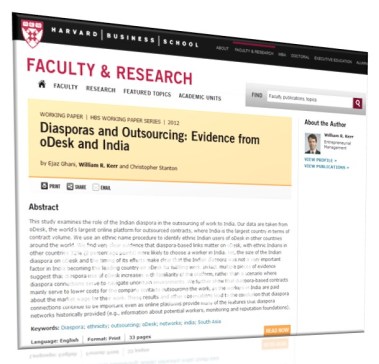
Crowdsourcing fundamentally transforms the way we work, particularly in creative industries or – on the other hand – in the execution of low-qualification tasks with platforms such as MTurk or oDesk. I’ve recently read a working paper about the latter, the marketplace for work oDesk (which has an army of researchers, mostly to analyze log data, see these cool visualizations). This paper particularly seeks to understand how culture impacts the attribution of work to people via oDesk. Or in other words: Do Indians from abroad attribute work more to Indians from the home country than to others, with similar qualification? Continue reading →