Those who follow this blog probably know that I like to relate the work of a Munich-based company called Hyve AG. The consultancy has worked with (mainly German) brands like BMW, Nivea, Henkel or Osram in co-creation efforts; building branded engagement platforms and setting up consumer communities to co-innovate with consumers. Hyve’s CEO, Dr. Michael Bartl, recently talked to Werben & Verkaufen (“promote & sell”) about web-based user communities and social relationships. Since the interview is in German, I thought I would translate some excerpts into English… Continue reading →
Tag / web
Is crowdsourcing dead? How creative crowdsourcing platforms evolve
When Jeff Howe coined the term crowdsourcing back in 2006, he defined it as “the act of a company or institution taking a function once performed by employees and outsourcing it to an undefined (and generally large) network of people in the form of an open call” (this definition is still on Wikipedia). Today, other buzzwords like co-creation and open innovation flood the marketing and innovation blogs. To know what’s happening with crowdsourcing, let’s just take a look at how the platforms based on crowdsourcing principles evolve. Let’s take a look at different types of platforms using crowdsourcing principles : virtual ad agencies, creativity platforms and (still) the crowd-sourcers. Continue reading →
Lessons from the failure of social product development-platform CrowdSpirit
When I read the German book Marke Eigenbau (Do-It-Yourself brand) about a year ago, I claimed that it was a fascinating and eye-opening book about the revolution of consumption going on currently. Mass-customization, co-creation, crafting and 3D-printing are symptomatic movements towards tailored consumption and/or production initiated by the the consumer. Seth Godin said it in 2005 already: Small is the new Big. Someone who recognized and wanted to build on this revolution is Lionel David, founder and former CEO of CrowdSpirit, an innovation community based on the idea of crowdsourcing the whole product development process, from ideation to marketing (and even distribution). The platform is not online anymore, and here’s why… Continue reading →
Crazy presentation about augmented research !
This presentation by Face‘s Director of Research Francesco d’Orazio kicks ass ! Several things make me say that : the pitch “Plugging brands into the fabric of society” is completely in line with the concept of societing that I’ve discovered recently, which basically recommends brands to propose themselves to society instead of imposing themselves to markets. In the future, we’ll “wear data like we wear clothes“, and this massive amount of data represents a tremendous opportunity for those who will be able to harness and analyze it !
+ it’s a beautifully designed presentation and… the main example is bikes !
Un exemple de co-création communautaire : Tchibo-Ideas.de
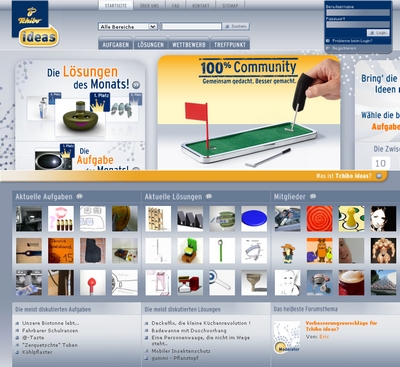
La co-création communautaire (social co-creation) fait référence à la capacité des entreprises à fédérer une communauté de consommateurs pour co-créer avec eux des produits ou des services. Il s’agit d’un domaine qui n’est pas spécifique au web, mais qui est quand même très fortement corrélé avec les plateformes sociales qui pullulent sur la toile. Il y a quelque temps, Francis Gouillart critiquait les deux initiatives de co-création les plus connues : Dell IdeaStorm et MyStarbucksIdea. Selon lui, c’est bien beau de collecter des idées sur une plateforme centralisée, encore faut-il pouvoir les mettre en œuvre ! Ce billet vise à présenter un exemple très intéressant de co-création communautaire, celui de la chaîne de café allemande Tchibo et son site Tchibo-Ideas.de. (et merci à Volker Bilgram pour l’indice) Continue reading →
Ca y est, on peut faire du vélo sur Google Earth !

Image via Instructables.com
C’est le site Instructables qui a trouvé le système. Après les vélos Google (qui capturent des images et autres données pour Google Street View) et l’option directions vélo sur Google Maps, la société de Mountain View permet maintenant à un cycliste de naviguer virtuellement dans Google Earth. Il suffit d’avoir un vélo (!), un home-trainer, une télé et quelques autres équipements courants ou open-source pour pouvoir réaliser le montage. Continue reading →
2010 in review
The stats helper monkeys at WordPress.com mulled over how this blog did in 2010, and here’s a high level summary of its overall blog health:

The Blog-Health-o-Meter™ reads Wow.
Crunchy numbers

About 3 million people visit the Taj Mahal every year. This blog was viewed about 34,000 times in 2010. If it were the Taj Mahal, it would take about 4 days for that many people to see it.
In 2010, there were 40 new posts, growing the total archive of this blog to 103 posts. There were 210 pictures uploaded, taking up a total of 383mb. That’s about 4 pictures per week.
The busiest day of the year was September 23rd with 210 views. The most popular post that day was Advertisement war within the automotive industry (2006).
Where did they come from?
The top referring sites in 2010 were facebook.com, bikerumor.com, bicycledesign.net, bicycledesign.blogspot.com, and twitter.com.
Some visitors came searching, mostly for boston university, sixt werbung, toblerone, alain minc, and colorado license plate.
Attractions in 2010
These are the posts and pages that got the most views in 2010.
1
Advertisement war within the automotive industry (2006) October 2009
2
Prison Valley, ‘Prison-nomics’ in Cañon City, Colorado (web-documentary) April 2010
5 comments
3
Cycleurope refreshes traditional brands Gitane & Peugeot January 2010
4 comments
4
Autovermieter SIXT : Aufmerksamkeit durch “Guerillastrategie” October 2009
2 comments
5
Le logo de Carrefour n’est pas le seul “subliminal” October 2009
4 comments
 Yannig Roth / This is my personal blog